
Custom Cleaning Brush
Brush Roller Snow Sweeping
Nylon PA keeps its bending recovery below freezing, so the roller keeps flicking snow and slush off the surface instead of dragging it along.
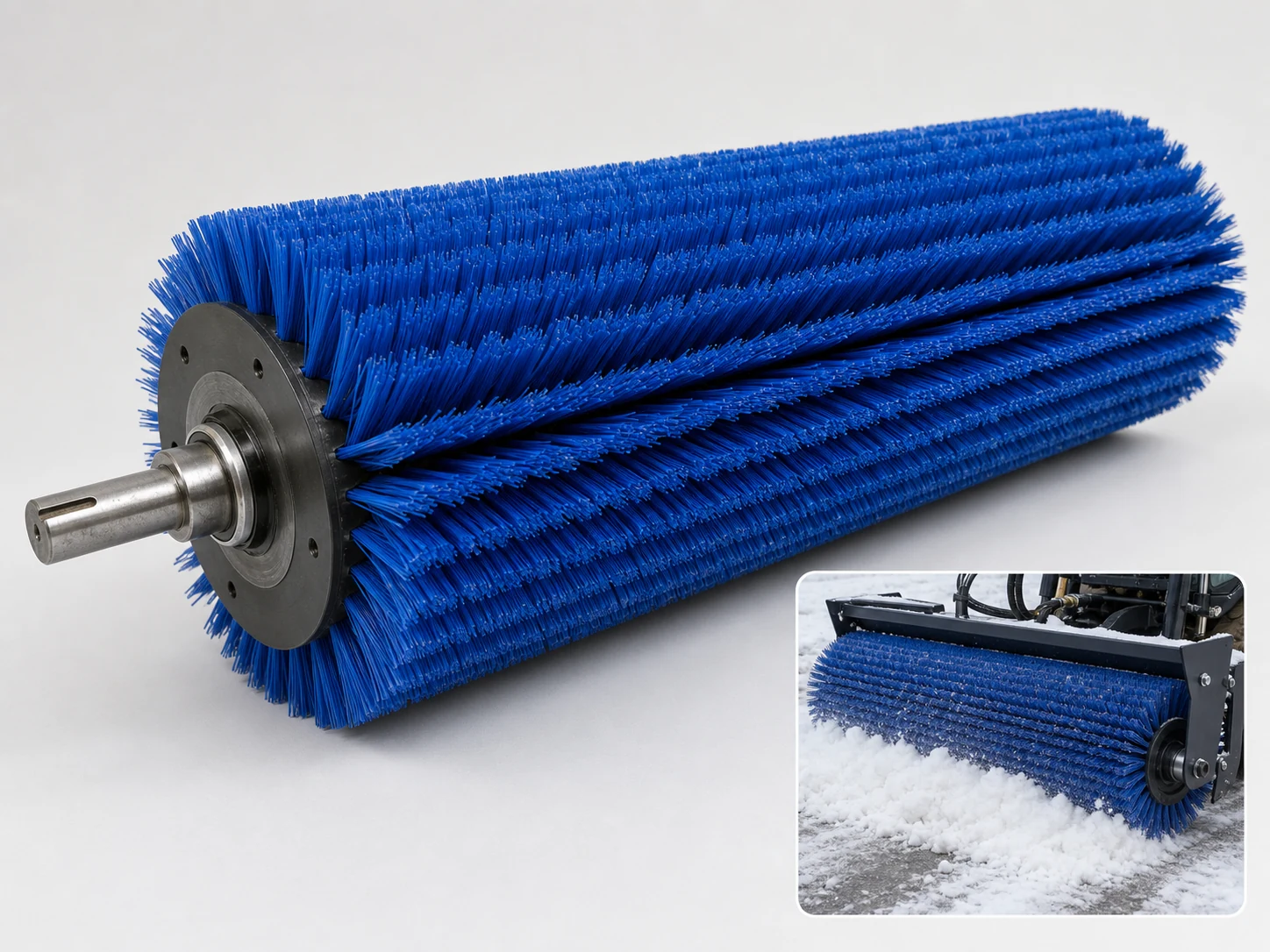
Large-format brush
100 pcs
Minimum order
Built one at a time on a core or channel: full-width rollers, sweeper brooms and long strip.
Production lead time, once the specification is confirmed
- Up to 100 pcsWithin 20 days
- 101–1,000 pcsWithin 30 days
- Over 1,000 pcsConfirmed with your quotation
Peak season can extend these times; the shipping date is confirmed in writing with your quotation. Sampling and shipping are quoted separately.
A cylindrical nylon PA brush roller engineered for snow, slush, grit, and sand removal on roads, airport surfaces, and pavement. It mounts directly onto rotary snow sweepers and is built to keep effective sweeping action in sub-freezing conditions where conventional filaments stiffen and flex poorly.
What can this brush do for you?
Keeps clearing power when temperatures drop
Nylon PA filament retains its bending recovery in cold weather, so bristles keep flicking snow and slush off the surface instead of dragging flat. Polypropylene stiffens noticeably below freezing, but nylon continues to spring back after each contact cycle, keeping the roller working through long winter shifts.
Sheds snow instead of packing it between rows
Wet snow pressed into a tightly packed filament pattern quickly turns the roller into a rotating snowball. Crimped or wave-profile filaments combined with segmented or spiral fill spacing let snow release from the fill during rotation. The roller keeps clearing continuously rather than building up a frozen outer layer.
Withstands salt, grit, and de-icing chemicals
Winter surfaces are loaded with road salt, calcium chloride, and traction grit. Nylon PA tolerates the moisture and salt exposure that corrodes untreated metal components and degrades some lower-cost fills. The filament also stands up to the constant abrasive contact of sand and fine grit without losing its shape quickly.
Drops into your existing sweeper machine
The core, shaft interface, end flanges, and bolt pattern are matched to the sweeper model, so the roller installs as a direct replacement for the OEM winter broom. No adapter machining or field modification is required. When a fleet runs mixed machine brands, each roller is built to the specific mount of that machine.
Delivers even contact across the full working width
Consistent trim and fill density across the face of the roller prevent streaking and missed center strips. The result is a uniform cleared path on lanes, taxiways, and pad surfaces rather than alternating clean and dirty bands behind the machine.
What is a Brush Roller Snow Sweeping?
A brush roller for snow sweeping is a horizontal rotary assembly: a metal core carrying tightly packed synthetic filaments arranged around the full circumference. Mounted on the main broom shaft or an accessory arm of a self-propelled sweeper or tractor attachment, it rotates against the direction of travel and throws snow, slush, loose grit, and sand off the hard surface and into the windrow or discharge path.
This roller is not a general dry-road broom that happens to be used in winter. Snow sweeping places specific demands on the fill: filaments must keep flexing in the cold, release wet snow freely, resist salt and chloride exposure, and tolerate constant wetting and freezing cycles. Nylon PA is the standard working material for this job, with variations in filament diameter, density, profile, and pattern determining how the roller behaves in different snow conditions.
During use, the key operating factors are rotation direction relative to travel, brush-to-surface pressure, machine speed, and the depth and moisture content of the snow. The roller is normally used after plowing, in combination with a plow pass, or as the primary removal tool for light falls. It clears loose, movable material from the surface — it does not break ice, scrape frozen layers, or push packed snowbanks.
Technical Specifications
The table below lists the parameters buyers most commonly check before selecting a snow sweeping brush roller. Values marked as project-variable are set during the ordering process to match the machine and operating conditions.
| Parameter | Value / Options |
|---|---|
| Roller outer diameter (filament tip) | 360–800 mm, matched to sweeper housing and ground clearance |
| Working width | 1,200–3,000 mm, matched to the machine sweep path |
| Core type | Steel tube or machined hub, built to the sweeper model |
| Fill material | Nylon PA (PA6, PA6.6, or low-moisture PA610/PA612); polypropylene or polypropylene/wire blend available for project-specific requirements |
| Filament diameter | 0.8–2.5 mm, selected by snow type and debris load |
| Filament profile | Straight, crimped, or wave pattern |
| Fill pattern | Continuous spiral, segmented rows, or block placement |
| Mount interface | Keyed shaft, hex-bore core, flanged ends with bolt pattern — per sweeper manufacturer |
| Rotation direction | Specified by machine manufacturer (clockwise or counterclockwise as installed) |
| Operating temperature | Practical service down to about -30°C; moisture-resistant nylon grades for extended cold-wet exposure |
| Material handled | Snow, slush, loose grit, sand, and light winter debris |
| Brush type | Custom Roller and Conveyor Brushes |
| How it is driven | Machine-driven, mounted in the equipment |
| Cleaning target | municipal road and street, airport runway, and bridge deck and elevated roadway cleaning |
| Surface or part | roller, roads, metal, profiles, runways, walkways, pavement, and bands |
| Residue or debris | snow, slush, sand, salt, leaves, and loose grit |
| Mounting / connection | Keyed shaft, hex-bore core, flanged ends with bolt pattern — per sweeper manufacturer; Specified by machine manufacturer (clockwise or counterclockwise as installed) |
Where does this brush work best?
- Municipal roads and streets — clearing light snowfall, residual slush after plowing, and the sand-grit mix spread for traction.
- Airport runways, taxiways, and aprons — loose snow and slush removal where FOD-safe, all-nylon fills are required and wire or metal components are prohibited in the contact area.
- Bridge decks and elevated roadways — surfaces where salt and de-icer accumulate and plowing leaves a thin residue layer behind.
- Parking lots, distribution yards, and industrial logistics areas — large open hard surfaces where a self-propelled sweeper attachment clears snow in a single pass pattern.
- Walkways and pedestrian zones — compact sweepers equipped with narrower rollers clean ground-level snow and slush without the surface scarring a plow blade can create.
- Ports, rail platforms, and transfer stations — exposed outdoor hard surfaces that need safe footing and traction-material cleanup through winter.
How do I choose the right one?
Confirm the mount before anything else
The most common sourcing mistake is ordering a roller with the correct diameter and width but the wrong core or shaft interface. Check the core inner diameter, keyway or hex size, end-flange bolt pattern, and drive engagement against the sweeper manufacturer’s specification or the roller currently installed. A photograph of the existing core and mount area speeds up confirmation.
Match the roller diameter to the machine housing
The outer diameter at the filament tips must clear the sweeper housing and allow the correct ground pressure at working height. A roller that is too large binds against the housing or digs too hard into the surface. A roller that is too small leaves a narrow contact band and reduces clearing width. Start from the machine’s specified broom size and adjust only with engineering review.
Select filament by snow condition, not just snow presence
Light dry snow needs finer nylon (about 0.8–1.2 mm) at moderate density for fast, efficient flicking. Wet, heavy slush needs medium filament (1.2–1.8 mm) with dense fill to carry material weight without flattening. Compacted snow or a thin crusted layer requires stiffer nylon or a poly/wire blend — but wire should only be used on surfaces where filament breakage and marking are acceptable.
Consider salt and moisture exposure when choosing the nylon grade
Nylon absorbs moisture, and in a wet winter environment that moisture can freeze inside the filament and reduce flexibility. For heavy salt and chloride exposure, or for machines that sit wet between shifts, a low-moisture grade such as PA610 or PA612 resists this effect better than standard PA6. The cost difference is usually justified by longer effective service in repeated freeze-thaw cycles.
Keep wire out of airport and marked-surface applications
Runways, taxiways, and aprons require all-nylon fills. Broken wire filaments become foreign object debris that can damage aircraft, and wire blend will abrade painted markings, joint seals, and surface treatments. If your surface has any marking, coating, or FOD sensitivity, specify nylon-only fills and raise the stiffness through filament diameter and density instead of wire.
Know what this roller will not do
A snow sweeping brush roller clears loose snow, slush, and surface grit. It will not break thick ice, remove frozen crust, cut through hard-packed windrows, or push deep snowbanks. Those tasks belong to plow blades, ice choppers, and material spreaders. Using a brush to force through hard ice accelerates filament wear dramatically and produces poor clearing results.
| Cleaning situation | Recommended fill configuration |
|---|---|
| Light, dry snow on lots, walkways, and pads | Nylon PA, 0.8–1.2 mm, moderate density |
| Wet slush after plowing on road lanes | Nylon PA, 1.2–1.8 mm, dense fill, crimped or wave profile |
| Sand and grit cleanup after de-icing | Nylon PA, medium to stiff, higher density |
| Compacted snow or thin ice crust, off-marked areas | Stiff nylon or poly/wire blend, with surface-wear caution |
| Airports, marked roads, coated surfaces | All-nylon PA, no wire |
Can I customize this brush?
Snow sweeping brush rollers are machine-specific by nature, so customization is the normal process rather than an exception. To define the configuration, provide the sweeper make and model, the OEM part number if available, the current roller’s core dimensions and mount photos, plus the working conditions: snow type, de-icer chemicals used, surface type, and operating temperature range.
We can adjust:
- Core and mount — steel grade, tube wall thickness, inner diameter, keyway or hex profile, end flange style, bolt pattern, and shaft engagement
- Roller dimensions — outer diameter at filament tips, overall length, working width, and multi-segment construction for wide machines
- Filament — nylon grade (PA6, PA6.6, PA610, PA612), filament diameter, filament length, straight/crimped/wave profile, and color
- Fill arrangement — continuous spiral, segmented rows, block pattern, density per row, and mixed filament combinations where beneficial
- Identification — colored filament bands, core marking, or labeling for fleet inventory control
- Packaging — bulk pallet, individual crate, or project-specific packing to match your receiving and warehouse flow
For projects that require documented inspection, material declarations, or third-party testing support, we can assist with those requirements during the customization process.
How do you tell when a brush roller snow sweeping is worn out?
Why does my current roller pack with snow instead of clearing it?
Snow packing usually comes from straight, smooth filaments in a tight continuous pattern. Wet snow enters the fill and has no path to release, so it builds into a frozen ring. Crimped or wave-profile filaments plus wider segment spacing give the snow space to eject during rotation. If your current roller packs, a fill-pattern change solves the problem more reliably than simply adding more filament.
Can the same roller be used for winter snow and summer road sweeping?
Nylon-only rollers can carry over into warm-weather use for general debris, but winter grit and salt exposure accelerate wear and shorten the filament set. Many fleets run a dedicated winter set and keep the summer broom for dry-season work, which extends both. If the machine must run year-round on one set, choose a nylon grade and density that balances both seasons and accept shorter replacement intervals.
How do I verify the mount matches my sweeper before ordering?
Measure the existing core’s inner and outer diameter, note the keyway or hex-bore dimensions, and photograph the end flanges and bolt pattern. Compare these against the machine manufacturer’s broom specification or the OEM part documentation. If the sweeper has no existing roller to reference, provide the machine model and the main broom shaft specifications, and we will confirm the correct interface.
What should operators check before each shift?
Confirm the rotation direction matches the machine specification, check that filament contact with the ground is even end to end, and inspect for frozen snow or debris packed into the fill from the previous shift. Verify the core is fully seated and the end fasteners are tight. Clearing packed material at the end of a shift prevents the fill from freezing into a rigid block overnight.
Can a nylon snow sweeping roller damage asphalt or painted markings?
Nylon-only fills used at the specified ground pressure are surface-safe for asphalt and for painted markings, lane lines, and runway symbols. Wire blends will abrade markings and joint seals, and broken wire is a serious contamination risk on airfields. If the surface carries markings or has a coating, keep the fill nylon-only and control downward pressure through the machine setting.
How do I know when the roller needs replacement?
Track filament length against the original dimension. When the tips have worn down to roughly 40–50% of the original trim length, clearing quality drops and the roller should be scheduled for replacement. Uneven wear on one side indicates a machine support or height adjustment issue that should be corrected before installing a new roller, or the new set will wear the same way.
Guides that go deeper on this
Abrasive Nylon Grit and Filament Selection
Read this guideGuideBrush Roller Conveyor Mistakes with Dry Dust
Read this guideGuideBrush Speed, Engagement, and Heat
Read this guideGuideConveyor Belt Cleaning Brush Design
Read this guideGuideSnow Sweeping Brush Roller: What Changes in Cold Outdoor Use?
Read this guideCustom Manufacturing RFQ
Describe Your Application
To prepare the correct quotation, provide the dimensions, cleaning task, residue, material, mounting details, quantity, and a drawing or photo.
Drawing or photo optional — it speeds things up, it does not gate the enquiry.
Custom Brush RFQ
Send Your Brush Project
Upload a drawing, product photo, or sample photo and provide the core dimensions and cleaning conditions.
“We need a brush to remove wet residue from a stainless steel conveyor, about 800mm wide. The current brush wears quickly. We can send photos.”
“We sell drinkware and need a cleaning brush to include with the product. Quantity around 5,000 pieces.”