
Custom Cleaning Brush
Brush Wheel Packaging
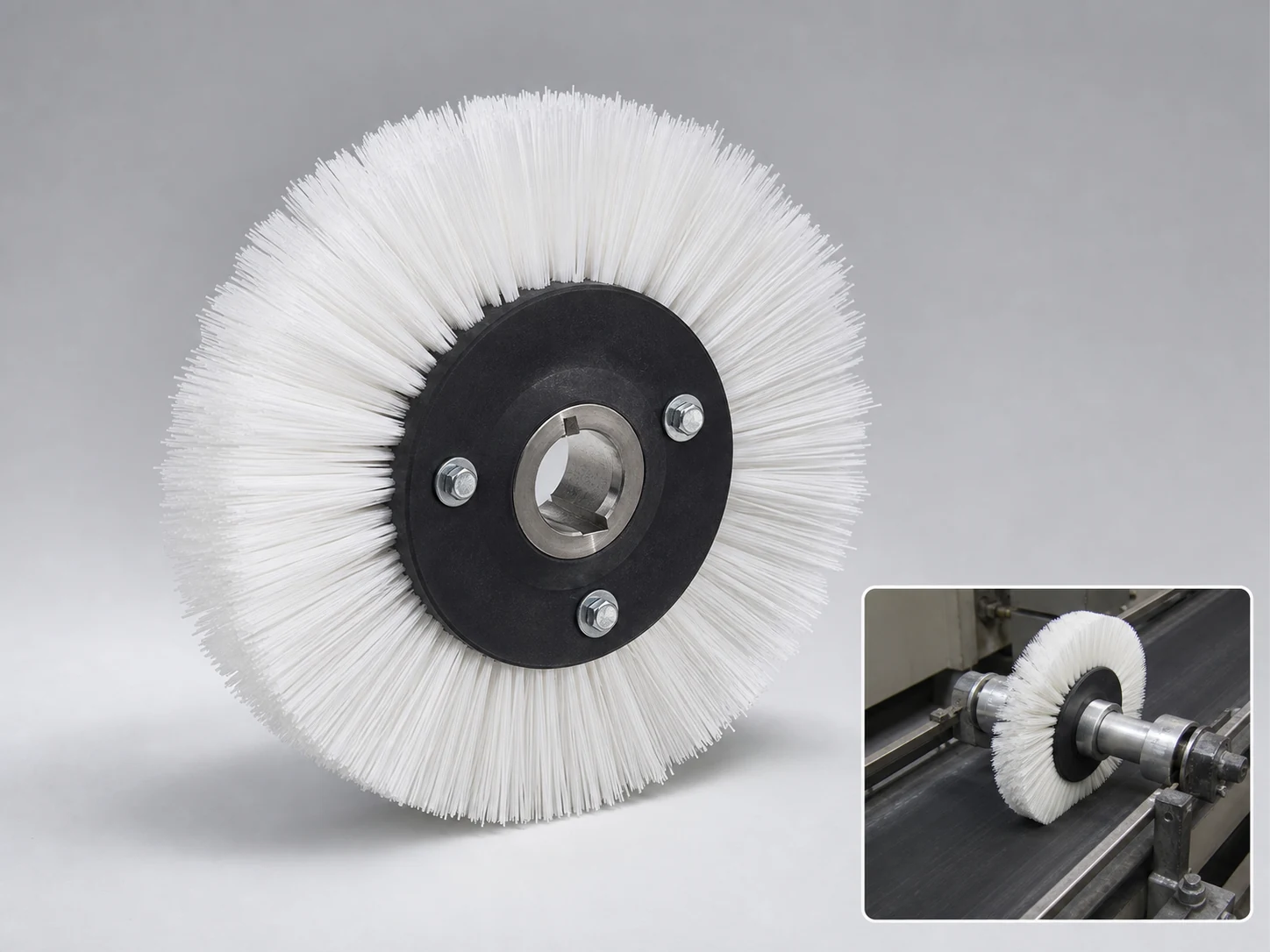
Rotating packaging wheel brush: nylon PA, conductive, or wire fills; 50–300 mm OD, keyed bores.
Medium brush
100 pcs
Minimum order
Worked with two hands or on a pole: chimney, gutter and pond-filter brushes, discs, cups and tank brushes.
Production lead time, once the specification is confirmed
- Up to 100 pcsWithin 7 days
- 101–5,000 pcsWithin 14 days
- 5,001–50,000 pcsWithin 21 days
- Over 50,000 pcsConfirmed with your quotation
Peak season can extend these times; the shipping date is confirmed in writing with your quotation. Sampling and shipping are quoted separately.
Brush Wheel Packaging is a rotating wheel brush that mounts onto packaging machinery to continuously remove cardboard dust, adhesive residue, shipping debris, and plastic particles from conveyor lines, guide surfaces, and container exteriors. The radial nylon PA fill provides controlled, non-damaging contact while the wheel rotates with the line, so cleanup stays automatic instead of a manual stop-and-scrub operation.
What can this brush do for you?
Keeps the line running while it cleans
The wheel mounts on an existing arbor and rotates with the line, brushing the belt, guide rail, or container exterior each time it passes. Cardboard dust and loose particles are lifted on contact, so operators spend less time stopping production for manual wipe-downs and scheduled cleaning can be stretched further.
Holds contact across the full face width
Dense nylon PA filaments are set across the wheel face to form a continuous brushing band. The filament set and trim length are chosen so the tips stay against the surface through minor runout and product variation, reducing streaking and missed lanes.
Stiff enough for adhesive, soft enough for printed exteriors
Trim length and filament diameter control how aggressively the wheel works. A shorter trim lifts label adhesive and compacted dust; a longer trim with thinner filament wipes container exteriors without scuffing printed film, coated cartons, or plastic surfaces.
Static-dissipative option for film and carton lines
Conductive nylon fill combined with a grounded metal hub drains static charge while the wheel removes loose particles. On film webs, folding cartons, and plastic containers, this cuts re-adhesion of dust and reduces rejects at labelers, printers, and inspection cameras.
Direct-fit mounting on the existing shaft
The bore, keyway, and hub are copied from the packaging machine’s arbor, so the wheel installs as a replacement element rather than requiring a new bracket. Rotation direction is matched during specification, and set screws or flanges keep the hub secured.
What is a Brush Wheel Packaging?
A Brush Wheel Packaging is a machine-mounted wheel brush built for continuous surface cleaning on packaging equipment. The body is a hub with radial nylon PA filaments, mounted on a rotating arbor. It is positioned at a tangent to a moving belt, guide surface, or product face; while the wheel rotates, line travel draws the surface past the filament tips, scrubbing and lifting loose debris. The removed material falls away or is collected by the line’s extraction system.
This is not a hand brush or a manual wipe. Once mounted and engaged, the wheel works continuously as part of the machine cycle. Contact is controlled by the bracket or shaft position, not by operator pressure. Heavy engagement accelerates filament wear and can wrap debris around the wheel; light engagement leaves film behind. The correct setup balances contact so the tips flex but do not fold.
The standard build uses nylon PA for its resilience and wear life on cardboard dust, plastic particles, and soft residue. For lines where static causes reject defects, a conductive PA fill and grounded core are available. For tougher or cured residue, wire fill fits the same wheel geometry but changes the contact character, so material choice follows the residue and surface, not the other way around.
Technical Specifications
All dimensions below are project-configurable. We will match the bore, keyway, rotation direction, and face width to the packaging machine that the wheel is intended for.
| Parameter | Value / Options |
|---|---|
| Brush form | Radial wheel brush; straight, spiral-wound, or segment fill arrangement |
| Wheel outside diameter | 50–300 mm (2–12 in) |
| Face width | 10–100 mm (0.4–4 in) |
| Bore / hub | 5–50 mm plain bore, keyed bore, set-screw hub, or flange per machine arbor |
| Trim length | 10–60 mm; shorter trim for stiffer contact, longer for conformability |
| Filament material | Nylon PA (PA6/PA66/PA612); conductive nylon; PBT for wet/damp conditions; stainless steel wire |
| Filament diameter | 0.10–0.80 mm, selected for stiffness and surface sensitivity |
| Core / hub material | Steel, aluminum, or engineered polymer |
| Static control | Conductive fill with grounded hub optional for static-sensitive lines |
| Rotation / engagement | Direction matched to machine; contact depth set by mounting bracket or shaft position |
| Brush type | Custom Wheel Brushes |
| How it is driven | Machine-driven, mounted in the equipment |
| Cleaning target | corrugated and folding carton line, conveyor belt and transfer plate, and container exterior cleaning |
| Surface or part | plastic, containers, belts, conveyors, hubs, guide rails, drain, and webs |
| Residue or debris | dust, particles, adhesive, adhesive residue, label adhesive, loose dust, loose debris, and leaves |
| Mounting / connection | 5–50 mm plain bore, keyed bore, set-screw hub, or flange per machine arbor; Direction matched to machine; contact depth set by mounting bracket or shaft position |
Where does this brush work best?
- Corrugated and folding carton lines: removes paper dust and die-cut particles around slotting, scoring, folding, and glue flap sections where dust accumulates between changeovers.
- Conveyor belts and transfer plates: clears label adhesive residue, plastic fragments, and shipping debris from belt surfaces and guide rails that touch every package.
- Container exteriors before labeling or coding: dusts bottles, cans, and cartons before label application, inkjet coding, or vision inspection so adhesive bonds and camera reads are clean.
- Case erectors, tray formers, and cartoners: keeps vacuum cups, flap folders, and glue heads working by removing cardboard dust at the forming stations.
- Film overwrap and sealing sections: conductive nylon configuration removes loose dust and drains static from film webs before sealing or printing.
How do I choose the right one?
Start from the machine, not from the brush. Five checks usually determine the right configuration.
- Copy the shaft and rotation direction first. Record the arbor diameter, keyway or set-screw location, and whether the machine drives the wheel clockwise, counterclockwise, or reversibly. If these do not match, nothing else matters.
- Set the outside diameter from clearance and curvature. A larger wheel keeps more uniform contact across curved container sides and reduces tip speed for a given RPM. A smaller wheel fits under guards and inside tight enclosures. Check available space before choosing diameter.
- Choose trim length for contact character. Shorter trim, about 10–25 mm, makes the brush stiffer and better for adhesive residue or stuck dust. Longer trim, about 40–60 mm, conforms to uneven belts and protects printed or coated exteriors. Filament diameter works in the same direction: thicker filament increases stiffness.
- Match the filament material to the residue and environment. Use nylon PA for cardboard dust, soft film, and fresh adhesive. Choose PBT for wet washdown lines. Choose conductive nylon with a grounded hub when static re-adhesion causes defects. Choose stainless steel wire for dried adhesive or abrasive particles if the surface tolerates metal contact.
- Decide between one wide wheel or several narrow wheels. A single wheel covers narrow tracks. For wide belts or multiple lanes, several narrower wheels distributed across the line allow independent engagement, easier replacement, and less risk of a single high-pressure band flattening the center.
When the wheel is not the right tool: if residue is cured glue, carbonized material, or thick adhesive masses, use a stainless steel wire wheel, scraper, or solvent step first; a nylon wheel will smear and load. If the surface is soft, printed, or extremely sensitive, an air knife, vacuum pickup, or static bar may be more appropriate than any mechanical brush. For occasional cleanup on a non-moving line, a hand-held brush often makes more sense than adding a rotating wheel to the machine.
| Situation | Recommended configuration |
|---|---|
| Fresh cardboard dust / plastic particles on dry lines | Nylon PA wheel, medium trim, full face width |
| Static-sensitive film or plastic containers | Conductive nylon fill, grounded metal hub |
| Wet washdown or high humidity | PBT filament or stainless wire, polymer or stainless hub |
| Cured adhesive / hardened residue | Stainless steel wire wheel or upstream removal, not standard nylon |
| Printed, coated, or scratch-sensitive exteriors | Long trim with thinner nylon filament and reduced engagement |
Can I customize this brush?
Brush Wheel Packaging is configured around the machine and line, not supplied as a fixed part number. To define the correct build, provide the shaft drawing with bore and keyway details, rotation direction, target surface and residue, line speed, available clearance, and any washdown or chemical exposure.
Variables we can adjust include:
- Hub and mount: bore diameter, keyway, set screws, flanges, arbor adapters, hub material, and balance grade
- Wheel geometry: outside diameter, face width, trim length, and straight, crowned, or contoured face profile
- Fill: nylon PA grade, filament diameter and density, conductive fill, PBT, stainless steel wire, and straight, spiral, or segmented fill arrangement
- Static control: conductive filament path, grounded hub, and continuity hardware
- Rotation: directional or reversible construction and locking hardware
- Identification: hub marking, color coding, or maintenance labels
- Packaging: bulk packing, protective wrap, line-specific kits, or project-defined delivery
For projects that require material declarations, inspection reports, or third-party testing, we can support those documentation requirements during the customization process.
How do you confirm a brush wheel packaging has actually cleaned the surface?
How should I set the contact engagement on the wheel?
Rotate the wheel against the target surface and adjust the bracket until the filament tips flex visibly but do not fold over. A practical starting point is 1–3 mm of compression beyond first contact for medium-density nylon fill. After a short run, wipe the cleaned area with a white cloth; if film remains, increase engagement slightly. If you see surface marking or flattened filament ends, reduce it.
Can one packaging brush wheel clean both sides of a belt or container?
No. Each wheel brushes one contact face at a time. For two-sided cleaning, install matched wheels on opposite sides of the line, either inline or slightly offset, with rotation directions set to carry debris away from the product path. A single wheel cannot wrap around both sides.
Does the nylon wheel remove cured adhesive or label gum?
Nylon PA is designed for fresh or semi-soft adhesive, dust, and loose particles. Hardened label gum will smear or load the filaments. Use a stainless steel wire wheel or an upstream solvent/scraper step to remove cured residue first, then keep the nylon wheel for daily dust and soft-residue duty.
What should I check during routine inspection?
Inspect filament length across the face, look for matted or missing tufts, confirm the hub and set screws are tight, and make sure the wheel spins freely without touching guards. On reversible wheels, schedule direction changes to equalize wear. Replace the wheel when trim length shortens so much that engagement is lost, or when filament density drops and the cleaned surface shows streaks.
How do I verify the static-dissipative path is still working?
Use an ohmmeter between the hub and the machine ground point; the path should be continuous. Also check that the conductive filament tips are not coated with adhesive or packed dust, which breaks contact. If static re-adhesion returns after cleaning, re-check the ground path before increasing brush engagement.
Guides that go deeper on this
Abrasive Nylon Grit and Filament Selection
Read this guideGuideAngle Grinder Wire Wheel Brush Mistakes in Weld Cleanup
Read this guideGuideBrush Speed, Engagement, and Heat
Read this guideGuideCar Wheel Brush vs Standard: Drill and Grinder Mounting
Read this guideGuideHorsehair Wheel Brushes: Where Printing Lines Use Them
Read this guideCustom Manufacturing RFQ
Describe Your Application
To quote this brush accurately, send the size, material, cleaning target, residue, quantity, and any available drawing or sample photo.
Drawing or photo optional — it speeds things up, it does not gate the enquiry.
Custom Brush RFQ
Send Your Brush Project
Upload a drawing, product photo, or sample photo and provide the core dimensions and cleaning conditions.
“We need a brush to remove wet residue from a stainless steel conveyor, about 800mm wide. The current brush wears quickly. We can send photos.”
“We sell drinkware and need a cleaning brush to include with the product. Quantity around 5,000 pieces.”