
Custom Cleaning Brush
50mm Carbon Fiber Static Wheel Brush
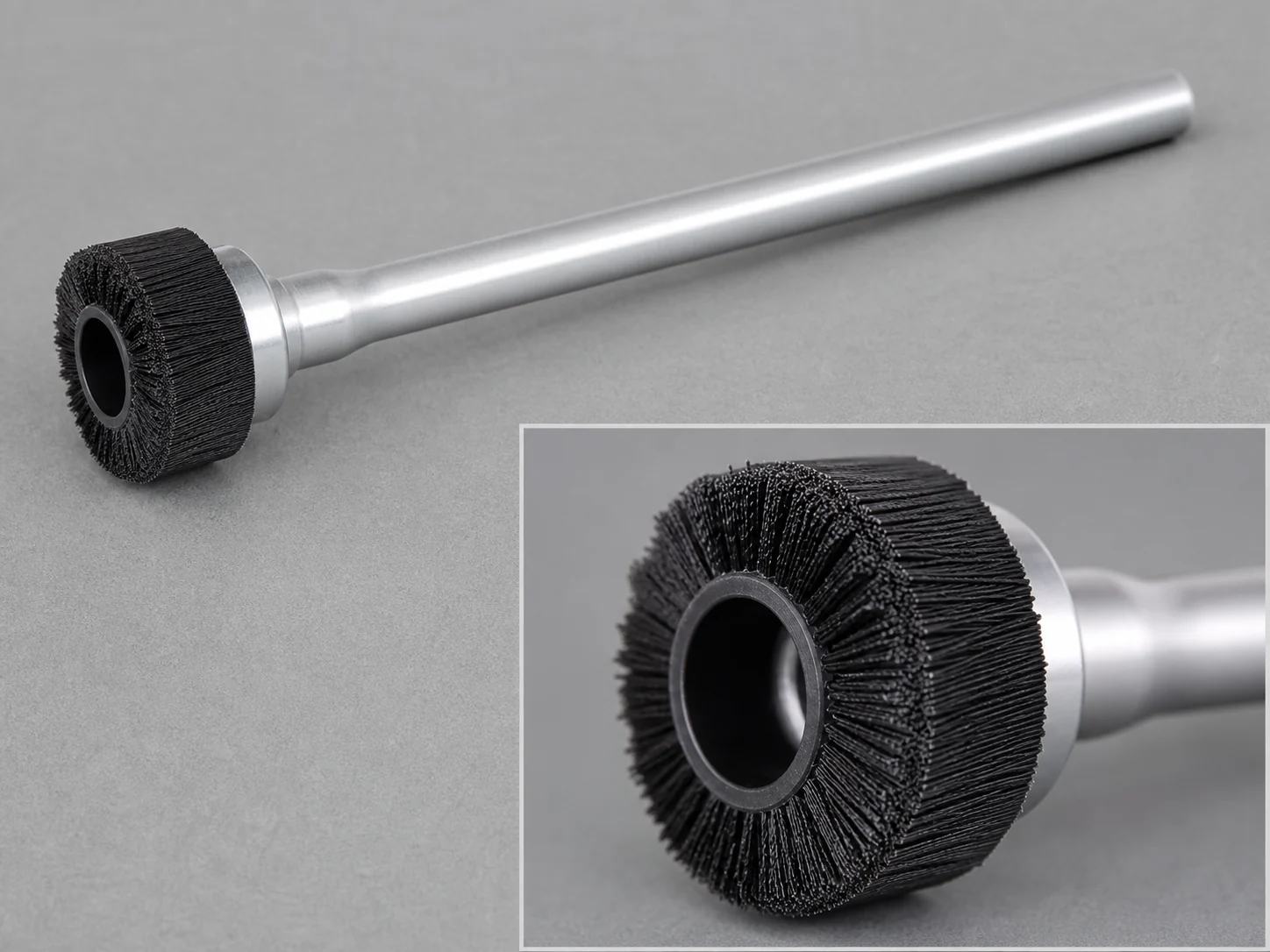
50mm carbon fiber static wheel brush for ESD dust removal. 50 mm OD x 20 mm face, 6061 aluminum hub, grounded conductive carbon fiber filaments.
Small brush
500 pcs
Minimum order
Held in one hand: tube, bottle, detail and swab brushes — including long-handled ones with a small head.
Production lead time, once the specification is confirmed
- Up to 500 pcsWithin 7 days
- 501–50,000 pcsWithin 14 days
- Over 50,000 pcsWithin 21 days
Peak season can extend these times; the shipping date is confirmed in writing with your quotation. Sampling and shipping are quoted separately.
A 50 mm outside-diameter wheel brush with a 20 mm face width, built from conductive carbon-fiber filaments on a 6061 aluminum hub. It creates a grounded contact zone that neutralizes static charge and removes dust, fibers, and loose particles from electronic assemblies, webs, panels, and rollers in dry cleaning operations.
What can this brush do for you?
Grounded Contact Neutralizes the Charge That Holds Dust
Each carbon-fiber filament provides a conductive path from the tip to the 6061 aluminum hub. When the hub is mounted to a grounded shaft or holder, surface charge drains through the brush instead of building up on the part. Dust stops clinging electrostatically and can be swept away by the wheel motion.
Rolling Wheel Covers a Continuous 20 mm Cleaning Band
The 50 mm wheel diameter lets the brush roll or wipe across moving and stationary surfaces without creating a hard contact point. The 20 mm face width maintains a consistent cleaning band, so an inline web, panel, or conveyor passes through the grounded contact zone instead of receiving intermittent swipes.
Fine Carbon Fiber Tips Protect Sensitive Surfaces
Carbon fiber filaments are thin, flexible, and non-abrasive for dry dusting applications. They lift loose particles, fibers, and powder from PCBs, optical films, glass, and coated rollers without the scratching or metal transfer that stiffer filament or wire brushes can cause.
Aluminum Hub Gives a Direct Ground Path and Repeatable Mount
The 6061 aluminum hub supports the filament fill, provides a conductive connection to the machine, and keeps the rotating mass low. Because the connection is fixed rather than handled, the brush stays in the same grounded position run after run.
Stable Behavior in Low-Humidity Dry Rooms
Carbon fiber does not absorb moisture the way natural fibers do, and it does not corrode like metal filament. The brush keeps consistent stiffness and conductivity in dry electronics assembly and converting environments where static problems are most severe.
What is a 50mm Carbon Fiber Static Wheel Brush?
A 50mm Carbon Fiber Static Wheel Brush is a cylindrical wheel brush engineered for dry, grounded-contact dust removal on static-sensitive equipment and materials. Carbon fiber filaments are filled around a 6061 aluminum hub and trimmed to a flat, rectangular contact face 50 mm in diameter and 20 mm wide.
In use, the wheel is mounted on a shaft, arbor, or grounded holder. The part, web, or roller either passes under the fixed wheel or contacts a rotating wheel. As the filament tips touch the surface, static charge flows through the carbon fiber into the aluminum hub and out through the machine ground. Once the electrostatic grip is removed, loose dust and fibers release for capture by a vacuum hood, adhesive roller, or downstream collection point.
This is a dry-cleaning contact component, not a scrubbing brush. It removes loose, static-attracted particles and may be used with an ionizing bar or vacuum for a complete particle-removal station. Ground continuity between the aluminum hub and the machine frame is essential to its function.
Technical Specifications
| Parameter | Specification |
|---|---|
| Outside diameter | 50 mm |
| Brush face width | 20 mm |
| Head profile | Rectangular / flat contact face |
| Filament material | Carbon fiber, electrically conductive |
| Core / hub material | 6061 aluminum alloy |
| Connection | Fixed hub mount, no handle; shaft or grounded holder interface to project specification |
| Grounding path | Conductive from filament tips through hub to grounded mount |
| Operating condition | Dry dust removal and static dissipation; standard configuration is not intended for wet or solvent cleaning |
| Filament density and trim length | Configurable to the application |
| Brush type | Custom Wheel Brushes |
| How it is driven | Machine-driven, mounted in the equipment |
| Cleaning target | electronics assembly line, web and sheet converting, and roll and roller cleaning |
| Surface or part | roller, webs, hubs, aluminum, panels, glass, electronic assemblies, and conveyors |
| Residue or debris | dust, fiber, particles, loose particles, carbon, powder, static-attracted particles, and loose fibers |
| Mounting / connection | Fixed hub mount, no handle; shaft or grounded holder interface to project specification |
Where does this brush work best?
- Electronics assembly lines: PCB conveyors, stencil printers, depaneling stations, and pre-inspection positions where loose fibers, powder, and static-attracted dust must be removed before soldering, AOI, conformal coating, or final assembly.
- Web and sheet converting: film, paper, and foil lines where static charge holds dust to the web before printing, coating, lamination, or slitting.
- Roll and roller cleaning: contact cleaning of process rollers that transfer particles back to product, especially in dry, low-humidity environments.
- Display, glass, and optical sheet handling: gentle removal of loose particles from glass, acrylic, and optical film surfaces before lamination or coating.
- Cleanroom fixtures and tray cleaning: fixed grounded brush positions that wipe dust from jigs, carriers, trays, and static-sensitive work surfaces during transfer or return.
How do I choose the right one?
Start with the residue and the surface. This wheel is designed for loose, dry, static-attracted particles such as dust, fibers, and powder. If the contaminant is oil, grease, adhesive, solder paste, or baked-on material, the carbon-fiber contact will not remove it and the wheel will load up. Choose a wet, solvent, or abrasive cleaning method instead.
Check the contact width you need. The standard configuration covers a 20 mm band. For wider webs, panels, or roller faces, use a multi-wheel assembly on a common shaft or ask for an extended face width. The wheel must make light, consistent contact without pressing hard enough to bend the hub or stall the surface motion.
Verify the mounting and grounding interface. The aluminum hub must mount to a shaft or holder that is electrically bonded to machine ground. Provide the bore diameter, keyway or set-screw requirements, and the available ground connection. If the brush floats on an insulated bracket, it cannot dissipate static and becomes an ordinary dusting wheel.
Decide whether the wheel should free-roll or be driven. Free-rolling wheels work well on moving webs and parts. Driven wheels are used for stationary parts or when you need controlled filament flick and surface dwell time. For driven applications at higher rotational speeds, specify the maximum RPM so the assembly can be balanced and the filament retention checked.
Use a different brush when the job needs stronger mechanical action or wet exposure. A conductive metal-filament brush may be more appropriate for aggressive scrubbing, while conductive-nylon or natural-fiber configurations may suit washdown or food-contact areas. Carbon fiber is the choice when you need gentle, dry, grounded dust removal on static-sensitive surfaces.
Can I customize this brush?
Yes. The 50 mm diameter and 20 mm face width are the standard base, but most production parameters can be adjusted to the line layout and the grounding design. To define the configuration, we need the surface material and width, line speed or use mode, required contact force, shaft or holder dimensions, available ground point, and any controlled-space requirements.
We can adjust:
- Wheel geometry: outside diameter, face width, trim profile, number of fill rows, and segment width for multi-wheel arrays.
- Filament: carbon-fiber grade, filament diameter, density, trim length, and tip treatment to match dust type and surface sensitivity.
- Hub and mounting: bore diameter, keyway, set screws, clamping flanges, shaft adapters, or alternative conductive core materials when weight or chemical resistance matters.
- Grounding interface: direct shaft-contact bonding, grounding screw, or other reliable conductive connection to the machine frame.
- Configuration: single wheels, spaced multi-wheel assemblies on one shaft, or continuous wide-face builds.
- Project support: dimensional inspection, material declarations, conductivity measurements, and other verification steps can be arranged for the specific project requirements.
How do you tell when a 50mm carbon fiber static wheel brush is worn out?
How can I check that the wheel is actually dissipating static?
Measure resistance from the filament tips to the aluminum hub with a megohmmeter or multimeter set to high resistance range. The reading should be low and stable across the circumference. Also confirm electrical continuity from the hub to machine ground with the wheel mounted. If either reading is high or intermittent, inspect the hub bonding point and filament condition before returning the line to production.
Does the wheel remove all the dust by itself?
No. The wheel neutralizes the static charge and mechanically dislodges loose particles. Without a vacuum hood, adhesive roller, or other collection device, dislodged dust can resettle on the product or surrounding equipment. Use it as part of a complete particle-removal station, not as a standalone collection system.
Can this brush run in a wet or solvent process?
The standard configuration is dry only. Carbon fiber and the aluminum hub are not intended for continuous liquid immersion, solvent washing, or high-humidity washdown. If your process requires wet or chemically exposed cleaning, specify the environment so we can evaluate alternative materials or a sealed hub design.
What should I check before mounting the wheel?
Confirm the bore fits the shaft without excessive play or binding, check runout and balance for driven applications, and verify grounding continuity after installation. Inspect the filament tips for matting, broken fibers, embedded debris, or uneven wear. Remove any packaging residues or loose fibers before the first product contact.
How do I know when to replace the wheel?
Replace when the filament tips are worn short enough that contact becomes uneven, when filaments are matted or permanently bent, when the hub shows cracks or bore wear, or when resistance from tip to hub increases. If dust begins re-adhering to product after the brush station, treat that as a signal to inspect the wheel and the grounding path.
My line is wider than 20 mm. What are the options?
Multiple 50 mm wheels can be mounted on a common grounded shaft with spacers to cover the full width, or a wider face can be built as a single custom wheel. Provide the total line width, any center gaps needed for guides or sensors, and the available shaft length so we can propose the best configuration.
Guides that go deeper on this
How to Choose Nylon Abrasive Wheel Brush
Read this guideGuideAbrasive Nylon Grit and Filament Selection
Read this guideGuideAngle Grinder Wire Wheel Brush Mistakes in Weld Cleanup
Read this guideGuideBrush Speed, Engagement, and Heat
Read this guideGuideCar Wheel Brush vs Standard: Drill and Grinder Mounting
Read this guideCustom Manufacturing RFQ
Describe Your Application
An accurate custom quote starts with the dimensions, working surface, residue, material choice, connection, quantity, and reference files.
Drawing or photo optional — it speeds things up, it does not gate the enquiry.
Custom Brush RFQ
Send Your Brush Project
Upload a drawing, product photo, or sample photo and provide the core dimensions and cleaning conditions.
“We need a brush to remove wet residue from a stainless steel conveyor, about 800mm wide. The current brush wears quickly. We can send photos.”
“We sell drinkware and need a cleaning brush to include with the product. Quantity around 5,000 pieces.”