
Custom Cleaning Brush
Ceramic Cleaning Brush
Custom ceramic cleaning brush with nylon PA or PBT abrasive filaments for tiles, GreenGrill grates, and ceramic coatings. Diameters 80–300 mm.
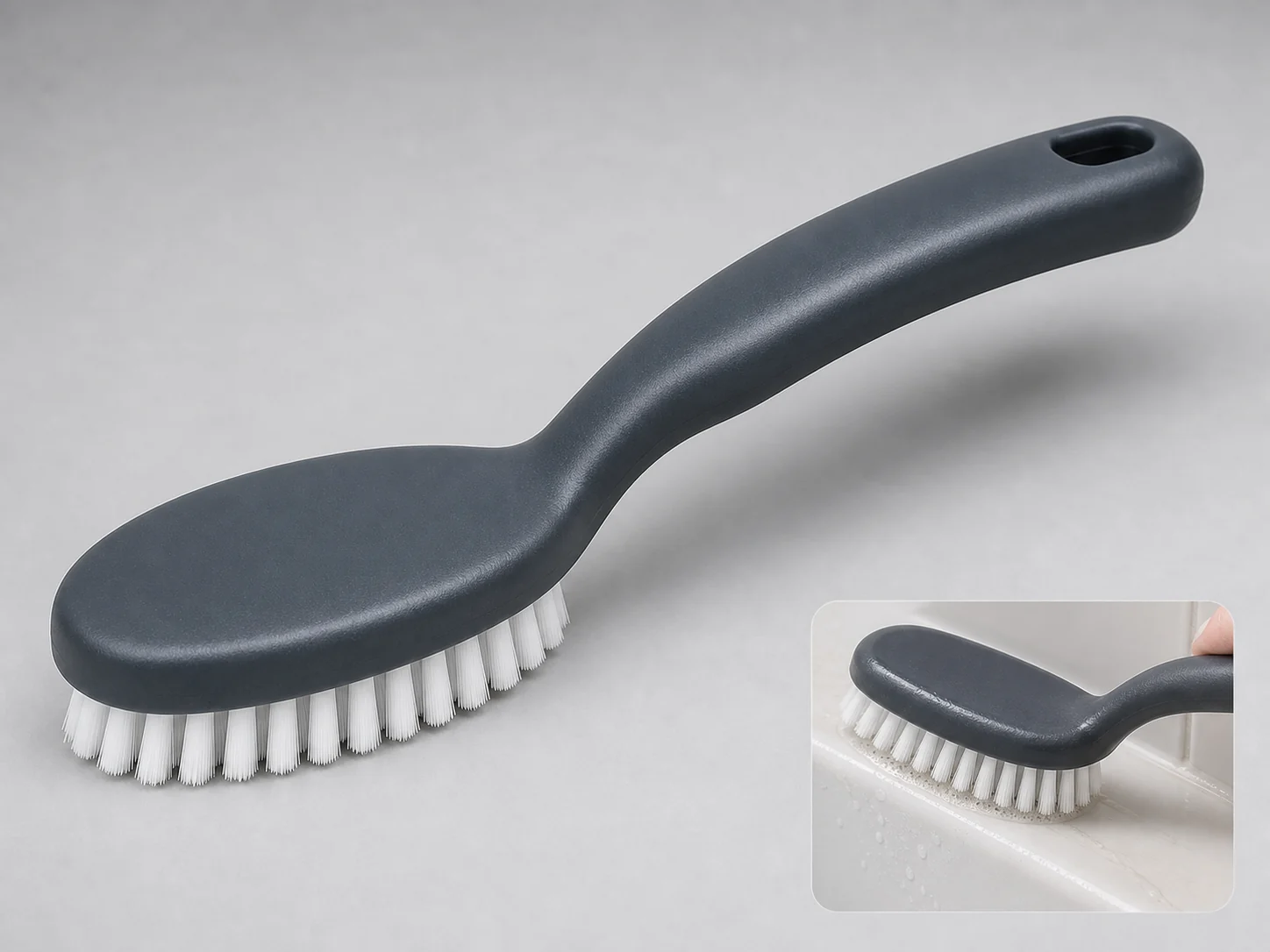
Medium brush
100 pcs
Minimum order
Worked with two hands or on a pole: chimney, gutter and pond-filter brushes, discs, cups and tank brushes.
Production lead time, once the specification is confirmed
- Up to 100 pcsWithin 7 days
- 101–5,000 pcsWithin 14 days
- 5,001–50,000 pcsWithin 21 days
- Over 50,000 pcsConfirmed with your quotation
Peak season can extend these times; the shipping date is confirmed in writing with your quotation. Sampling and shipping are quoted separately.
A machine-mounted nylon filament brush engineered to clean ceramic tile, ceramic-coated surfaces, and GreenGrill non-stick grates without scratching the glaze or coating. It removes manufacturing dust, residual glaze, food residue, and grease while adapting to angle grinders, floor machines, and custom rotary equipment.
What can this brush do for you?
Removes residue without damaging the ceramic surface
The nylon PA or PBT filaments are selected for controlled tip pressure. When loaded with the right abrasive grade, they lift food grease, dust, and loose glaze residue from ceramic tile and coated surfaces without the deep scoring a wire brush would leave. This keeps the ceramic’s glaze, non-stick coating, or polished finish intact through repeated cleaning cycles.
Works with the machine you already run
Mounting options include thread, arbor, snail lock, T1/T2 flange, bore, or a custom block. The brush body is sized to fit common angle grinders, floor scrubbers, and dedicated rotary cleaning stations. You don’t need to buy a separate machine just to get the brush on the surface.
Covers wide areas and tight corners
Tool outside diameters range from 80 mm to 300 mm with active face widths from 20 mm to 160 mm. A large-diameter cup or wheel covers open tile floors quickly, while a narrow end or disc configuration reaches grout lines, edges, and the slotted surface of a grill grate.
Wet or dry cleaning with one filament family
Nylon PA performs well in damp environments and with water-based cleaning solutions. The brush can run dry to remove dust and manufacturing debris, or wet to lift grease and food film. Filament retention stays stable under both conditions when the trim length and density are matched to the operating speed.
Longer service life than natural-fiber or wire alternatives
Nylon filaments resist fracture, absorb impact, and return to shape after deflection. They wear gradually and predictably instead of snapping off like wire bristles. This reduces replacement frequency and the risk of loose metal fragments ending up on the cleaned surface.
What is a Ceramic Cleaning Brush?
A Ceramic Cleaning Brush is a rotary cleaning tool built with nylon or PBT filaments, often abrasive-impregnated, designed to clean hard ceramic surfaces without the scratching associated with metal brushes. It mounts to a power tool or floor machine and uses controlled filament deflection to scrub away dust, residual glaze, food residue, and grease.
The working principle is contact under deflection. The operator sets the brush face against the ceramic surface with light pressure so the filament tips flex 1–4 mm. That flexing creates a scrubbing effect across the entire contact patch while limiting the force any single filament tip can apply. On a glazed tile, that means the glaze stays intact. On a GreenGrill non-stick grate, the ceramic coating is preserved while baked-on food lifts away.
This is not a hand brush for light daily wiping, and it is not a wire brush for aggressive metal prep. It sits in the middle: strong enough to remove process residue, soft enough to keep the ceramic surface’s functional and visual properties.
Technical Specifications
These are the typical ranges for a standard Ceramic Cleaning Brush. All dimensions, materials, and mountings can be adjusted to the equipment and surface specifications.
| Parameter | Value / Options |
|---|---|
| Tool outside diameter | 80–300 mm, matched to machine size and surface width |
| Active face width | 20–160 mm, selected for coverage and edge access |
| Tool thickness | 10–80 mm |
| Fill material | Nylon PA (PA6, PA612) or PBT, plain or abrasive-impregnated |
| Filament diameter | 0.20–1.50 mm, stiffer for heavier residue |
| Trim length | 15–65 mm, shorter for higher stiffness, longer for conformability |
| Abrasive grade | 24–3000 grit (silicon carbide or aluminum oxide), selected by surface sensitivity |
| Maximum rotational speed | Up to 15,000 RPM for small diameters; lower for larger sizes per filament retention |
| Mounting | Snail lock, T1, T2, threaded bore, arbor, flange, or custom block |
| Filament density | Standard, dense, or sparse fill pattern for residue loading or self-flushing |
| Wet/dry use | Suitable for wet cleaning with water-based solutions and dry dust/debris removal |
| Operating temperature | Continuous use up to 120°C for nylon PA; consult engineering for higher-temperature PBT variants |
| Brush type | Custom Polishing Buffing Wheels |
| How it is driven | Machine-driven, mounted in the equipment |
| Cleaning target | ceramic tile production and restoration, greengrill and ceramic-coated bbq grate, and ceramic-coated cookware cleaning |
| Surface or part | ceramic, tile, floors, profiles, edges, metal, roller, and grout lines |
| Residue or debris | glaze, dust, grease, food residue, food film, process residue, kiln debris, and mineral deposits |
| Mounting / connection | Snail lock, T1, T2, threaded bore, arbor, flange, or custom block |
Contact setting matters. On a stitched or dense brush face, use light edge contact. On a filament or abrasive face, set 1–4 mm of deflection. Excessive pressure shortens filament life and can transfer too much heat into the coating.
Where does this brush work best?
Ceramic tile production and restoration
After firing, tiles often carry dust, kiln debris, or residual glaze that must be removed before packaging or installation. A mounted nylon brush cleans the tile face quickly without dulling the glaze or rounding profile edges.
GreenGrill and ceramic-coated BBQ grates
Ceramic non-stick grill surfaces need a cleaning tool that removes carbonized food and grease without scraping off the coating. A soft- to medium-grit nylon brush on a low-RPM driver cleans the grate between cooks without damaging the GreenGrill layer.
Ceramic-coated cookware in commercial kitchens
Pans, griddles, and baking surfaces with ceramic non-stick coatings accumulate polymerized oil and food film. The brush lifts that film with wet cleaning solution while preserving the coating for repeated use.
Floor scrubber brush replacement
For large ceramic tile floors in retail, healthcare, or food facilities, the brush is configured as a disc or roller for floor scrubbers. It removes ground-in dirt and grime from tile and grout lines without damaging the tile face.
Ceramic sanitary ware and fixtures
Toilets, sinks, and architectural ceramics benefit from a mounted brush that reaches under rims and into contours while removing mineral deposits and biofilm without scratching the glaze.
How do I choose the right one?
Start with the surface you must not damage
Identify the coating or finish type. Glazed tile, polished ceramic, and GreenGrill non-stick coatings all tolerate different grit levels and filament stiffness. A 320-grit abrasive filament is safe for most glazed surfaces, but a 24-grit would cut into the coating. Match the abrasive to the surface first, then adjust for residue.
Match the residue to the filament fill
Loose dust and manufacturing debris call for a plain nylon filament, which sweeps without abrasion. Food grease, carbonized film, and stubborn process residue require an abrasive-impregnated filament. Higher grit numbers (finer abrasive) remove film gently; lower grit numbers (coarser) remove heavier residue but increase surface material removal.
Check the machine interface and speed
The mounting must fit your existing driver: angle grinder thread, floor machine block, T1/T2 flange, or custom arbor. Maximum RPM of the brush must exceed or match the machine’s no-load speed. A small 80 mm brush can run at 15,000 RPM, but a 300 mm floor scrubber brush is typically limited to 600–2,000 RPM for safe filament retention.
Size the contact face to the cleaning area
For flat open tile, a wide face (up to 160 mm) shortens cleaning time. For grill grates, slotted surfaces, or edges, a narrow end or disc with 20–40 mm face width reaches the contact points without wasting filament on empty space.
Wet cleaning? Choose PA6 or PA612
Nylon PA absorbs a small amount of water, which actually increases its flexibility and impact resistance in wet conditions. PA612 absorbs less and holds stiffness better in humid environments. PBT is a good option when dimensional stability and chemical resistance matter more than impact toughness.
When this brush is the wrong tool
Use a wire brush or stainless steel brush when you must remove rust, heavy scale, or weld spatter from metal. Use a diamond or carbide tool when you need to remove glaze intentionally or resurface ceramic. Use a non-abrasive microfiber or sponge for light dusting of polished decorative surfaces. This brush is for controlled removal of process residue and food film, not for changing the surface profile.
Can I customize this brush?
Ceramic Cleaning Brushes are built to the machine, the surface, and the residue. To start a custom configuration, provide the ceramic material, coating type, residue description, cleaning machine make and model, RPM, wet/dry operation, and the area to be cleaned in one pass. A photo or drawing of the part accelerates the design review.
We can adjust:
- Brush geometry — cup, wheel, end, disc, roller, or custom profile to fit the machine and surface contour
- Tool diameter and face width — 80–300 mm outside diameter, 20–160 mm active width, thickness 10–80 mm
- Filament material — nylon PA6, PA612, PBT, with or without silicon-carbide or aluminum-oxide abrasive particles
- Filament diameter and trim length — 0.20–1.50 mm filament diameter, 15–65 mm trim, to control stiffness and conformability
- Abrasive grade — 24–3000 grit, selected for coating preservation
- Density and pattern — standard, dense, sparse, or channeled fill for self-flushing or residue loading
- Mounting system — threaded bore, arbor, snail lock, T1/T2 flange, or custom block keyed to your machine
- Color marking and identification — filament color coding, hub marking, laser engraving, or pad printing
- Packaging — bulk carton, individual sleeve, retail-ready pack, or project-specific labeling
If your project requires material documentation, inspection reports, or third-party testing against your internal standards, we can support those requirements during the customization process.
Which filament survives the cleaning and still lasts on a ceramic cleaning brush?
Will an abrasive nylon brush scratch my ceramic coating?
Not if the abrasive grade and filament stiffness are matched to the coating. For GreenGrill and polished ceramic, use 320 grit or finer with a medium or soft filament. Perform a test patch on a sample or a non-visible area. If the surface shows visible marks after 10 seconds of contact, reduce the grit number, soften the filament, or lower the RPM before full production use.
How do I know when the brush needs replacement?
Check the trim length against the original specification. When filaments have worn down 30–40%, the brush face becomes shorter and stiffer, which can increase surface pressure. Also look for melted, frayed, or permanently bent filaments. Replace the brush when the contact patch no longer covers the intended area or when cleaning time per part increases noticeably.
Can I run this brush dry on GreenGrill grates?
Yes, but keep the RPM low (under 3,000) and the pressure light. Dry brushing removes carbonized food without steam shock, which can help the ceramic coating last longer. For heavy grease buildup, apply a mild soapy solution first and then brush wet. Avoid aggressive dry scrubbing with coarse grit on non-stick ceramic surfaces.
Does this brush replace chemical cleaning agents?
No. The brush removes attached residue mechanically. Chemical cleaners dissolve or soften the residue first, and the brush then removes the loosened material. For baked-on food grease on GreenGrill, pre-soak or spray with a grill-safe cleaner, then brush. The brush alone will take much longer on thick carbon deposits and may force you to use damaging pressure.
How do I verify the brush is removing all residue without damaging the ceramic?
Run the brush over a test area for a fixed time, then inspect under good light. Check for remaining film with a white cloth — any color transfer means residue remains. Check the ceramic surface at a low angle for micro-scratches or haze. Adjust grit, filament stiffness, or contact pressure until the cloth comes away clean and the surface shows no change.
What should I do if the brush loads up with grease?
Stop and clean the brush face. Rinse with warm water and a mild degreaser, then spin the brush at low RPM to fling out loosened material. Let it dry completely before reuse. If the loading is a chronic problem, switch to a sparser filament density or a larger filament diameter so residue has room to fall away during rotation.
Guides that go deeper on this
Custom Manufacturing RFQ
Describe Your Application
For a custom quote, we need the key dimensions, surface or part, residue, material preference, quantity, and reference image or drawing.
Drawing or photo optional — it speeds things up, it does not gate the enquiry.
Custom Brush RFQ
Send Your Brush Project
Upload a drawing, product photo, or sample photo and provide the core dimensions and cleaning conditions.
“We need a brush to remove wet residue from a stainless steel conveyor, about 800mm wide. The current brush wears quickly. We can send photos.”
“We sell drinkware and need a cleaning brush to include with the product. Quantity around 5,000 pieces.”