
Custom Cleaning Brush
Ceramic Glaze Line Disc Brush
Custom ceramic glaze line disc brushes remove glaze residue, edge burrs, and ceramic fines from tile faces and edges.
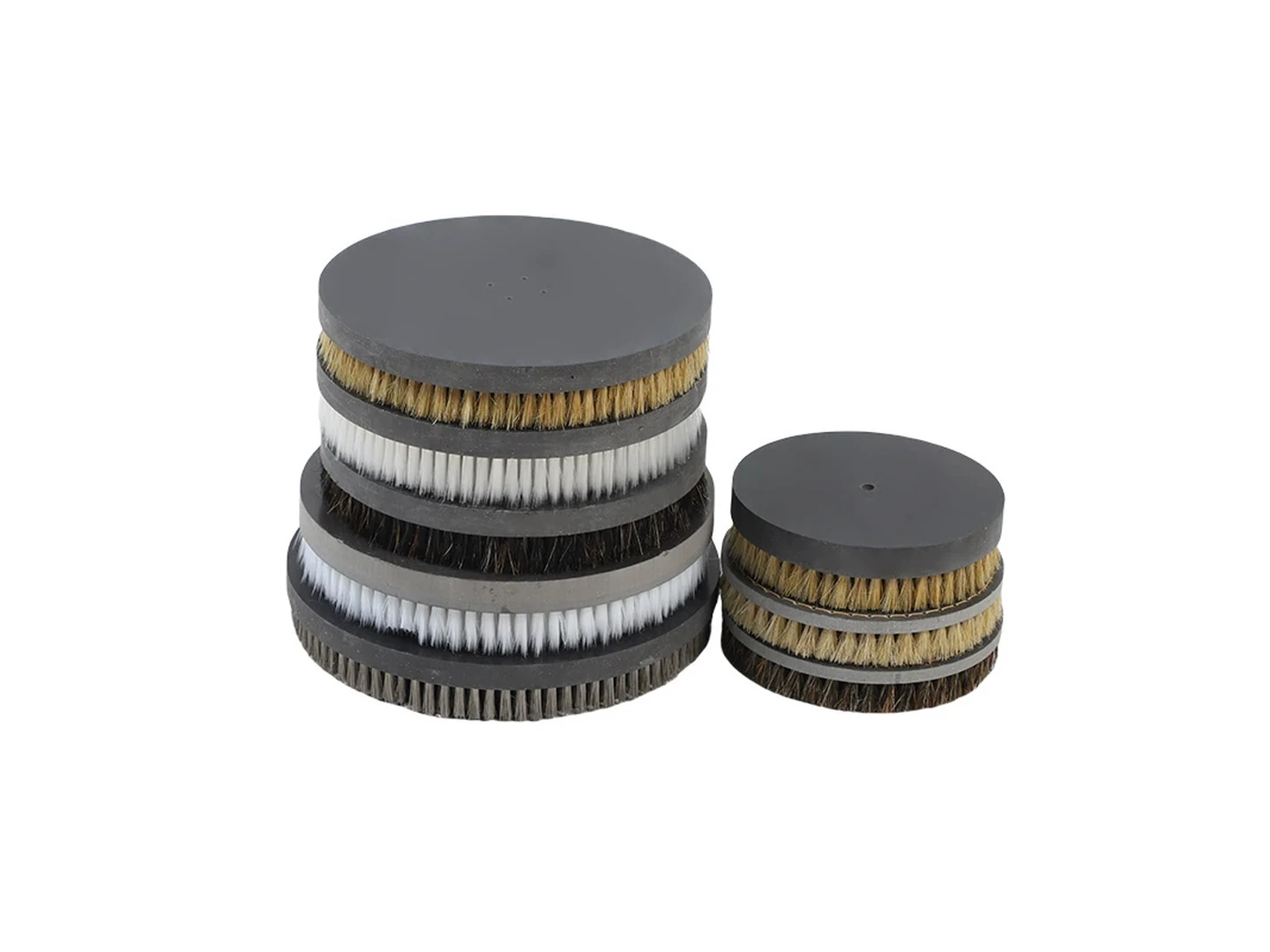
Medium brush
100 pcs
Minimum order
Worked with two hands or on a pole: chimney, gutter and pond-filter brushes, discs, cups and tank brushes.
Production lead time, once the specification is confirmed
- Up to 100 pcsWithin 7 days
- 101–5,000 pcsWithin 14 days
- 5,001–50,000 pcsWithin 21 days
- Over 50,000 pcsConfirmed with your quotation
Peak season can extend these times; the shipping date is confirmed in writing with your quotation. Sampling and shipping are quoted separately.
A machine-mounted rotating disc brush for ceramic glaze lines that removes glaze residue, oxide stains, ceramic fines, and edge burrs from tile faces and edges without marring the glazed surface. Available in non-abrasive and abrasive nylon filament grades from 80 to 320 grit, sized to fit your existing spindles and line layout.
What can this brush do for you?
Tips contact the tile, not the side of the filament
The disc is engineered so that only the filament tips strike the tile surface as it rotates. This controlled tip contact lifts loose glaze, dust, and fines without the side-scuffing action that leaves haze or micro-scratches on freshly glazed or decorated tile. The result is a clean surface that can move directly to drying or kiln loading.
Abrasive grades handle burrs and dried drips
When the line produces edge burrs, dried glaze drips, or oxide stains, abrasive nylon filaments with aluminum oxide, silicon carbide, or ceramic grit cut through the residue at a controlled rate. Because the abrasive is embedded throughout the filament, fresh cutting particles are exposed as the filament wears, so the finishing action stays consistent until the disc is replaced.
Balanced for smooth running at line speed
Each disc is assembled and dynamically balanced for the intended RPM range. A balanced disc reduces spindle vibration, prevents chatter marks on the tile, and keeps contact pressure even across the full width of the brush. Operators see fewer finish variations and longer bearing life on the cleaning station.
Built for dry, dusty ceramic production
PA nylon resists the bending fatigue and abrasive dust load typical of glaze lines, while the core and hub materials are selected for the heat, moisture, and chemical exposure of your process. Abrasive discs wear predictably, making it easier to plan replacement intervals around scheduled line stops.
Quick-change wear part for minimal downtime
The disc is a consumable that mounts directly onto your existing spindle, arbor, or bolt-on hub. When filaments reach their wear limit, the operator swaps the disc in minutes without removing the shaft or recalibrating the machine. Multiple discs can be staged on one shaft to cover wide tile formats.
What is a Ceramic Glaze Line Disc Brush?
A Ceramic Glaze Line Disc Brush is a circular brush with a central bore or hub and filaments projecting from the rim or face, driven by a motorized spindle on a ceramic tile production line. As tiles pass beneath the rotating disc on a conveyor, the filament tips contact tile faces, edges, or localized work zones to remove glaze residue, oxide contamination, ceramic fines, and edge burrs.
The brush functions differently depending on the fill. Non-abrasive nylon discs perform final cleaning and dust removal on glazed or decorated surfaces, while abrasive nylon discs add a controlled mechanical action for deburring, edge softening, oxide stain removal, or creating a uniform matte finish. The right configuration depends less on the brush itself than on the process stage, tile material, line speed, and the specific residue left on the tile.
Operating considerations are simple but important: the disc must rotate in the correct direction relative to tile travel, adjacent discs should overlap enough to avoid missed strips, and contact pressure is set by machine downfeed rather than speed. For dry lines, dust extraction prevents re-deposition of removed fines. For wet lines, the core and hub must be corrosion-resistant and the filament must retain stiffness when saturated.
This is not a heavy grinding tool. It is designed for light to medium mechanical cleaning, deburring, and surface preparation where controlled filament contact is safer than rigid abrasives. For severe stock removal, a diamond grinding head is used upstream, and the disc brush follows to clean and finish the surface.
Technical Specifications
The dimensions below are typical working ranges. Every disc is matched to your spindle interface, tile format, and residue type, so treat these as selection starting points rather than fixed limits.
| Parameter | Value / Options |
|---|---|
| Disc diameter | 20–150 mm standard; larger diameters available for wide-format tile lines |
| Bore / hub interface | 10–50 mm bore, keyway, set-screw, or bolt-on hub matched to spindle drawing |
| Core material | Aluminum, steel, phenolic, or nylon — selected by speed, weight, and corrosion exposure |
| Core thickness | 10–40 mm, depending on filament length and load |
| Visible filament length (trim) | 20–80 mm; shorter for aggressive contact, longer for conformability on uneven tile |
| Fill material | Nylon PA6/PA66, abrasive nylon with aluminum oxide, silicon carbide, ceramic grit, or diamond abrasive nylon |
| Grit range (abrasive fill) | 80–320; select 80–120 for burrs and drips, 180–240 for medium finishing, 320 for fine surface conditioning |
| Filament diameter | 0.3–1.5 mm non-abrasive; 0.8–2.0 mm abrasive |
| Trim profile | Flat, beveled, cup, or custom contour to match tile edge geometry |
| Operating speed | Up to 4,000 RPM depending on disc diameter, core material, and balance class |
| Temperature resistance | 125°C continuous for standard PA; higher grades available for hot zones |
| Wet / dry compatibility | Dry or wet operation; specify moisture, pH, and cleaning chemical before material selection |
| Balancing | Dynamically balanced assembly to prevent vibration and finish variation at line speeds |
| Brush type | Custom Disc Brushes |
| How it is driven | Machine-driven, mounted in the equipment |
| Cleaning target | post-glaze cleaning station, edge deburring and deflashing, and oxide and contaminant removal cleaning |
| Surface or part | tile, edges, ceramic, tile faces, glaze lines, hubs, bores, and aluminum |
| Residue or debris | glaze, oxide, burrs, dust, fines, ceramic fines, glaze residue, and spatter |
| Mounting / connection | 10–50 mm bore, keyway, set-screw, or bolt-on hub matched to spindle drawing |
Where does this brush work best?
- Post-glaze cleaning stations. After spray glazing or dipping, wet or dried glaze drips and spatters are removed from tile faces before the kiln. Non-abrasive nylon removes soft residue; abrasive nylon handles dried drips without damaging the glaze layer.
- Edge deburring and deflashing after cutting or squaring. Tiles leaving cutting, squaring, or calibration equipment carry sharp burrs and chipped edges. Abrasive discs soften and even the edge before packaging or further processing.
- Oxide and contaminant removal before decoration. Kiln wash, oxide stains, and airborne dust on bisque or technical porcelain surfaces must be removed before decoration or glazing. Disc brushes provide consistent contact across the full tile width.
- Matte or satin finishing of technical porcelain. Abrasive nylon discs with fine grit create a uniform brushed or matte surface on unglazed porcelain and technical stoneware, replacing secondary hand finishing.
- Rectification line support. After calibration grinding, the disc brush cleans edge residue and removes loose grains, improving the visual quality of rectified edges.
- Transitions between line stages. Between spraying and drying, drying and decoration, or decoration and loading, the disc removes contamination that would otherwise cause defects in downstream processes.
How do I choose the right one?
Match the fill to the process stage
Start with the residue you need to remove. Light glaze dust and soft film call for non-abrasive nylon PA. Dried drips, edge burrs, and oxide stains call for abrasive nylon with aluminum oxide or silicon carbide. Very hard porcelain or precise surface conditioning may require ceramic or diamond abrasive fill. Grit selection follows the same logic: 80–120 removes material, 180–240 balances cut and finish, 320 produces a fine uniform surface.
Get the mounting interface right first
Measure the spindle diameter, keyway or flat, bolt circle, and available shaft length before ordering. The bore must fit tightly, and the disc must seat perpendicular to the tile surface. A loose bore causes wobble; an off-center mount creates uneven wear and streaking. Send a spindle drawing or sample hub whenever possible.
Set trim length and density for your contact pressure
Longer filaments bend away from the tile and produce softer contact, useful on delicate glaze or contoured surfaces. Shorter filaments transfer more pressure and are better for stubborn dried residue. Fill density matters too: a dense fill gives more contact points for even coverage, while an open fill sheds dust better and resists loading in dry lines.
Check speed and downfeed limits
Each disc has a maximum RPM based on diameter, core material, and balance. Exceeding it causes filament flare, vibration, and premature failure. Contact pressure should be set by adjusting the machine downfeed or gap, not by increasing speed. Run a short trial on scrap tiles to confirm the brush removes the target residue without scratching or glazing the surface.
Consider wet or dry operation now
Dry glaze lines generate fine dust that can re-deposit on tiles, so dust extraction is strongly recommended. Wet lines require a corrosion-resistant core and hub plus filament that keeps its stiffness when saturated. Specify your moisture, pH, and cleaning chemicals up front so the material package is built for the actual environment.
When to choose a different tool
For heavy stock removal, severe burrs, or reshaping an edge, use diamond grinding discs or cup wheels first. For high-gloss polishing, resin-bond polishing pads are the correct tool. For cleaning narrow grooves, holes, or recessed areas, end brushes or cup brushes reach where a disc cannot. The ceramic glaze line disc brush is the right choice for controlled light to medium cleaning, deburring, and surface finishing across flat tile faces and edges.
A simple reference for common glaze line duties:
| Process duty | Recommended fill | Typical grit |
|---|---|---|
| Dust and soft residue removal | Non-abrasive nylon PA | — |
| Dried glaze drips and edge burrs | Abrasive nylon, aluminum oxide or silicon carbide | 80–180 |
| Oxide stain removal and medium finishing | Abrasive nylon, ceramic or silicon carbide | 180–240 |
| Fine surface conditioning / matte finish | Abrasive nylon or diamond abrasive nylon | 240–320 |
Can I customize this brush?
Ceramic glaze line disc brushes are configured per machine and per process. To quote your build, we need the spindle interface drawing, disc diameter and thickness, tile format, line speed, tile material, residue description, wet or dry operation, operating temperature, and your finish requirement. A sample of the current brush or a machine photo shortens the process.
We can adjust:
- Disc geometry — diameter, core thickness, trim length, trim profile (flat, beveled, cup, notch), and overall disc weight
- Mount interface — bore diameter, keyway, set-screw location, bolt circle, arbor adapters, or machine-specific hub
- Core material — aluminum, steel, phenolic, or engineering nylon to match speed, weight, and corrosion requirements
- Filament fill — non-abrasive PA, abrasive nylon, abrasive particle type, grit range, filament diameter, density, and fill pattern
- Color and marking — filament color coding for grit or station identification, core marking, or machine-readable identification
- Packaging — bulk, individual protective wrap, tray packs, or station-specific kit packing
If your project requires material data sheets, inspection reports, third-party testing, or documentation support for your internal quality system, we can assist with those requirements during the customization process.
Which filament survives the cleaning and still lasts on a ceramic glaze line disc brush?
How can I tell when the disc brush has worn out?
Check the visible filament length against the minimum specified for your disc. When the filament is worn to the point where the core or hub could contact the tile, replace the disc immediately. Also watch for uneven wear across the face, loss of cleaning effectiveness, or increased vibration — these indicate the brush is past its service life even if some length remains.
Does a stiffer filament always clean better?
No. A stiffer or larger-diameter filament transfers more force, but on soft glaze or decorated surfaces it can scratch, glaze-burn, or chip edges. Start with the smallest filament diameter that still removes the target residue at your line speed, and increase stiffness only if a trial shows incomplete cleaning.
Can I run this brush on wet tiles?
Yes, if the core, hub, and filament are specified for wet operation. Nylon absorbs moisture and can lose some stiffness, so wet lines often use a slightly larger filament or a denser fill to maintain the same contact pressure. Make sure the spindle bearings, shaft, and mounting hardware are also rated for your moisture and chemical exposure.
What should I do if the brush leaves marks on the glaze?
Stop the line and check four things: filament material and grit (too aggressive for the surface), line speed (tile dwelling under contact too long), disc pressure (downfeed set too low), and balance or mounting (wobble causing edge contact). Switch to a finer grit or non-abrasive fill, raise the downfeed gap, reduce RPM, or re-balance the disc. Test on scrap before returning to production.
Can one disc brush do both cleaning and finishing?
It is possible, but not recommended when both duties are critical. Abrasive grit embedded in the filament can shed a few particles into the line, contaminating later glaze or decoration stages. Use separate discs for cleaning and finishing, and clearly identify them so operators do not swap them accidentally.
How do I verify the disc is mounted correctly before startup?
After mounting, rotate the spindle by hand and confirm the disc runs true against a fixed reference point, with no visible wobble or contact with surrounding guards. Confirm the rotation direction matches the machine specification, and check that the disc face is parallel to the tile conveyor. Run the spindle at low speed for one minute, watch for vibration, then bring it to production speed.
Guides that go deeper on this
Custom Manufacturing RFQ
Describe Your Application
Please share the brush dimensions, working area, residue type, material direction, quantity, and a drawing or photo for quotation.
Drawing or photo optional — it speeds things up, it does not gate the enquiry.
Custom Brush RFQ
Send Your Brush Project
Upload a drawing, product photo, or sample photo and provide the core dimensions and cleaning conditions.
“We need a brush to remove wet residue from a stainless steel conveyor, about 800mm wide. The current brush wears quickly. We can send photos.”
“We sell drinkware and need a cleaning brush to include with the product. Quantity around 5,000 pieces.”