
Custom Cleaning Brush
Cleaning Brush Lithium Battery
Custom cleaning brushes for lithium battery production lines. Remove electrode powder and metal fines from webs, rollers, and machine surfaces.
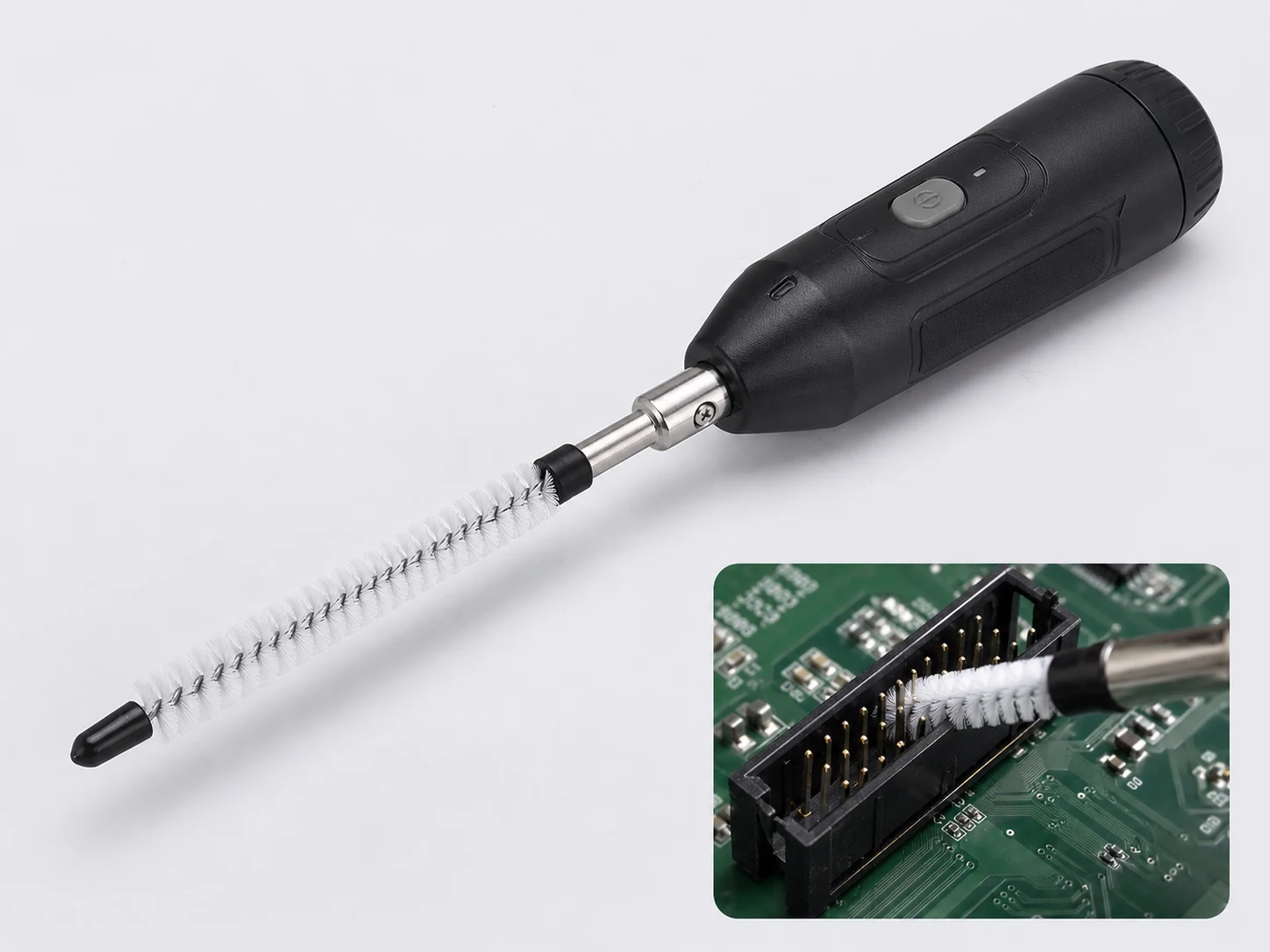
Large-format brush
100 pcs
Minimum order
Built one at a time on a core or channel: full-width rollers, sweeper brooms and long strip.
Production lead time, once the specification is confirmed
- Up to 100 pcsWithin 20 days
- 101–1,000 pcsWithin 30 days
- Over 1,000 pcsConfirmed with your quotation
Peak season can extend these times; the shipping date is confirmed in writing with your quotation. Sampling and shipping are quoted separately.
A configurable industrial cleaning brush for lithium battery manufacturing lines, designed to remove electrode powder, metal fines, and loose process particles from electrode webs, rollers, guides, and accessible machine surfaces without introducing contamination or static buildup.
What can this brush do for you?
Dislodge Process Particles Before They Become Cell Defects
Loose electrode powder, metal fines, and dust left on electrode web or machine contact surfaces can lead to coating voids, short circuits, or contamination in downstream assembly. The brush uses engineered nylon filament tips to mechanically lift and remove these particles where they are still loosely attached, before they can be embedded into the coating or carried into the cell.
Static-Dissipative Contact for Dry Room Conditions
In low-humidity dry rooms, standard insulating filaments can build static charge and attract charged particles back onto cleaned surfaces. A conductive nylon configuration with surface resistance in the 10⁶–10⁹ Ω range allows the brush to dissipate charge when the core and mounting are grounded, reducing re-contamination on ESD-sensitive electrode and separator materials.
Geometry Matched to the Actual Cleaning Zone
The brush is built as a roller, strip, hand tool, disc, or tube depending on whether you are cleaning a continuous moving web, a rotating roller, a guide edge, or a local surface before welding. Working width can be set from 100 mm up to 3000 mm for full-web coverage, or narrowed to a few millimeters for edge and guide contact.
Low-Shedding Filaments Keep the Process Cleaner
Filament material, diameter, crimp, and retention are selected to minimize fiber loss during operation. This is critical in lithium battery cleanrooms and dry rooms where stray fibers can become foreign-object defects. Nylon PA filaments release captured particles during rotation or wiping strokes, so the brush does not simply redeposit what it removes.
Uniform Contact Pressure Across Wide Electrode Webs
For roller configurations, filament density, diameter, and trim length are engineered together to apply consistent pressure from edge to edge. This prevents missed zones in the center or excessive abrasion at the edges of thin electrode coatings, which can happen with off-the-shelf brushes that are not load-matched to the web path.
What is a Cleaning Brush Lithium Battery?
A Cleaning Brush Lithium Battery is a specialized industrial brush used inside lithium battery cell and pack production lines to remove loosely attached particulate contamination from surfaces that must stay particle-free. Unlike a general-purpose maintenance brush, it is selected and configured for the specific contact surface, particle type, line speed, environmental conditions, and static control requirements of electrode manufacturing and battery assembly.
In a typical continuous application, a roller brush is mounted above or below the electrode web after coating, drying, or calendering. The rotating brush contacts the moving web surface, and its nylon filaments physically dislodge electrode powder and metal fines. A vacuum or air extraction system then carries the loosened particles away from the line. The brush itself does not replace that extraction step; it makes it effective by breaking the particle-to-surface adhesion.
For non-continuous zones, the same product family includes strip brushes that press against rotating rollers or guides, disc brushes for localized rotary cleaning, and hand brushes for manual wiping of tooling, fixtures, or welding contact areas. In all configurations, the operating logic is the same: controlled filament-tip contact removes the particles you can see and the fines you cannot, without abrading the underlying surface or adding fibers of its own.
The brush is not designed to remove baked-on slurry, carbonized deposits, or strongly adhered foreign material. It is a line-integrated particle control tool that works best when loose contamination is the problem and surface preservation plus ESD safety are the constraints.
Technical Specifications
| Parameter | Value / Options |
|---|---|
| Brush form | Roller, strip, hand, disc, wheel, or tube — selected from the cleaning zone geometry |
| Working width | 100–3000 mm (custom); narrow strip widths available for edge and guide contact |
| Filament material | Nylon PA6, PA6.6, conductive nylon, PP, PBT, or project-specific grade |
| Filament diameter | Nylon 0.05–1.2 mm; PP 0.07–2.0 mm; PBT 0.15–0.2 mm (reference ranges) |
| ESD resistance option | 10⁶–10⁹ Ω surface resistance with conductive nylon configuration |
| Core / holder | Aluminum, stainless steel, or engineering polymer, matched to mounting and environment |
| Shaft / bore | Custom diameter, keyway, or flange to fit existing roller shafts and drives |
| Filament density / trim | Selected for required contact pressure, particle release, and coating abrasion limit |
| Operating temperature | Up to 120°C continuous for nylon; higher with alternate materials if specified |
| Chemical exposure | Nylon resists common NMP-free aqueous and solvent-based electrode cleaning solutions; confirm compatibility with your process chemicals |
| Cleaning environment | Dry room, cleanroom, or general production area; low-particulate filament options available |
| Brush type | Custom Roller and Conveyor Brushes |
| How it is driven | Machine-driven, mounted in the equipment |
| Cleaning target | electrode coating line, roller and guide bar, and slitting and cutting station cleaning |
| Surface or part | roller, webs, metal, guides, edges, fixtures, tooling, and accessible machine surfaces |
| Residue or debris | particles, powder, fines, process particles, loose process particles, coating residue, slurry, and burrs |
| Mounting / connection | Shaft-Mounted / Flange |
All dimensions, materials, and mounting interfaces are configured per project. Provide your equipment drawing, web or roller dimensions, and process parameters, and we will match the brush to your line.
Where does this brush work best?
- Electrode coating lines: mounted after the coating head, dryer, or calender to remove loose electrode powder from the moving anode or cathode web before slitting or winding.
- Rollers and guide bars: strip brushes pressed against idlers, tension rollers, and web guides that accumulate metal fines or coating residue and transfer it back to the web.
- Slitting and cutting stations: remove edge particles and burrs from freshly cut electrode strips before they reach stacking or winding.
- Tab welding and cell assembly: hand brushes or small discs clean tab surfaces and current collector contact areas before ultrasonic or laser welding.
- Dry room and cleanroom equipment maintenance: low-shedding hand brushes for wiping down tooling, fixtures, and machine surfaces that must remain particle-free between production runs.
- Battery module and pack assembly: cleaning busbar contact zones, cooling plate surfaces, and terminal areas before electrical connections are made.
How do I choose the right one?
Start with the cleaning zone and motion
The brush form comes first. A continuous electrode web passing under a fixed position calls for a roller brush. A rotating roller or guide bar that needs constant contact is best served by a strip brush pressed against it. Localized manual cleaning before welding or inspection points to a hand brush. Disc and wheel forms fit rotary cleaning fixtures. If you are unsure, send a photo or drawing of the area and the motion path, and we will recommend the correct form.
Match the filament to the residue and surface
Loose dry electrode powder and dust can be removed with standard nylon PA. If the powder is fine and static-prone, conductive nylon is the safer choice. For surfaces exposed to aggressive solvents or higher temperatures, PBT or PP may be required. For partially dried slurry that is still soft but sticky, a stiffer nylon grade with a slightly larger diameter can improve removal without scratching, but test on the actual coating first. If particles are embedded or hardened, a brush alone will not solve the problem.
Set contact pressure deliberately
Filament diameter, density, and trim length control how hard the brush presses on the surface. Thin filaments (0.1–0.3 mm) at moderate density are gentler and suit thin or fragile electrode coatings. Thicker filaments (0.5–1.0 mm) or higher density provide more scrubbing action for heavier contamination, but they also increase abrasion risk. The right setting is the lowest pressure that reliably removes the target particles in your process.
Confirm ESD requirements early
If the brush will operate in a dry room or on materials sensitive to electrostatic discharge, specify conductive nylon and ensure the core and mounting provide a continuous path to ground. Standard nylon is an insulator and may cause static accumulation. Do not assume any brush is ESD-safe unless it is configured that way.
Verify dimensional fit
Measure the available space: roller diameter and overall length, web width with desired overlap, shaft diameter and keyway, and mounting clearance. A brush that is slightly too wide can interfere with adjacent machine parts; too narrow leaves uncleaned edges. For strip brushes, the holder channel width and mounting hole pattern must match your frame.
When a different cleaning method is more suitable
Use a vacuum or air-knife system alone if particles are already loosely resting on the surface and you only need to remove them without contact. Use a tacky roller if the goal is to lift particles without any mechanical scrubbing and the surface is extremely delicate. If particles are baked on or chemically bonded, an abrasive nylon or wire brush may be required, but test for surface damage first. For cleaning inside assembled cell components or tight internal channels, this brush is not the right tool; consider a tube brush or ultrasonic cleaning in those cases.
Can I customize this brush?
Every configuration is built to your line. We need the following information to define the right brush: cleaning zone drawing or photos, web or roller dimensions, line speed, residue type and particle size, surface coating sensitivity, ESD requirements, chemical exposure, ambient temperature, and mounting interface. A sample of the current brush or a CAD model of the equipment helps us match the fit exactly.
We can adjust:
- Brush form: roller, strip, hand, disc, wheel, or tube geometry
- Filament: material (nylon PA, conductive nylon, PP, PBT), diameter, density, trim length, crimp, and color
- Core / holder: material, diameter, shaft ends, keyways, flanges, and mounting holes
- Working width: from narrow edge strips to full-web rollers up to 3000 mm
- ESD configuration: conductive nylon with specified surface resistance range and grounded core design
- Interface: shaft adapters, quick-release mounts, or direct replacement geometry for existing roller positions
- Marking and packaging: custom identification, lot coding, bulk or single-brush packaging, and cleanroom-compatible wrapping
If your project requires material declarations, third-party testing, particle shedding data, or inspection reports, we can assist with those requirements during the customization process.
Which filament survives the cleaning and still lasts on a cleaning brush lithium battery?
How can I tell if the brush is shedding fibers into the battery process?
Run the brush on a clean section of electrode web or a test surface for a short period, then wipe the surface with a clean white lint-free cloth and inspect under a bright light. Any visible loose fibers indicate shedding. The filament material, crimp, or retention method may need to be changed. We can also provide particle shedding test data for the selected filament configuration before production use.
What is the difference between standard nylon and conductive nylon in this application?
Standard nylon is electrically insulating and will not dissipate static charge. In a dry room with low humidity, rubbing contact can generate charge that attracts particles back onto the cleaned surface. Conductive nylon is formulated with a conductive filler, giving it a surface resistance between 10⁶ and 10⁹ Ω. When the brush core and mounting are grounded, the charge flows to ground instead of accumulating. Choose conductive nylon when static is a known problem or when you are cleaning fine, dry powders.
Can this brush be used on wet electrode slurry or only dry particles?
Some configurations work on wet surfaces if the filament material is chemically compatible with the solvent and the brush is designed to avoid liquid retention. However, wet cleaning often requires softer filaments and more frequent brush cleaning because slurry can mat the filaments and reduce contact effectiveness. Specify the solvent, moisture level, and temperature so we can recommend an appropriate material combination.
How often should roller brushes be inspected or replaced on a continuous line?
Inspection frequency depends on line speed, particle load, and duty cycle, but a weekly visual check is a sensible starting point. Look for filament matting, uneven wear, loss of contact pressure, or accumulation of debris that no longer releases. Replace the brush when it stops removing particles at the required level or when filament wear changes the contact geometry. Keeping a spare roller ready reduces downtime on high-throughput lines.
Does brushing replace vacuum or air-knife cleaning systems?
No. The brush loosens and lifts particles from the surface, but those particles must then be transported away from the line. In most lithium battery applications, a brush is used together with a vacuum extraction hood or air knife positioned immediately downstream. A brush used alone can redeposit loosened particles further along the web. Treat brushing, vacuum, and air as complementary stages of one particle removal sequence.
Can a single brush clean both sides of the electrode web at the same time?
Yes, if the web path provides access to both sides. The most common configuration is two opposing roller brushes positioned above and below the web, or a double-sided roller with integrated top and bottom brush elements. The web must be tensioned and guided so that it stays in the correct position relative to both brush faces. Send your web path drawing and we will design the appropriate top-and-bottom contact system.
Guides that go deeper on this
Custom Manufacturing RFQ
Describe Your Application
To prepare the correct quotation, provide the dimensions, cleaning task, residue, material, mounting details, quantity, and a drawing or photo.
Drawing or photo optional — it speeds things up, it does not gate the enquiry.
Custom Brush RFQ
Send Your Brush Project
Upload a drawing, product photo, or sample photo and provide the core dimensions and cleaning conditions.
“We need a brush to remove wet residue from a stainless steel conveyor, about 800mm wide. The current brush wears quickly. We can send photos.”
“We sell drinkware and need a cleaning brush to include with the product. Quantity around 5,000 pieces.”