
Custom Cleaning Brush
Passivation Line Brush
Acid-resistant roller or strip spanning the strip width, lifting oxide smut and acid salts after the bath so the rinse and dry sections work clean.
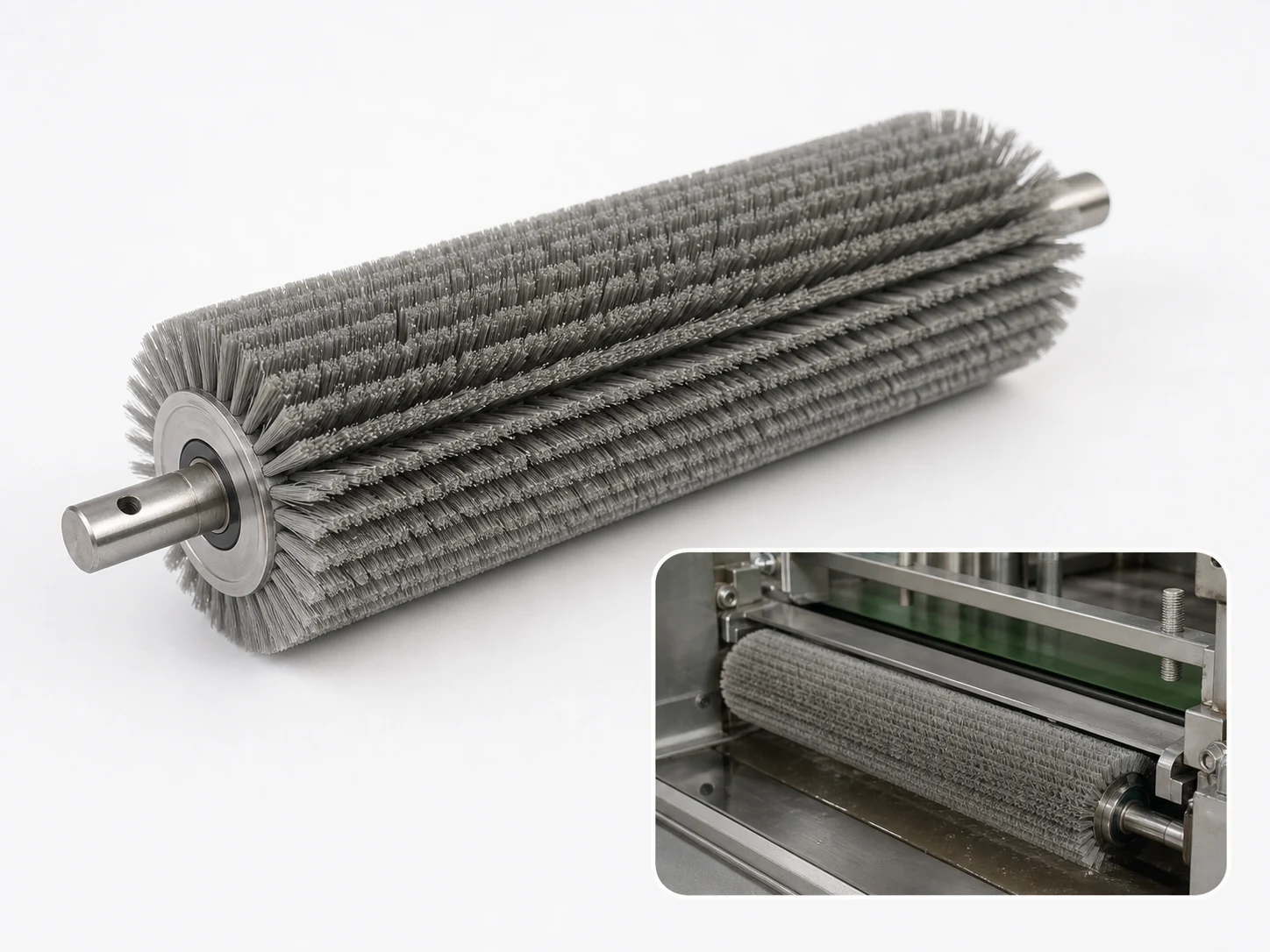
Large-format brush
100 pcs
Minimum order
Built one at a time on a core or channel: full-width rollers, sweeper brooms and long strip.
Production lead time, once the specification is confirmed
- Up to 100 pcsWithin 20 days
- 101–1,000 pcsWithin 30 days
- Over 1,000 pcsConfirmed with your quotation
Peak season can extend these times; the shipping date is confirmed in writing with your quotation. Sampling and shipping are quoted separately.
A mechanically driven roller or strip brush for continuous passivation lines on stainless steel and coated metal strip. It removes residual oxide smut, acid salts, and process sludge from strip surfaces and line rolls in wet acid environments, helping the final rinse and dry sections deliver a cleaner, more uniform surface.
What can this brush do for you?
Full-width conditioning after the acid bath
The brush face spans the strip or roll width and rotates against the moving surface to lift loose oxides, smut, and metallic salts that spray rinsing alone often leaves behind. Filament density and engagement are set so contact remains even across the face, including the strip edges where deposits tend to concentrate.
Built for continuous acid mist and solution exposure
PP and PBT filament fills resist the nitric, hydrofluoric, sulfuric, and mixed acid environments common in passivation and pickling lines. Cores and mounting hardware are stainless steel 316 or non-metallic, so the brush itself does not introduce rust or carbon steel contamination onto a passivated surface.
Controlled surface conditioning without overworking thin strip
Engagement depth, filament diameter, and brush-to-line speed ratio set how aggressively the brush works. Fine PP or PBT filaments at lower engagement condition the surface and preserve the finish; heavier filament diameters or wire fill remove thicker smut and scale when the duty requires it.
Continuous cleaning for squeegee, bridle, and backup rolls
Passivation solution and removed residue deposit on line rolls and transfer back to the strip as stains or marks. The same brush configuration can be positioned against roll surfaces to continuously remove that build-up, reducing periodic manual roll cleaning and unplanned line stops.
Drops into existing brush machines without line rework
Roller or strip/lath configurations are dimensioned to your current brush housings, chucks, journals, and drive connections. Face length matches strip width or roll face, and end details match the machine. This is a direct replacement brush assembly, not a stand-alone machine.
What is a Passivation Line Brush?
A Passivation Line Brush is a driven brush assembly installed in a continuous stainless steel or coated metal passivation or pickling line to mechanically condition the strip surface after chemical treatment. In a typical wet section, the brush rollers rotate against moving strip between the passivation or acid tank and the final rinse or drying section. The filament tips contact the strip surface and loosen oxides, smut, chromium and nickel salts, and loosely bonded process residue so the rinse section can carry them away.
Two installation formats are common. A roller brush is a cylindrical filament fill wound or set on a stainless steel core, mounted across the strip width and driven by the line. A strip or lath brush uses a linear brush channel clamped into a brush machine or holder, using the same filament materials. Both formats can be built for top and bottom strip surfaces, usually as opposed pairs.
This brush does not replace chemical passivation. It is a surface-conditioning step that improves passivation uniformity, reduces residual staining, and protects downstream rolls from deposit transfer. It works best when the line has a driven brush station or when the assembly is sized to be installed into one.
Technical Specifications
The table below lists the main selection parameters for a passivation line brush. All dimensions are project-matched to your line drawing rather than fixed catalog sizes.
| Parameter | Value / Options |
|---|---|
| Brush format | Cylindrical roller or strip/lath carrier sized to the treatment line |
| Fill material | PP or PBT for strong acid service; nylon only after chemistry review; SS 316 wire for mechanical descaling options |
| Filament diameter | PP 0.07–2.0 mm; PBT 0.15–0.2 mm; nylon 0.05–1.2 mm; SS 316 wire 0.10–0.40 mm |
| Working face length | Matched to strip width or roll face from the line drawing |
| Roll outside diameter | Sized to the existing brush machine and required engagement |
| Core / shaft | 316 stainless tube or solid shaft; diameter and end journals matched to the existing drive |
| Mounting | Keyed hubs, flange plates, split carriers, or bearing journals to match the machine |
| Filament pattern | Straight, spiral, or custom pattern for uniform contact |
| Fill density | Adjustable rows per axial length or filament count per cm² |
| Operating environment | Wet acid mist, passivation solution, and solution temperature; material grade selected for the actual chemistry |
| Engagement adjustment | Brush-to-strip interference set by machine position; range depends on filament length and strip gauge |
| Line speed | Project-specific; confirmed with brush OD, drive, and dynamic balance |
| Brush type | Custom Roller and Conveyor Brushes |
| How it is driven | Machine-driven, mounted in the equipment |
| Cleaning target | stainless steel coil passivation line, chrome-free passivation, and roll and squeegee cleaning |
| Surface or part | roller, rolls, metal, tanks, coils, channel, aluminum, and substrates |
| Residue or debris | salt, oxide, sludge, scale, oxide scale, and process residue |
| Mounting / connection | Keyed hubs, flange plates, split carriers, or bearing journals to match the machine |
Where does this brush work best?
- Stainless steel coil passivation lines: after nitric acid or citric acid passivation tanks and before final rinse, to remove smut and chromium-iron salts from top and bottom strip surfaces.
- Continuous annealing and pickling lines (AP lines): scrubber sections where annealed stainless strip carries oxide scale and acid reaction products that need mechanical assistance for removal.
- Chrome-free passivation on galvanized or coated steel: brush rollers maintain uniform passivate film thickness and remove excess solution to prevent drying streaks.
- Aluminum coil pretreatment and passivation lines: soft PP filament brushes for light smut and salt removal without roughening the substrate.
- Roll and squeegee cleaning in wet sections: passivation line brush assemblies positioned against backup rolls, bridle rolls, or wringer rolls to continuously remove sludge build-up.
- Mechanical descaling ahead of passivation: SS 316 wire fill option for removing cracked scale before chemical treatment in selected pickling lines.
How do I choose the right one?
1. Match the brush duty to the line position
For post-passivation surface conditioning, choose PP or PBT filament fill. For mechanical descaling before the passivation bath, a SS 316 wire fill may be the better choice. If scale is still hard and bonded after pickling, the acid chemistry or descaling stage must be corrected before adding more brush aggressiveness.
2. Confirm the fill material against the chemistry
| Line chemistry / duty | Recommended fill | Notes |
|---|---|---|
| Nitric / hydrofluoric or mixed acid passivation, wet | PP or PBT filament | Good acid resistance; PP is conformable, PBT offers more wear resistance |
| Weak acid or neutral post-rinse conditioning | Nylon filament | Only after chemistry review; not for concentrated HCl or H2SO4 |
| Mechanical descaling before passivation | SS 316 wire | Removes cracked scale; can roughen the surface, so use minimum effective engagement |
3. Copy the existing brush station dimensions
Face length, roll outside diameter, core or shaft diameter, journal details, keyways, and drive connection must match the machine. Provide the line drawing or a sample of the current brush. There is no universal roller size for passivation lines.
4. Select filament diameter, density, and engagement
Finer filaments and lower density create a gentler conditioning action for thin strip and finished surfaces. Thicker filaments and higher density remove heavier smut and deposits. Engagement, the distance the brush penetrates into the strip plane, is then fine-tuned with the actual gauge and line speed. Start light and increase only until the residue is removed.
5. Verify the wet environment and drive direction
Specify acid type, concentration, solution temperature, spray pattern, and whether the brush runs wet or semi-dry. Cores, end plates, and bearings must be selected for that environment. Confirm brush rotation direction relative to strip travel; opposed pairs normally run counter to strip direction.
If the strip must remain completely scratch-free, use soft PP filament at minimum engagement or consider whether a non-contact rinse additive can do the job. If the line has no driven brush station, the correct purchase is a brush machine retrofit, not a replacement roller alone.
Can I customize this brush?
Yes. Passivation line brushes are engineered to the line, not taken from a fixed catalog. To define your configuration, provide the line drawing, strip width and gauge range, line speed, acid type and concentration, solution temperature, existing core or shaft dimensions, mounting details, drive direction, and the required surface finish. A photo or sketch of the current brush helps match the replacement exactly.
We can adjust:
- Brush format: cylindrical roller, spiral wound, or strip/lath carrier for channel mounting
- Fill material: PP, PBT, nylon, or SS 316 wire according to chemistry and duty
- Filament specification: diameter, trim length, stiffness, density, and pattern such as straight or spiral rows
- Core and shaft: 316 stainless tube or solid shaft, end journals, keyways, drive hubs, or flange plates
- End details: non-metallic or stainless end plates, bearing types, and sealing features for wet sections
- Face width and OD: matched to strip width or roll face, with balanced construction for line speed
- Packaging: industrial crating, moisture protection, and identification marking for warehouse control
If your project requires material certificates, inspection reports, or third-party testing for specific acid resistance or operational conditions, we can support those requirements during the customization process.
When is a passivation line brush worn out rather than just dirty?
How can I tell whether my passivation line actually needs a brush rather than just a stronger rinse?
After the final rinse but before drying, wipe the strip with a clean white cloth. If gray or black smut, salt residue, or a visible film transfers to the cloth, mechanical brushing plus rinse is likely to help. Also check line rolls for deposit build-up that returns to the strip as stains. If the defect comes from incorrect passivation chemistry or insufficient bath time, a brush will not correct it.
Can this brush run continuously in nitric acid or hydrofluoric acid passivation lines?
Yes, when the brush is built with PP or PBT filament and 316 stainless steel core components. Nylon fill is not recommended for concentrated nitric or hydrofluoric acid service. Provide the acid type, concentration, and solution temperature so the exact material grade can be confirmed for your line.
How do I check when the brush roller should be replaced?
Inspect filament trim length, matting, breakage, core corrosion, and dynamic balance at planned line stops. When filament tips are worn so that correct engagement can no longer be restored, or when filaments are matted and no longer spring back, replace the roller or strip brush. On opposed top and bottom pairs, compare the contact pattern across the width to catch uneven wear early.
Does brushing create the passivation layer?
No. The passive chromium oxide layer forms chemically in the passivation bath. Brushing removes loose oxides, smut, and process salts before or after chemical passivation so the layer can form and remain uniform. It improves surface cleanliness, but it cannot replace correct passivation chemistry.
My thin strip shows brush marks. What should I change first?
Reduce brush-to-strip engagement first. Then change to a finer filament diameter, switch from PBT or wire to softer PP filament, and check the brush speed ratio relative to line speed. If marks remain, verify core runout and filament trim uniformity; thin gauges require lower energy input than heavier strip.
Can one brush roller clean both top and bottom strip surfaces?
Generally no. A cylindrical roller contacts only one side as the strip passes over or under it. Lines that clean both sides use opposed top and bottom brush stations or two sequential rollers. For roll-cleaning duty, one brush assembly contacts the single roll surface it serves.
Guides that go deeper on this
Custom Manufacturing RFQ
Describe Your Application
To quote this brush accurately, send the size, material, cleaning target, residue, quantity, and any available drawing or sample photo.
Drawing or photo optional — it speeds things up, it does not gate the enquiry.
Custom Brush RFQ
Send Your Brush Project
Upload a drawing, product photo, or sample photo and provide the core dimensions and cleaning conditions.
“We need a brush to remove wet residue from a stainless steel conveyor, about 800mm wide. The current brush wears quickly. We can send photos.”
“We sell drinkware and need a cleaning brush to include with the product. Quantity around 5,000 pieces.”