
Custom Cleaning Brush
Phosphating Line Brush
Custom phosphating line brushes in PP, PBT or acid-resistant stainless steel. Roller and strip forms for sludge and smut removal, built to your drawing.
Medium brush
100 pcs
Minimum order
Worked with two hands or on a pole: chimney, gutter and pond-filter brushes, discs, cups and tank brushes.
Production lead time, once the specification is confirmed
- Up to 100 pcsWithin 7 days
- 101–5,000 pcsWithin 14 days
- 5,001–50,000 pcsWithin 21 days
- Over 50,000 pcsConfirmed with your quotation
Peak season can extend these times; the shipping date is confirmed in writing with your quotation. Sampling and shipping are quoted separately.
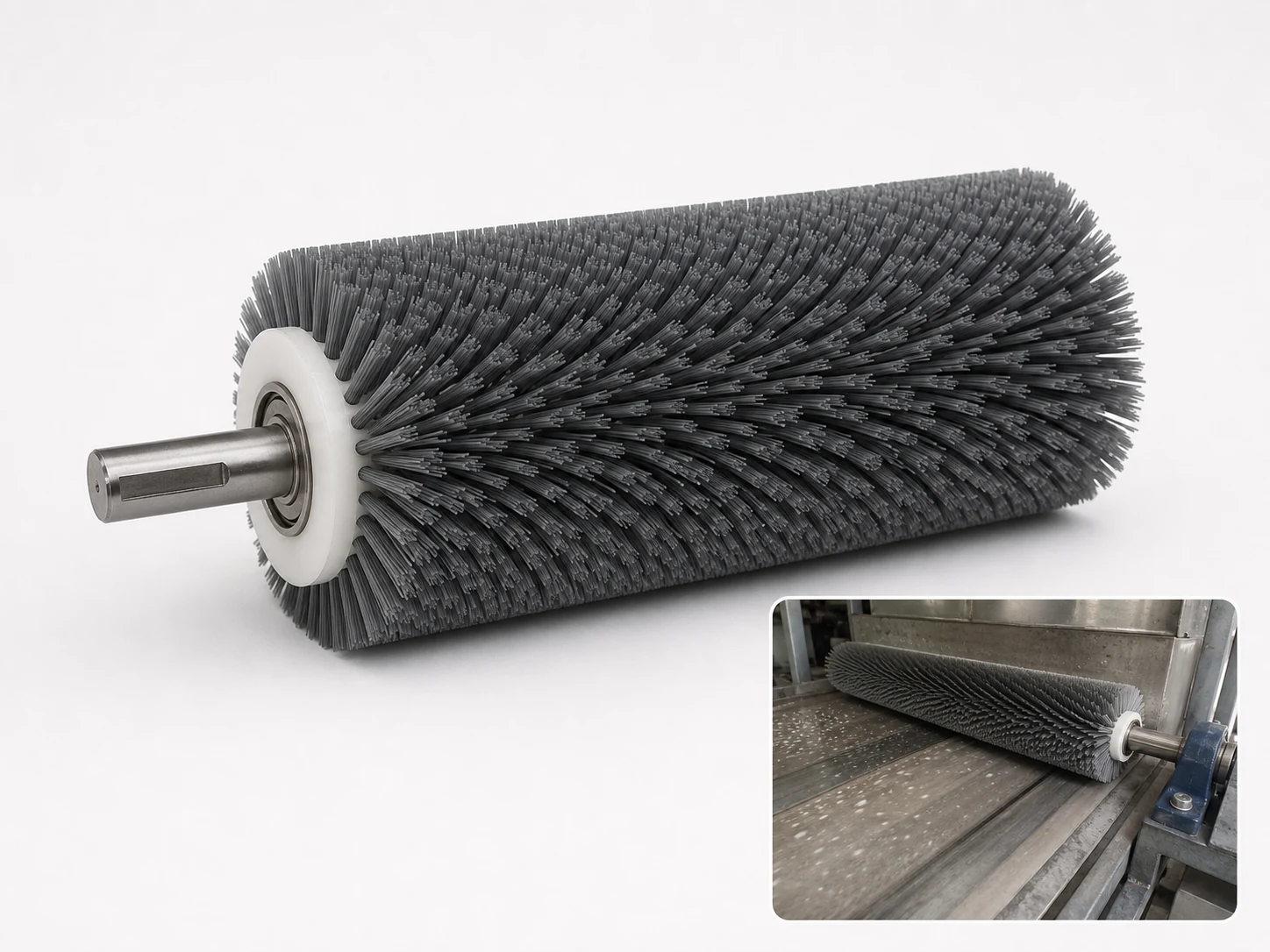
A chemical-resistant industrial brush for continuous duty on phosphating and metal pretreatment lines. Built as a rotating roller brush or a stationary strip/lath brush, this phosphating line brush removes loose phosphate sludge, oxide smut, process film and metal fines from strip, process rollers, tanks, racks and contacts while the line keeps running.
What can this brush do for you?
Keeps the strip clean across the full working width
A roller face matched to the strip width gives continuous, even contact from edge to edge. Loose iron-phosphate sludge, carbon smut released after acid activation, and metal fines are lifted or wiped away before they become defects in the conversion coating or in the finish applied downstream. Because the face is continuous, the cleaning action follows the strip with no dead bands where the strip edges travel.
Holds its shape wet, in hot acidic chemistry
General-purpose nylon bristle softens as it absorbs water and eventually hydrolyzes in hot acid, leaving broken filament in the bath and a brush face that flops during the shift. We specify polypropylene, PBT, or acid-resistant stainless steel filament by stage, so the fill keeps its stiffness and trim height in zinc, iron or manganese phosphate solutions at operating temperature. No filament shedding into the tank, and no loss of contact halfway through a run.
Cleans the rollers, tank edges and contacts where sludge accumulates quietly
Sludge does not only build on the strip. Process rollers pick up phosphate residue and mark the strip; weirs, splash walls and tank edges pack with iron-phosphate sludge; racks and hangers lose conductivity when they get coated. A strip/lath brush mounted at these positions wipes the surface continuously, so buildup is removed at the source instead of during a weekend boil-out.
Sheds sludge instead of packing the face
Filament diameter, density and spiral layout are set according to the debris type. Open, self-cleaning layouts let loosened sludge release from the fill as the roller turns, so the brush keeps wiping instead of becoming a solid, sludge-caked roll that stops cleaning the strip.
Is a drop-in replacement for your existing journals
There is no universal phosphating line brush size. The face width, outside diameter, core, shaft ends and drive details are copied from the line drawing, so the replacement mounts on the existing bearings and clearances without modification to the line.
What is a Phosphating Line Brush?
A Phosphating Line Brush is a wet-service industrial brush placed inside a phosphating or pretreatment line to keep contact surfaces clean while the line operates. Phosphating converts the metal surface into a crystalline phosphate layer for paint adhesion or corrosion protection; in doing so, the bath continuously generates sludge, solution carryover and loose surface residue. The brush’s job is mechanical conditioning and residue removal around the chemical process — it does not replace the chemistry.
Two forms cover most line positions:
- Roller brush — filament wound around a core, rotating against the moving strip or a process roller. Used where continuous scrubbing or wiping contact is needed across a surface.
- Strip/lath brush — a brush strip mounted in a holder, installed as a stationary wiper, scraper or edge-cleaning element at rollers, tank walls, weirs, splash shields or rack-cleaning positions.
On a typical line, the same family of brushes appears in several stages: a degrease/cleaner stage, an acid pickle or activation position, the phosphate stage itself, and the rinses after it. Filament follows the stage — polypropylene or PBT where the solution is acidic, nylon where it is neutral or alkaline, stainless wire where the residue is hard. That is why one line usually runs several filament specifications rather than one.
Operating conditions are wet, acidic and continuous. These brushes are designed for chemical resistance first, but they are not deburring or mill-scale brushes. They remove loose process residue, smut, sludge and light films; heavy mechanical stock removal is not their job.
Technical Specifications
Final dimensions copy the actual line drawing. The table below reflects the build envelope we work within for phosphating and pretreatment positions.
| Parameter | Value / Options |
|---|---|
| Brush form | Spiral-wound roller brush or strip/lath brush sized to the line position |
| Fill material | Polypropylene PP, PBT, or acid-resistant stainless steel wire; nylon PA for neutral/alkaline pre-treatment stages |
| Filament diameter | PP 0.07–2.0 mm; PBT 0.15–0.2 mm; nylon 0.05–1.2 mm; stainless wire selected per duty |
| Roller OD | 100–300 mm |
| Working length (face) | 100–600 mm; built to drawing, segmented for wider lines |
| Core / backing | 316 stainless steel, PP tube, or coated steel core; PP, PVC or aluminum strip backings |
| Shaft / journals | Turned journals, keyways, flanges or drive coupling matched to the existing mounting |
| Fill density and pattern | Set by duty — dense for fluid control and wiping, open for sludge shedding |
| Engagement | Light wipe to active scrub; set from strip condition and process duty, re-set as filament wears |
| Chemical environment | Zinc, iron or manganese phosphate solutions, pH approx. 2–5, with specified temperature and additives |
| Continuous wet-service temperature | PP to approx. 80°C; PBT for hotter positions; stainless steel wire when heat or abrasion exceeds polymer limits |
| Brush type | Custom Roller and Conveyor Brushes |
| How it is driven | Machine-driven, mounted in the equipment |
| Cleaning target | continuous strip phosphating line, process roller cleaning station, and hanger and contact cleaning |
| Surface or part | roller, tanks, metal, racks, edges, tank edges, aluminum, and coils |
| Residue or debris | sludge, scale, fines, salt, process film, oxide, powder, and process residue |
| Mounting / connection | Shaft-Mounted / Flange |
If the existing drawing is not available, we can work from field measurements and photographs — but drawing-backed numbers reduce fit risk when the replacement goes into the journals.
Where does this brush work best?
- Continuous strip phosphating lines for steel, galvanized and aluminum coil or plate ahead of painting, powder coating or coil coating: scrubber and wiper positions before and after the phosphate stage remove smut, sludge and excess solution from the strip face.
- Pretreatment tunnels and dip lines for fabricated parts — appliance panels, metal furniture, and agricultural or automotive components where carriers pass through degrease, rinse, phosphate and rinse tanks: strip brushes at rollers, tank edges and rack-cleaning positions keep the line running between chemical changes.
- Process roller cleaning stations: rollers pick up sludge and mark the strip or cause carryover. A dedicated brush on the roll face controls the buildup before it damages product.
- Rack, hanger and contact cleaning: racks coated with phosphate lose conductivity and produce uneven coating. Brushes restore the contact points during the return run.
- Upstream positions on the same line, including acid pickle segments, where accumulated scale, smut and iron salts need constant removal from strip, tank and roller surfaces.
How do I choose the right one?
Start with the stage, not the dimensions. The same mechanical brush design behaves differently depending on the solution it runs in.
Choose filament from stage chemistry first
| Line condition | Filament recommendation |
|---|---|
| Zinc or iron phosphate, roughly 45–65°C, light sludge and smut | Polypropylene PP — good acid resistance, moderate stiffness, holds trim height wet |
| Hot manganese phosphate, or firmer scrubbing on heavy smut | PBT, or acid-resistant stainless steel wire when temperature and abrasion exceed polymer limits |
| Acid pickle segment with hard scale and iron salts | Acid-resistant stainless steel wire |
| Neutral or alkaline degrease/rinse stage | Nylon PA 612 (wet-stable) or PP |
Do not use plain nylon in the acid phosphate position itself. Nylon absorbs moisture and softens, and in hot acid it hydrolyzes — shedding and losing stiffness well before the rest of the brush is worn.
Choose the form from the motion
If the surface passes under the brush, a rotating roller is usually the best form. If the brush is cleaning a roller, tank edge, weir or rack, a stationary strip/lath brush is more practical and easier to replace during the line’s maintenance window.
Set the dimensions from the line drawing
Face or working length, OD, core, journal centers and drive detail come from the existing position. The face is normally sized slightly wider than the strip or contact track it cleans, but clearances, drive torque and bearings all come from the drawing, not from the strip width alone.
Match diameter and density to duty
Fine filament and dense fill wipe solution and control carryover; coarse filament and open fill scrub sludge and smut without packing. Too fine a fill in a sludge position loads and stalls; too heavy a fill in a wiping position carries excess fluid and marks the strip.
Set engagement in steps
Start with light contact and increase until the residue clears. Excessive engagement bends the filament, raises drive torque and shortens brush life without meaningfully improving cleaning.
When another design or method fits better
If the task is only to remove an excess liquid film, a squeegee, air knife or nonwoven roll is usually the cleaner choice. If the deposit is hard mill scale, weld spatter or baked-on scale, a conventional wire or abrasive brush carries more removal duty. If the finish needs polishing, use an impregnated nonwoven brush. A phosphating line brush is the right selection when the job is continuous sludge removal, surface conditioning and fluid control under line chemistry.
Can I customize this brush?
Phosphating line brushes are almost always project-built. Send the position drawing and the stage chemistry sheet, and we size and fill each brush to that position, not to a catalog.
Adjustable for the project:
- Form — roller or strip/lath; solid or segmented construction
- Dimensions — roller OD, face or working length, overall length, core diameter
- Filament — material, diameter, trim height, density, spiral pitch, tuft or continuous-wound layout
- Core and backing — 316 SS, PP tube, coated steel; PP, PVC or aluminum channel for strip brushes
- Shaft ends — plain or turned journals, keyways, flanges, bearing seats, drive coupling
- Fitting — end caps, retainer covers, mounting channel, clips or brackets for strip positions
- Color and marking — resin color, laser or engraved core marking, position coding
- Packaging — bulk, individually wrapped, or sequence-packed by line position
What to send: the line drawing with roller OD, face length, journals and drive; per-stage pH, temperature, accelerators and additives; strip width and line speed; a description or photo of the residue; and photos of the worn brush. If the project requires material declarations, chemical-compatibility documentation, incoming inspection or third-party testing, we can support those as part of the project.
How do you tell when a phosphating line brush is worn out?
How can I check whether the filament will survive my phosphate bath before committing the line?
Run a soak test. Put filament samples of each candidate material in the actual bath chemistry at the actual operating temperature for 48–72 hours, then compare stiffness, diameter, weight and surface before and after. Softer, curled, swollen or significantly lighter samples indicate the material will degrade in service. This is a quicker and cheaper screen than a failed first production order.
What should I check before installing a new roller brush?
Confirm the OD, face length and journal diameter against the drawing, spin the brush to check runout, verify rotation direction, and start at light engagement. Also check that the shaft and core show no transit or storage damage that would fail under line torque.
Does this brush replace the pickle, rinse or conversion bath?
No. The brush loosens and removes residue and controls fluid at the surface. Pickling, rinsing and phosphate conversion are still chemical steps. Brushing reduces what carries into the next stage, but it does not substitute for the chemistry or the rinses.
How do I know when the brush is worn enough to replace?
Watch the contact evidence, not just the calendar. If the strip shows residue bands where the brush used to wipe clean, if filaments are flattened or curled, or if drive amps change significantly, the trim has usually worn to the point where it stops cleaning. For sludge positions, compare the face diameter against the installed drawing once the filament no longer reaches past the sludge line on the strip.
Sludge still packs the brush face — what should I change?
Open the fill density, increase the trim height in the debris zone, or use an angled spiral layout so rotation helps eject the sludge. If the position allows it, a directed fresh-water spray across the brush face carries the loosened material away. The bath itself should also be filtered; a brush cannot overcome a sludge-loaded tank alone.
Can one brush design serve every stage on the line?
Only if the filament is selected for the harshest condition — the lowest pH and highest temperature among the stages where it runs. In practice, most lines get better life and lower total cost by specifying the filament per stage: polymer in the moderate zinc/iron phosphate positions, stainless in the hot or aggressive positions, and a different fill for the alkaline cleaner stages.
Guides that go deeper on this
Custom Manufacturing RFQ
Describe Your Application
For an accurate quotation, please provide the main dimensions, material preference, working surface, residue, quantity, and a drawing or photo.
Drawing or photo optional — it speeds things up, it does not gate the enquiry.
Custom Brush RFQ
Send Your Brush Project
Upload a drawing, product photo, or sample photo and provide the core dimensions and cleaning conditions.
“We need a brush to remove wet residue from a stainless steel conveyor, about 800mm wide. The current brush wears quickly. We can send photos.”
“We sell drinkware and need a cleaning brush to include with the product. Quantity around 5,000 pieces.”