
Custom Cleaning Brush
Cotton Yarn Industrial Oil Brush
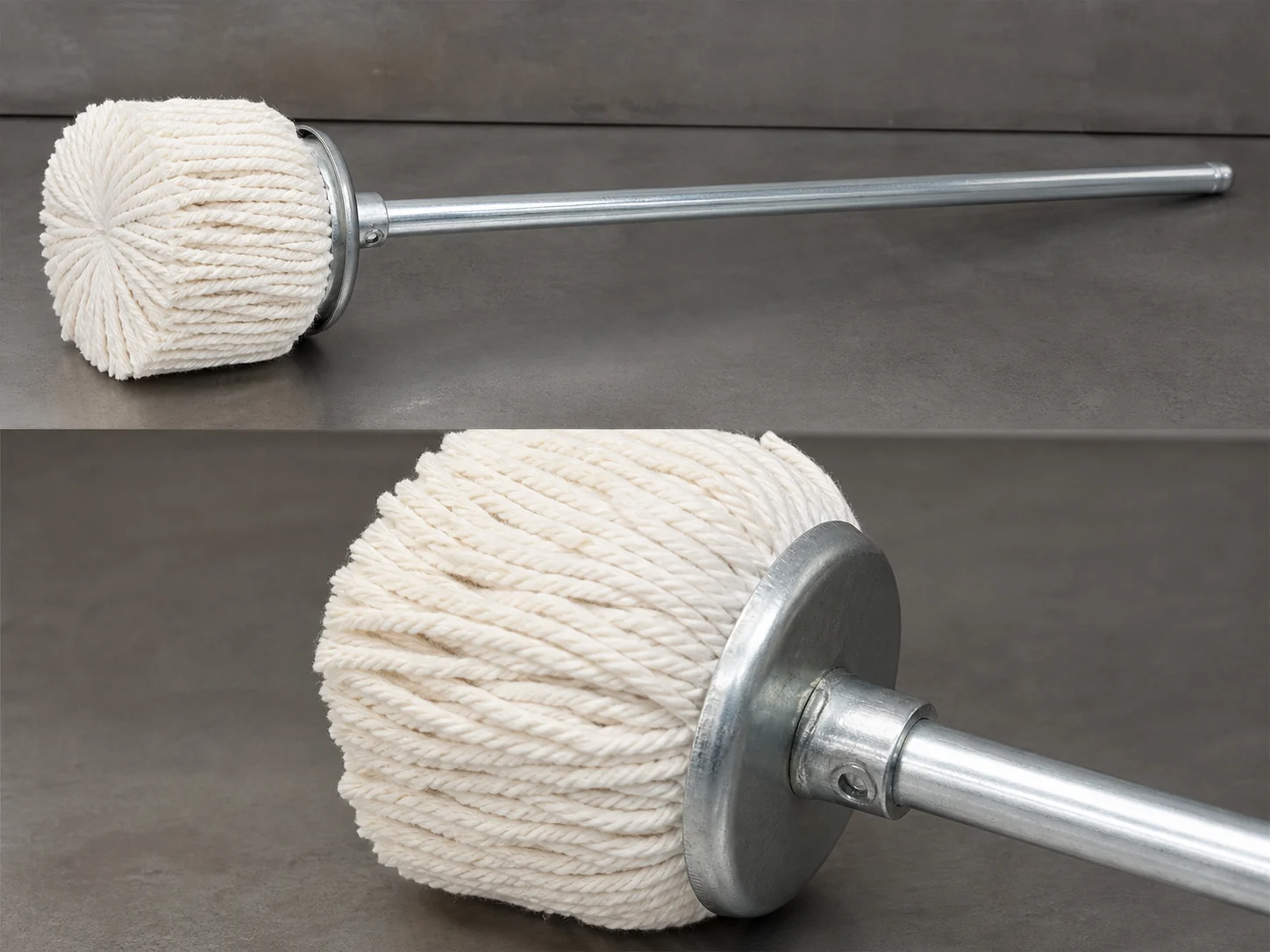
Cotton yarn industrial oil brush for green-tire release agents, retread conditioning fluids, mold-release and rubber process fluids.
Small brush
500 pcs
Minimum order
Held in one hand: tube, bottle, detail and swab brushes — including long-handled ones with a small head.
Production lead time, once the specification is confirmed
- Up to 500 pcsWithin 7 days
- 501–50,000 pcsWithin 14 days
- Over 50,000 pcsWithin 21 days
Peak season can extend these times; the shipping date is confirmed in writing with your quotation. Sampling and shipping are quoted separately.
An absorbent cotton yarn applicator for process fluids in tire manufacturing, retreading and mold care — release agents, conditioning and building fluids, and rubber dressings. The 50 mm round yarn head carries and releases fluid evenly on green-tire surfaces, casings and mold faces, while the fixed ferrule and rigid galvanized steel rod hold their shape through a production shift.
What can this brush do for you?
Carries lubricant in the yarn instead of leaving puddles
The dense cotton yarn bundle absorbs thin and medium-viscosity tire lubricants and release agents, then releases a controlled film as the operator swabs. You get even coverage on the bead and sidewall without overspray, drips, or wasted product pooling on the rim or bench.
Soft yarn ends protect raw rubber and mold surfaces
Cotton yarn ends are far more forgiving than stiff synthetic bristles or wire. They spread dressing and lubricant without scratching green tire beads, cured sidewalls, or precision-machined mold details.
Round head covers the full bead contact band in one pass
The standard 50 mm round swab follows the curved transition from bead toe to sidewall. A single stroke lays a continuous lubricant band across the contact zone, reducing the number of passes an operator needs per tire.
Galvanized steel handle resists corrosion in wet lubricant areas
Water-based tire soaps, release emulsions, and humid workshop air can quickly rust untreated steel handles. The galvanized coating protects the handle, so the tool remains clean and safe to grip through repeated wet use.
Fixed connection keeps the head from working loose at production speed
The yarn head is locked to the handle with a fixed ferrule connection. There is no wobble or rotation as the brush is dipped and swabbed all day, which keeps application pressure consistent from the first tire to the last.
What is a Cotton Yarn Industrial Oil Brush?
A cotton yarn industrial oil brush is a hand-guided swab applicator built around a dense bundle of cotton yarn, formed into a round head and fixed to a galvanized steel rod handle. It is used in tire mounting, tire manufacturing, retreading, and mold care to apply lubricants, mold release agents, and rubber dressings to curved rubber and metal surfaces.
In operation, the operator dips the yarn head into a lubricant container, allows the cotton fibers to absorb fluid, then presses and draws the head along the tire bead, sidewall, or mold face. The cotton wicks liquid into the fibers and releases it under contact pressure, leaving a thin, continuous film. The round head lets the brush work into concave bead pockets and around curved shoulders without digging in.
This is an application tool, not a scrubbing brush. It is designed to transfer and spread fluid onto surfaces that need protection from scratches. It should not be used to remove dried rubber, rust, or hardened release-agent buildup, and it is not intended for aggressive mechanical cleaning.
Technical Specifications
The table below lists the standard configuration for this cotton yarn oil brush. All dimensions and materials can be adjusted to match a specific tire size, mold profile, or lubricant system.
| Parameter | Standard Configuration |
|---|---|
| Head diameter | 50 mm |
| Head length | 50 mm |
| Head shape | Round swab |
| Yarn material | Cotton yarn, absorbent grade |
| Handle material | Galvanized steel rod |
| Handle length | 250 mm |
| Grip diameter | 6 mm |
| Connection | Fixed ferrule |
| Overall length | approx. 300 mm |
| Fluid compatibility | Water-based tire lubricants, mineral-oil dressings, rubber release agents |
| Service temperature | Up to 60°C / 140°F continuous for standard yarn and handle |
| Brush type | Custom Handheld Detail Brushes |
| How it is driven | Hand-guided |
| Cleaning target | tire manufacturing and green-tire preparation, retread and repair shop conditioning, and tire mold release-agent application |
| Surface or part | green-tire bead and sidewall, buffed casing, tread edge, and mold segment and vent detail |
| Residue or debris | lubricant, mold, dressing, release agent, oil, overspray, fiber, and rust |
| Mounting / connection | Fixed ferrule |
Where does this brush work best?
- Tire manufacturing and green-tire preparation — swabbing release agent onto bead areas, sidewalls, and tread zones before curing.
- Rubber process-fluid transfer on the line — laying conditioning, building or anti-tack fluid where a rigid rod and a fixed round head give the operator a repeatable stroke.
- Retread and repair shops — dressing buffed casings, sidewalls, and tread edges with conditioning or building fluids.
- Tire mold maintenance — applying release agent to curved mold segments, shoulder details, and vent areas where spray would overspray or miss.
- Industrial rubber part lubrication — applying water-based or oil-based dressing to seals, gaskets, and other accessible rubber components.
How do I choose the right one?
This brush has to match three things: the contact width you need to cover, the lubricant or dressing chemistry, and the operator’s working position. Working through these points before ordering prevents short-lived heads and uneven coverage.
Start with the application width
The standard 50 mm round head suits most green-tire, casing and mold-face bands. If you work with wide OTR, agricultural, or industrial tires, a 60–80 mm head covers the full band in fewer strokes. For narrow cycle, specialty, or recessed bead areas, a smaller 30–40 mm head keeps lubricant inside the intended zone instead of spilling onto the rim or tire face.
Match yarn density to the fluid viscosity
Thin water-based lubricants tend to run, so a medium-to-high density yarn head holds more liquid and controls release. Thicker paste lubricants require a shorter, denser yarn bundle that applies enough pressure to spread the paste without flattening completely. If the yarn is too long for a paste, it flops and smears; if it is too loose for a thin fluid, it drips.
Set handle length and grip for the workstation
The standard 250 mm handle with a 6 mm grip works well for hand swabbing at a tire machine or bench. For deep mold cavities, large-diameter tires, or elevated work positions, a longer handle reduces operator strain. High-volume production often benefits from an ergonomic overmolded grip or knurled section for wet, slippery hands.
Check fluid chemistry before committing to cotton
Cotton yarn performs well with water-based soaps, emulsions, and mineral-oil-based dressings. Strong solvents, ketones, chlorinated fluids, and aggressive acids or alkalis attack cotton fibers and can compromise the galvanized coating. If the fluid is solvent-based or chemically aggressive, select a nylon, PBT, or fluoropolymer applicator instead.
Know when this is the wrong tool
If the surface has dried rubber, cured release buildup, corrosion, or heavy dirt that must be removed before lubricant is applied, use a stiff nylon, PBT, brass, or steel brush first. The cotton yarn oil brush is for clean surfaces that need a protective, even fluid film — not for cutting through contamination.
Can I customize this brush?
Most cotton yarn oil brush orders are adjusted to the customer’s tire size, mold shape, or lubricant system. The standard configuration is a starting point, not a limit.
We can adjust:
- Head geometry — diameter from about 30 mm to 80 mm, yarn length from 30 mm to 100 mm, round, oval, or tapered profile
- Yarn — cotton grade, density, low-lint combed yarn, pre-washed yarn, or cotton-blend options
- Handle — length, diameter, galvanized or stainless steel, plastic-coated steel, wood, or ergonomic grip design
- Connection — standard fixed ferrule or threaded/replaceable head configuration when your process calls for it
- Identification — colored yarn band or handle mark to distinguish lubricant types, laser marking, pad printing, or custom packaging
- Packaging — bulk cartons, individual polybags, shelf-ready boxes, or project-specific labeling
To specify a custom brush, provide the tire size or bead width, the exact lubricant or release agent and its viscosity, the working temperature, preferred handle length and grip style, and whether operators need color coding to separate fluids. A sample or drawing of the application area helps us confirm the head shape and yarn density.
If your project also requires material documentation, inspection reports, or third-party testing support, we can assist with those requirements as part of the customization review.
How long does a cotton yarn industrial oil brush last before it needs replacing?
How much lubricant will the standard 50 mm head hold?
Absorption depends on yarn density and fluid viscosity, so there is no fixed milliliter rating. A practical way to set your production standard is to weigh a dry brush, dip it for a set time, reweigh, and record the grams of retained fluid. Use that value to keep application consistent between operators.
Will cotton yarn leave fibers on the tire bead or mold surface?
Combed, tightly wound cotton greatly reduces loose fibers, but natural fiber can release a small amount under repeated friction. For critical surfaces, specify a low-lint or pre-washed yarn grade, and inspect the surface after a short trial. If zero fiber transfer is required, an absorbent synthetic or non-woven applicator may be a better fit.
Can this brush remove old release agent or dried lubricant buildup?
No. The cotton yarn head is soft and designed to apply and spread fluid. Dried or baked-on residue needs a stiffer tool first, such as a nylon, PBT, brass, or steel brush. Use the cotton yarn brush afterward to apply the fresh lubricant or release agent.
What happens if the lubricant is heated?
Standard cotton yarn and the galvanized handle are suitable for fluids up to about 60°C (140°F). Above that temperature, cotton can degrade and the zinc coating may be affected. If your process uses heated lubricant, tell us the maximum temperature so we can select a more heat-resistant yarn or an alternative filament.
How can I tell when the brush head needs replacement?
Replace the brush when the yarn is flattened, matted, torn, or no longer releases an even film; when the head becomes loose at the ferrule; or when the operator starts applying extra lubricant to compensate for poor coverage. A worn head produces uneven bead coverage and increases product consumption.
Can the yarn head be replaced separately?
The standard configuration uses a fixed ferrule, so the head is not intended to be replaced while the handle is reused. If your production process wants a replaceable head, ask for a threaded or bayonet ferrule option during customization.
Guides that go deeper on this
Custom Manufacturing RFQ
Describe Your Application
Please share the brush dimensions, working area, residue type, material direction, quantity, and a drawing or photo for quotation.
Drawing or photo optional — it speeds things up, it does not gate the enquiry.
Custom Brush RFQ
Send Your Brush Project
Upload a drawing, product photo, or sample photo and provide the core dimensions and cleaning conditions.
“We need a brush to remove wet residue from a stainless steel conveyor, about 800mm wide. The current brush wears quickly. We can send photos.”
“We sell drinkware and need a cleaning brush to include with the product. Quantity around 5,000 pieces.”