
Custom Cleaning Brush
Injection Mold Cleaning Brush
Injection mold cleaning brush with brass wire or nylon PA filaments for cavity, vent, and parting line maintenance.
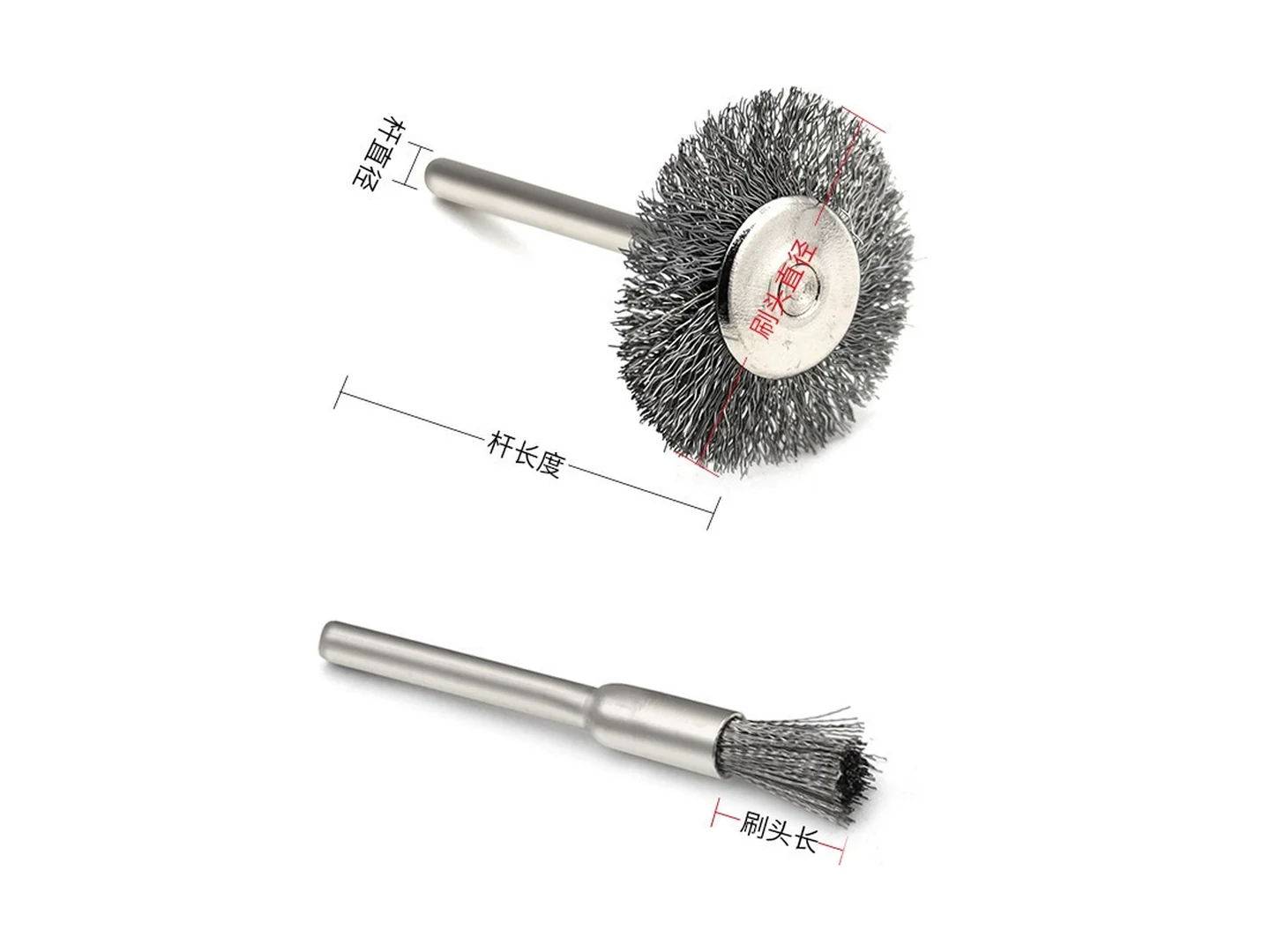
Small brush
500 pcs
Minimum order
Held in one hand: tube, bottle, detail and swab brushes — including long-handled ones with a small head.
Production lead time, once the specification is confirmed
- Up to 500 pcsWithin 7 days
- 501–50,000 pcsWithin 14 days
- Over 50,000 pcsWithin 21 days
Peak season can extend these times; the shipping date is confirmed in writing with your quotation. Sampling and shipping are quoted separately.
A hand-held maintenance brush built for cleaning injection mold cavities, parting lines, vents, and textured tool surfaces. Available with brass wire or nylon PA filaments, it removes release agent, polymer flash, light carbon, and oxide deposits without scratching hardened tool steel.
What can this brush do for you?
Brass wire lifts baked deposits without scoring mold steel
Brass is softer than hardened tool steel, so the wire filaments break up carbonized resin, oxidized release agent, and light polymer buildup while leaving the cavity surface intact. A steel wire brush risks scratches and dimensional changes on precision surfaces; brass gives the scrubbing action without the tool damage, so you can remove baked deposits during regular maintenance instead of waiting for a full regrind.
Nylon PA filaments protect polished and textured surfaces
On fine textures, polished areas, aluminum components, or soft metals where even brass might mark, nylon PA acts as a soft wiper. It removes fresh release agent, dust, and soft flash without altering the surface finish. This lets the same brush program cover both rugged steel cavities and delicate insert faces without changing the cleaning routine.
Narrow heads reach ribs, vents, and ejector pin holes
The working head can be built as a slim strip, round tuft, or angled profile, sized down to a few millimeters. That means you can clean clogged vents, the base of deep ribs, and around ejector pins—areas where a cloth, sponge, or general-purpose brush cannot apply consistent pressure. The brush goes where the residue actually collects.
Trim length and filament gauge control the scrubbing force
Short, stiff trim applies concentrated pressure for stubborn carbon or oxidized deposits. Longer, finer filaments conform to curved cavity walls and clean gently. Since filament diameter and trim length are selected for the job, the operator gets the right balance of aggression and surface safety—no need to press harder and risk damaging a vent or texture.
Built to hold up in a toolroom
Filaments are mechanically retained and the handle is selected for repeated use, solvent exposure, and hand fatigue. A brush that sheds bristles into the mold creates a new contamination problem; a solidly constructed brush keeps every filament in place and remains controllable over long cleaning sessions.
What is an Injection Mold Cleaning Brush?
An Injection Mold Cleaning Brush is a hand-guided cleaning tool used by mold maintenance technicians, toolroom staff, and setup operators to remove process residues from mold surfaces during maintenance, troubleshooting, or production changeovers. It typically consists of a rigid handle and a working head with brass wire, nylon PA, or a combination of filaments. The brush is applied with manual linear, rotary, or scrubbing motions, often dry or with a compatible mold cleaner or solvent.
Brass wire functions like a soft scraper: it fractures baked polymer, carbon, and oxide deposits that have adhered to the steel. Nylon PA works more like a gentle wiper: it lifts off fresh release agent, light flash, and loose debris without mechanical abrasion. Because the two filament types behave differently, the brush is usually matched to the specific mold material, surface finish, and residue condition.
The exact geometry depends on where the residue sits. A flat strip cleans parting lines and mold plates. A round or angled head reaches into cavities and bores. A narrow vent-style head gets into slots and ribs. The handle length and angle are chosen for the operator’s working position inside the open mold half.
This is a precision residue-removal tool. It is not a substitute for grinding, polishing, media blasting, or ultrasonic cleaning when those processes are required. It cannot correct surface damage or remove heavy weld spatter, scale, or deeply embedded contamination.
Technical Specifications
The values below represent typical standard production choices. Every dimension and material can be adjusted to your specific mold geometry, residue, and operating environment.
| Parameter | Specification / Options |
|---|---|
| Filament material | Brass wire (65/35 or 70/30 brass), nylon PA6/PA66, or mixed brass/nylon configuration |
| Filament diameter | Brass: 0.10–0.30 mm; Nylon: 0.20–0.60 mm (project-selectable) |
| Trim length | 10–30 mm; shorter trim for aggressive deposit removal, longer trim for soft conforming contact |
| Head geometry | Rectangular strip, round, angled, narrow vent profile, or custom molded to cavity contour |
| Working head width / diameter | 5–50 mm, sized to the mold feature or narrowest access opening |
| Overall length | 150–400 mm, selected for reach and operator grip |
| Handle material | Hardwood, polypropylene, ABS, or metal core with overmold; solvent-resistant grades available |
| Handle angle | Straight, 45°, 90°, or adjustable; matched to working position inside mold half |
| Operating temperature | Brass filament: up to 250°C intermittent; Nylon PA filament: up to 120°C; handle material may set a lower limit |
| Chemical exposure | Brass compatible with common mold cleaners and hydrocarbon solvents; nylon PA suitable for mild aqueous and aliphatic hydrocarbon cleaners—verify aromatic solvent compatibility |
| Brush type | Custom Handheld Detail Brushes |
| How it is driven | Hand-guided |
| Cleaning target | cavity and core, parting line and vent maintenance, and ejector pin and core pin area cleaning |
| Surface or part | molds, cavities, vents, parting lines, pins, profiles, holes, and slots |
| Residue or debris | mold, release agent, carbon, oxide, baked deposits, polymer flash, polymer residue, and scale |
| Mounting / connection | Fixed |
Where does this brush work best?
- Cavity and core cleaning: Removes release agent buildup and thin polymer residue from injection mold cavities and cores, especially on textured surfaces where residue locks into the grain.
- Parting line and vent maintenance: Cleans clogged vents, trapped flash, and grease from parting surfaces. Brass wire breaks up baked deposits that would otherwise reduce venting and cause short shots or burn marks.
- Ejector pin and core pin areas: Narrow head profiles reach around ejector pins, through pin holes, and into blind pockets where residue accumulates and causes sticking or pin breakage.
- Hot runner and gate areas: Removes degraded material and drool from nozzle faces and gate lands, provided the contacting surfaces are hardened steel or allow non-abrasive brushing.
- Fixture and tooling cleanup: Cleans clamping surfaces, jaws, and tool interfaces after machining, molding, or assembly operations to restore proper seating and alignment.
How do I choose the right one?
Start with the mold surface and the residue
Identify the mold material and surface finish first. For hardened tool steel (HRC 48 or higher) with baked carbon, oxidized release agent, or hard deposits, brass wire is the primary choice because it removes the residue without scratching the steel. For aluminum, beryllium copper, polished surfaces, or finely textured areas, nylon PA is the safer option and still handles fresh release agent and soft films. If you are unsure, test both on a non-critical area and inspect the surface after cleaning.
Match filament diameter and trim length to the job
Thicker filaments with a short trim produce more scrubbing force for stubborn carbon and oxidized material. Thinner filaments with a longer trim conform better to curved cavity walls and apply gentler pressure. For cleaning tight vents, ribs, and pin areas, choose a shorter trim with a narrow head so the filaments stay upright and reach the bottom of the feature instead of folding over.
Select a head shape that follows the feature
A flat strip works on flat parting lines, mold plates, and open surfaces. A round or angled head reaches into cavities, bores, and curved sections. A narrow vent profile gets into slots and between ribs. If the mold has complex geometry, a custom contour that mirrors the cavity shape improves contact and reduces the chance of missing residue in corners.
Size the handle for access and control
Longer handles reach into deep mold halves but reduce fine control; shorter handles give precision in open setups. The angle matters as much as the length. A straight handle suits vertical surfaces, a 45° handle works for angled faces, and a 90° handle helps when cleaning the sides of deep cavities. Choose based on the operator’s actual working position.
Check solvent compatibility
If the cleaning process uses solvents, confirm that both the filament and handle materials resist the specific chemical. Brass wire is generally compatible with most mold cleaners and hydrocarbon solvents. Nylon PA can soften or swell in strong acids, certain phenols, and some aromatic solvents. In those cases, select a solvent-resistant polymer filament or a brass configuration.
When to use a different tool
Do not use this brush for surface refinishing or material removal—that requires polishing stones, abrasive pads, or machining. If the mold has deep internal passages, water lines, or blind holes, ultrasonic cleaning reaches areas a brush cannot. For extremely narrow slots under 0.5 mm, a non-abrasive plastic pick or fine dental-style tool may be more effective. If the residue is heavy scale, weld spatter, or deeply embedded contamination, media blasting or chemical stripping will be faster and safer for the tool steel.
Can I customize this brush?
Yes. Injection mold cleaning brushes are built to match the mold feature, residue, and operator preference. To specify a custom configuration, provide the mold material and hardness, target feature dimensions (width, depth, radius), residue type, cleaning frequency, solvent or cleaner used, access space, and preferred handle form. A drawing, photo, or sample of the mold area helps us match the geometry.
Adjustable parameters include:
- Filament: Brass, nylon PA, stainless steel (for non-mold applications), blended, or alternate polymer; diameter, crimp or straight, trim length, tuft density
- Head: Shape, width, length, angle, single or multiple rows, tufted or continuous strip, custom contour to cavity profile
- Handle: Material, length, straight or angled, ergonomic grip, hanging hole, stamped or laser-marked identification
- Color and marking: Custom filament color, handle color, pad print, laser engraving, or color coding for different mold lines
- Packaging: Bulk, individual sleeve, kits with multiple head profiles, or project-specific packing
If your project requires material declarations, inspection data, third-party testing, or compliance documentation, we can assist with those requirements during the customization process.
Which filament survives the cleaning and still lasts on an injection mold cleaning brush?
How do I know whether brass or nylon is the right filament for my mold?
Check the mold material and surface finish. Hardened tool steel with baked carbon or oxide calls for brass wire because it is softer than the steel and will not score the surface under normal hand pressure. Aluminum, beryllium copper, polished, or finely textured surfaces are better served by nylon PA, which still removes fresh release agent and soft residue without mechanical marking. When in doubt, test on a non-visible area and inspect the surface under magnification.
Can brass wire scratch my mold?
Under normal hand pressure, brass wire will not scratch hardened steel because brass is significantly softer. However, aggressive pressure, heavy carbonized residue, or use on soft metals such as aluminum can cause marking or brass transfer. Always start with light pressure, inspect the surface, and increase force only if no change appears.
How do I clean deep narrow vents without damaging them?
Use a brush with a narrow head (5–15 mm width), a short trim around 10 mm, and a fine filament diameter. The short trim keeps the filaments upright so they work the bottom of the vent instead of bending over. A 90-degree angled handle improves access. If the vent is extremely narrow—under 0.5 mm—switch to a non-abrasive plastic pick or fine dental-style tool.
Does this brush replace ultrasonic cleaning of mold components?
No. The brush cleans accessible external surfaces, but ultrasonic cleaning reaches internal channels, threads, and blind holes through cavitation. For molds with water lines, deep holes, or complex internal passages, ultrasonic cleaning is often still required after brushing to remove loosened debris and residue from areas the brush cannot reach.
What should I inspect on the brush before each use?
Check for bent, flattened, or missing filaments, loose tufts, cracks in the handle, and any visible brass transfer or melted nylon. If filaments have lost their spring or are permanently deformed, the brush will not clean evenly and should be replaced. If the handle shows solvent damage, cracks, or softening, replace it to avoid breakage during use.
Can this brush be used with solvent?
Yes, but confirm compatibility first. Brass wire is compatible with most hydrocarbon and chlorinated solvents used in mold shops. Nylon PA can soften or swell in strong acids, some phenols, and certain aromatic solvents. For those environments, choose a brass configuration or a solvent-resistant polymer filament and handle. Always follow the solvent manufacturer’s safety guidelines.
Guides that go deeper on this
Custom Manufacturing RFQ
Describe Your Application
Please include the main sizes, application, residue, preferred material, interface, quantity, and any drawing or sample available.
Drawing or photo optional — it speeds things up, it does not gate the enquiry.
Custom Brush RFQ
Send Your Brush Project
Upload a drawing, product photo, or sample photo and provide the core dimensions and cleaning conditions.
“We need a brush to remove wet residue from a stainless steel conveyor, about 800mm wide. The current brush wears quickly. We can send photos.”
“We sell drinkware and need a cleaning brush to include with the product. Quantity around 5,000 pieces.”