
Custom Cleaning Brush
Long Stainless Flexible Brush
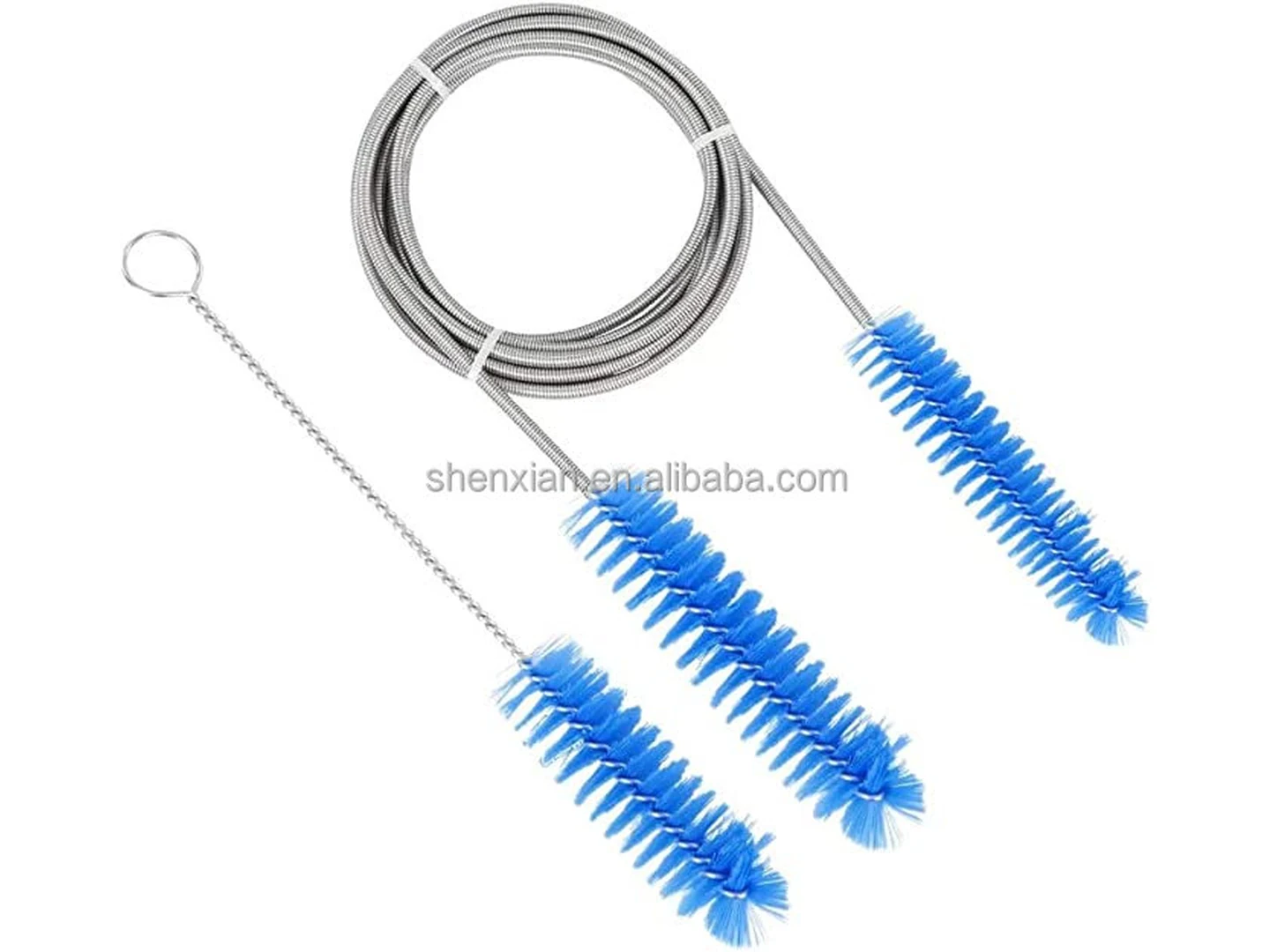
Long stainless flexible brush for duct, vent, chimney and pipe cleaning. A 316 twisted-wire core and nylon PA fill reach through elbows and 3 m runs.
Medium brush
100 pcs
Minimum order
Worked with two hands or on a pole: chimney, gutter and pond-filter brushes, discs, cups and tank brushes.
Production lead time, once the specification is confirmed
- Up to 100 pcsWithin 7 days
- 101–5,000 pcsWithin 14 days
- 5,001–50,000 pcsWithin 21 days
- Over 50,000 pcsConfirmed with your quotation
Peak season can extend these times; the shipping date is confirmed in writing with your quotation. Sampling and shipping are quoted separately.
A long stainless flexible brush for cleaning long, curved, or restricted passages such as dryer vents, chimney flues, HVAC ducts, and industrial pipe runs. The stainless steel twisted-wire core flexes through elbows and transitions while nylon fill sweeps lint, dust, soot, and loose deposits from the internal walls.
What can this brush do for you?
Flexes through elbows and offsets without binding
The 316 stainless steel twisted-wire core bends continuously along the passage axis, so the brush follows 45° and 90° elbows, gradual offsets, and gentle curves instead of hanging up. You can push, pull, or rotate the brush through transitions while keeping the fill in contact with the duct wall.
Reaches deep into long runs from one access point
Brush length and overall length can be built up to 3 meters. A single tool covers long dryer vent runs, tall flue sections, or extended ductwork without needing to open intermediate access panels. Threaded end fittings accept extension rods when the run is longer.
Nylon fill sweeps deposits without gouging the duct
PA nylon filaments remove lint, dust, soot, grease film, and loose scale from galvanized duct, stainless flue liners, and flexible vent material without scoring the surface. If you need to preserve the interior lining or prevent scratch sites that collect new debris, nylon is the correct contact.
Stainless core stays strong in damp, humid passages
The 316 stainless wire resists rust and weakening in moist dryer vents, humid exhaust ducts, and outdoor flues. A plain steel core would corrode over repeated use; the stainless core keeps its flex and structural integrity between jobs.
Continuous spiral contact for even cleaning
Filaments are secured in a continuous spiral along the core — single or double row depending on the requirement. That gives an even sweep across the full working length instead of leaving gaps between tufts, so the brush cleans the whole internal circumference in one pass.
What is a Long Stainless Flexible Brush?
A long stainless flexible brush is a hand-guided or drill-driven cleaning tool with a twisted-wire core made from 316 stainless steel and nylon PA filaments trimmed to a selected diameter. The twisted-wire construction is what gives the brush its flexibility while holding the fill securely in place.
It is built for long, curved, or restricted passages where a rigid rod brush cannot follow the contour of the duct, vent, flue, or pipe. The brush is inserted through an access opening and drawn through the run, usually while rotating. Rotation improves sidewall contact; push-pull motion alone also works for light deposits.
The brush removes loose debris by sweeping action. It is not designed to cut through baked-on, carbonized, or heavily mineralized deposits. For those, a wire fill or a preliminary chemical step is required. Also important: if the brush is driven by a drill, the rotation must be in the forward direction only — reversing can unwind the twisted-wire core and cause filament loss.
Technical Specifications
These are the standard build parameters for the long stainless flexible brush. All dimensions and materials can be adjusted to your passage size and operating conditions.
| Parameter | Standard / Options |
|---|---|
| Brush diameter | 25–400 mm typical; up to 500 mm for large flues on request |
| Brush length (fill section) | 150–2500 mm; longer possible with segmented construction |
| Overall length | 300–3000 mm including end fitting |
| Core material | Stainless steel 316 twisted wire |
| Fill material | Nylon PA; PA 610 or PA 612 available for high humidity |
| Fill pattern | Single spiral or double spiral |
| Flexibility | Continuous bending through 45° and 90° elbows; minimum bend radius scales with brush diameter |
| End connection | 1/4″ or 3/8″ male/female threaded adapter for extension rods or drill chuck |
| Operating temperature | Nylon fill suitable for up to 250°F (120°C) continuous; higher with alternative fill |
| Operating environment | Wet, humid, or mildly corrosive ducts; stainless core resists rust |
Where does this brush work best?
The brush is selected when the passage is longer than a hand brush can reach, includes bends, and the deposit is loose or lightly attached. Typical applications:
- Dryer vent cleaning — lint and fiber accumulation on 4-inch flexible and rigid vent runs, including transitions and elbows.
- HVAC and air duct cleaning — dust, debris, and loose insulation in round or rectangular supply and return ducts.
- Chimney and flue maintenance — light soot and loose deposits in lined flues where a wire brush would be too aggressive for the liner.
- Industrial exhaust and dust collection piping — fine dust build-up in long pipe runs with multiple bends.
- Equipment bores and process piping — long internal passages accessible from one end only, where a straight rod cannot negotiate the geometry.
For heavy creosote, hardened grease, or thick mineral scale, the nylon fill will not cut through. In those cases, choose a stainless steel or brass wire fill configuration, or perform chemical cleaning before brushing.
How do I choose the right one?
Start with the passage, not the residue. Five decisions define the correct brush.
1. Measure the smallest internal diameter
Select a brush diameter about 5–15% larger than the narrowest internal diameter so the fill presses against the walls. Oversize too much and the brush binds in elbows or folds over; undersize and the fill skims without cleaning.
2. Map the bends and offsets
If the run contains 90° elbows, confirm their centerline radius. A larger brush diameter requires a larger minimum bend radius. For tight elbows, reduce the brush diameter or specify a more flexible core. Send a simple sketch with bend angles and radii if you are unsure.
3. Match the fill to the residue and surface
Nylon PA is the right choice for lint, dust, light soot, grease film, and loose scale on galvanized, coated, or flexible duct surfaces. If the deposit is hardened, carbonized, or mineralized, specify stainless steel or brass wire fill — nylon will wear quickly and will not cut through hard material.
4. Set the reach from the access point
The overall length must reach the farthest point while leaving enough grip outside the access opening. For runs longer than a single brush, use threaded connectors to join extension rods or stack multiple brush sections.
5. Confirm the drive method and rotation
For power use, the end connection must fit your drill or drive shaft. Use a low speed and never reverse the rotation — reversing can unwind the twisted-wire core. For manual use, push-pull strokes work for light deposits; rotation gives more aggressive sidewall contact.
If the passage is under 25 mm in diameter, a smaller tube brush or mono-filament brush will fit better. If you need to remove hard creosote or scale, consider a steel wire fill or a scraper tool instead of nylon. If chemical compatibility is uncertain, send the safety data sheet for the cleaning chemical.
Can I customize this brush?
Yes. The brush is built around the dimensions and conditions of your specific passage. To define the custom configuration, provide the passage internal diameter, total length, number and radius of bends, surface material, residue type, drive method, and any chemical or temperature exposure.
We can adjust:
- Diameter and length — fill section length and overall length to suit the run.
- Fill material — nylon PA, PA 610/612, stainless steel, brass, or abrasive nylon.
- Fill density — single spiral, double spiral, or variable density zones.
- Core — stainless 304/316, galvanized steel (not for wet service), or polymer core for metal-free applications.
- End connection — threaded male/female, hex shank for drill, loop handle, or custom adapter.
- Fill trim — static trimmed, flagged, or spiral-trimmed tips for fine dust collection.
- Color and marking — custom fill color, brand marking, or laser/pad print on connector.
- Packaging — bulk, individual bag, kit with extension rods, or project-specific packing.
If your project requires material documentation, inspection support, or third-party testing, we can assist with those requirements during the customization process.
Which filament survives the cleaning and still lasts on a long stainless flexible brush?
How do I know if this brush will pass through my duct elbows?
Measure the duct internal diameter and the elbow centerline radius. The brush must bend to that radius without kinking. As a practical check, provide the duct dimensions and bend angles so we can confirm the minimum bend radius for your selected diameter, or request a short sample section for physical trial.
Can I use this brush with a cordless drill?
Yes, if the end connection has a drill-compatible shank. Use a low speed under 500 RPM and forward rotation only. Reversing the drill can loosen the twisted-wire core and cause filaments to shed.
How should I clean the brush after use?
Knock out loose debris, then rinse the fill with water and mild detergent if needed. Dry the brush before storage to prevent mildew on the nylon. If the filaments become matted or flattened, rotate the brush against a clean surface to restore the fill or replace the brush.
Does this brush remove creosote or hard mineral scale?
Nylon fill removes loose soot and light deposits but will not cut through glazed creosote or calcium/mineral scale. For those deposits, specify stainless steel or brass wire fill, or use a chemical cleaning step before brushing.
How can I tell when the nylon fill is worn out?
Inspect the brush after each job. Replace when filaments are missing from more than about 20% of the spiral, the brush diameter has visibly decreased, or the nylon feels brittle, cracked, or no longer springs back when bent.
What should I check before inserting the brush into a duct?
Make sure the access opening is large enough for the brush diameter and there are no protruding screws, nails, sharp edges, or collapsed sections that could catch the fill. Also confirm the end connection is tight if using extension rods.
Guides that go deeper on this
We have not written a guide specific to this one yet. The material that covers selection, filament, dimensions, maintenance and sourcing is collected in the technical resources library.
Custom Manufacturing RFQ
Describe Your Application
For an accurate quotation, please provide the main dimensions, material preference, working surface, residue, quantity, and a drawing or photo.
Drawing or photo optional — it speeds things up, it does not gate the enquiry.
Custom Brush RFQ
Send Your Brush Project
Upload a drawing, product photo, or sample photo and provide the core dimensions and cleaning conditions.
“We need a brush to remove wet residue from a stainless steel conveyor, about 800mm wide. The current brush wears quickly. We can send photos.”
“We sell drinkware and need a cleaning brush to include with the product. Quantity around 5,000 pieces.”