
Custom Cleaning Brush
15mm Brass Tube Brush
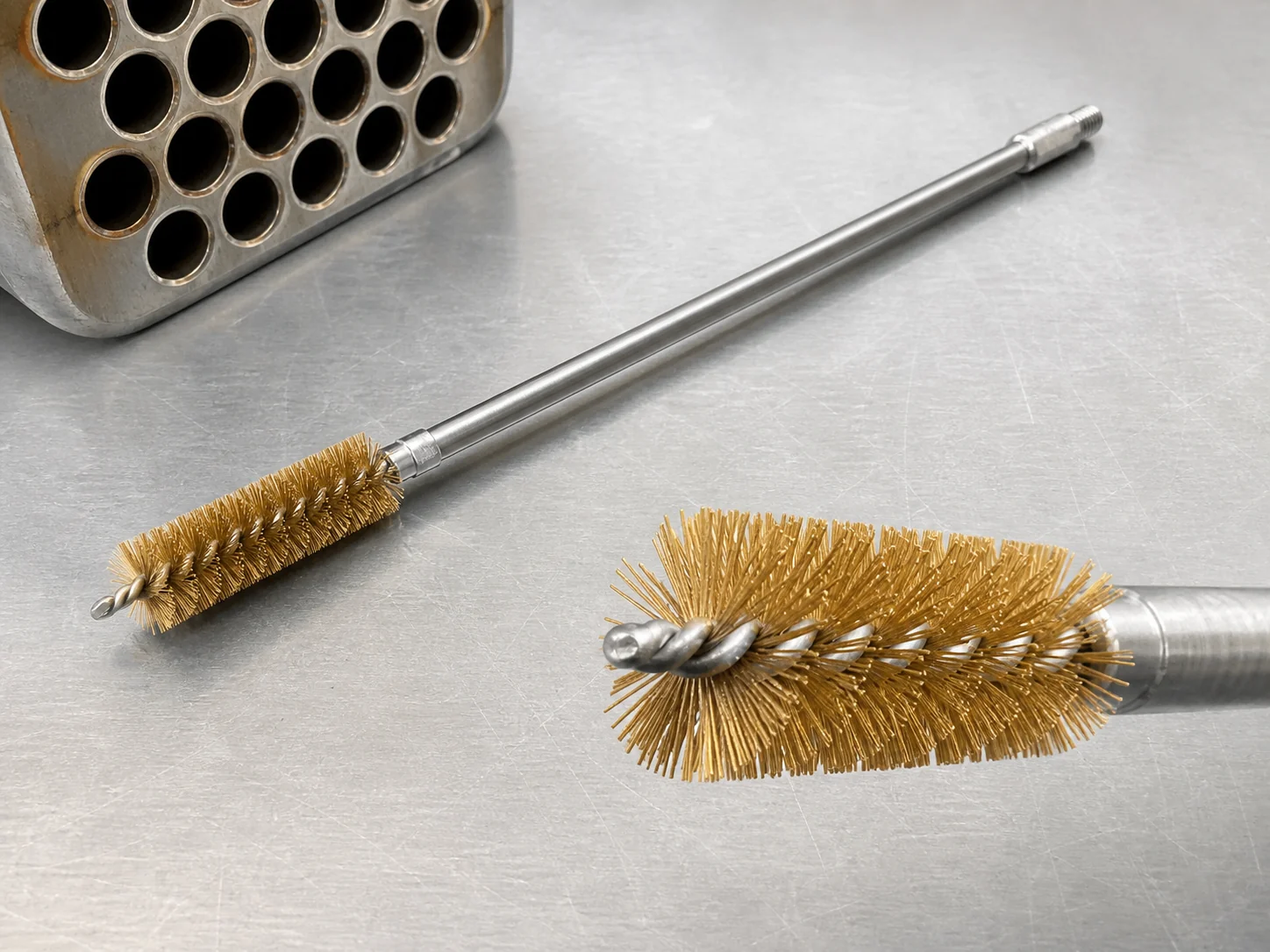
15mm brass tube brush with waved wire fill and threaded 304 stainless steel handle for small-bore heat exchanger and condenser tube cleaning.
Small brush
500 pcs
Minimum order
Held in one hand: tube, bottle, detail and swab brushes — including long-handled ones with a small head.
Production lead time, once the specification is confirmed
- Up to 500 pcsWithin 7 days
- 501–50,000 pcsWithin 14 days
- Over 50,000 pcsWithin 21 days
Peak season can extend these times; the shipping date is confirmed in writing with your quotation. Sampling and shipping are quoted separately.
A 15 mm nominal-diameter brass tube brush with dense waved brass wire fill and a threaded, removable AISI 304 stainless steel handle. It scrubs scale, corrosion film, light carbon, and process deposits from the internal walls of small-bore heat exchanger tubes, condenser passages, ports, and threaded bores without cutting into copper, brass, or cupronickel tube stock.
What can this brush do for you?
Contacts the full circumference of a 15 mm bore
The round head carries waved brass fill across the full diameter, so the bristle tips contact the top, bottom, and side wall as the brush is pushed, pulled, and rotated. In a 15 mm tube, a smaller brush only clears a narrow contact strip, while a larger brush cannot enter at all.
Removes fouling without aggressive metal removal
Brass wire is harder than soft deposits but softer than carbon steel and stainless steel. It breaks up scale, rust bloom, light carbon, oil residue, and process film while preserving the tube wall finish. This makes it a practical first-pass tool for copper, brass, bronze, cupronickel, and stainless steel tubes where a steel-wire brush would be too aggressive.
Waved fill gives more working points per stroke
The brass filaments are crimped or waved rather than straight, which creates a denser contact surface with more filament tips per centimeter. It removes a wider band of residue in each pass and reaches into minor pits and surface roughness better than straight fill in the same diameter.
Threaded removable head keeps maintenance cost low
The head separates from the 304 stainless steel handle at a threaded connection. Replace only the worn brush head, or keep one handle for multiple diameters and lengths across a tube bundle. The threaded interface can also accept an extension rod when the working length needs to go deeper into the exchanger.
Non-sparking contact for solvent and vapor environments
Brass wire does not produce the sparking risk associated with steel-on-steel brushing. That matters when the tube has recently carried solvents, fuels, or vapors and the work area calls for non-sparking hand tools.
What is a 15mm Brass Tube Brush?
A 15mm Brass Tube Brush is a round-head internal cleaning brush made with waved brass wire fill, a stainless steel stem or core, and a removable AISI 304 stainless steel handle. The standard configuration uses an 80 mm working head, a 180 mm handle, an 8 mm grip diameter, and a threaded connection. The finished tool is built to be pushed, pulled, and rotated by hand or at low speed inside a bore close to 15 mm in internal diameter.
In a heat exchanger or condenser, the head enters at the tube sheet face and follows the internal wall. The brass tips scrape and sweep deposits from the surface while the waved fill maintains contact through minor internal irregularities. The threaded connection lets the operator extend reach, swap heads, or attach the brush to a suitable driver in shops that use rotary cleaning.
This is a mechanical cleaning tool, not a chemical descaler or a replacement for hydroblasting. It works best on soft to moderate deposits that can be released by bristle contact. Hard mineral scale, baked carbon, or welded spatter will wear brass fill quickly and are usually handled better with a more aggressive brush type or a different cleaning process.
Technical Specifications
The standard build is listed below. Dimensions, fill, thread, and handle can be adjusted to a specific tube map or maintenance procedure.
| Parameter | Value / Options |
|---|---|
| Nominal head diameter | 15 mm |
| Head shape | Round |
| Working head length | 80 mm |
| Bristle material | Waved brass wire |
| Fill style | Waved or crimped for denser contact; density selected by deposit type |
| Stem or core | Stainless steel twisted-wire construction compatible with brass fill |
| Handle or base material | AISI 304 stainless steel |
| Handle length | 180 mm |
| Grip diameter | 8 mm |
| Connection | Threaded removable; thread size and pitch matched to application |
| Combined length | Approximately 250 to 260 mm depending on thread engagement |
| Tube ID range | Approximately 14.5 to 17 mm; confirm with a pin gage |
| Operating mode | Manual push, pull, and rotation; low-speed rotary with suitable shank |
| Brush type | Custom Tube & Pipe Bore Brushes |
| How it is driven | Hand-guided |
| Cleaning target | small-bore shell-and-tube heat exchanger, stainless steel tube, and hydraulic and pneumatic component bore cleaning |
| Surface or part | tubes, bores, walls, ports, internal walls, metal, passages, and sheets |
| Residue or debris | scale, carbon, corrosion, corrosion film, oil, process deposits, chips, and sludge |
| Mounting / connection | Threaded removable; thread size and pitch matched to application |
If the brush will be used with a chemical cleaner, confirm the full material combination, brass fill, stem wire, and handle, against the cleaning chemistry before the first production run.
Where does this brush work best?
- Small-bore shell-and-tube heat exchangers, condensers, evaporators, sample coolers, and oil coolers with straight tube IDs near 15 mm. The brush removes light to moderate scale, sludge, corrosion film, and oil residue before a chemical flush or hydrotest.
- Copper, brass, bronze, cupronickel, and stainless steel tubes where harder steel wire can leave groove marks or remove base metal. Brass is the conventional first-pass hand tool for these alloys.
- Hydraulic and pneumatic component bores, valve ports, cross-hole intersections, threaded openings, and blind holes around 15 mm where chips, dried oil, and light corrosion need to be cleared before reassembly.
- Pump, compressor, and heat exchanger rebuild benches where internal bores must be cleaned and verified before new seals or tube plugs are installed.
This is a straight-bore tool. U-bend sections, serpentine paths, and tube IDs under about 14 mm require a different brush construction or diameter.
How do I choose the right one?
Start with the fouled inside diameter, not the outside diameter or the pipe schedule. A pin gage or an ID micrometer reading at the tube sheet tells you what will enter and what will contact the wall.
- If the fouled bore is between about 14.5 and 17 mm, the 15 mm fill is the right working zone. If the bore is under 14 mm, go down a diameter. If it is over 17 mm, the brush will contact only part of the wall.
- When the bore is heavily scaled, consider a smaller first-pass brush or chemical softening before the 15 mm brass head. Forcing an oversize brush through scale bends stems and folds fill.
- Choose brass when the tube is copper, brass, bronze, cupronickel, or stainless steel, surface preservation matters, and the deposit is soft or moderate. If the deposit is hard, sintered, or deeply carbonized, a stainless steel or carbon steel wire brush will cut faster and last longer.
- Check the total reach. The standard 80 mm head and 180 mm handle reach about 250 to 260 mm. Tubes longer than that need a threaded extension rod, a longer handle, or a longer head.
- If using a rotary driver, confirm the thread size, shank fit, and speed limit with your maintenance procedure. Brass fill fatigues fast at high RPM or when kinked at the tube sheet edge.
- For polymer linings, PTFE sleeves, or other non-metallic tube materials, switch to a nylon, PBT, or similar non-metallic tube brush. Brass will scratch or transfer into soft non-metallic surfaces.
Can I customize this brush?
The standard 15 mm size is a starting point, not a fixed limit. For a specific tube map or maintenance procedure, we can adjust the head, fill, stem, handle, and connection around the same brass-wire platform.
- Head diameter and length: 15 mm standard; adjacent diameters, longer or shorter heads, and stepped head profiles can be produced.
- Brass fill: filament gauge, waved or straight fill, fill density, and brush stiffness can be tuned to the deposit.
- Stem or core: length, diameter, flexibility, 304 or 316 stainless steel, and single or double-stem construction.
- Handle: overall length, grip diameter, knurling, loop or T-handle end, and coating if needed.
- Connection: thread size and pitch, male or female thread, collar, and extension-rod interface can be matched to existing tools.
- Identification and packaging: color coding, laser marking, individual bags, bulk boxes, or kit packing.
For critical maintenance programs that require material certificates, inspection records, documentation, or third-party testing, provide those project requirements during inquiry. We can support the documentation package along with the brush build.
Which filament survives the cleaning and still lasts on a 15mm brass tube brush?
How do I know if the brush fit is too tight before forcing it into a tube?
Insert the head by hand at the tube sheet. It should slide in with firm, uniform drag and still allow rotation without the handle twisting or the stem bowing. If it requires hammering, the bore is fouled tighter than 15 mm or the wrong diameter was selected. Step down one size or soften the deposit first.
Can this brush be run on a drill or rotary driver?
Only if the threaded connection is matched to a suitable shank and the driver speed is kept low. Brass filament is softer than steel and will fatigue and shed if the head is over-rotated, run dry at high speed, or forced through a kinked entry. If you see brass slivers during the first pass, reduce speed and check the alignment.
Will the brass wire leave a color mark on stainless steel tube walls?
Brass is softer than stainless steel, so it normally removes surface film without cutting the wall. A faint golden transfer can occur where pressure is high or the fill is new. Wipe the test spot with a solvent and compare the wall under light. If the metal surface itself is unchanged and the color wipes away, it is transfer rather than scoring.
How do I know when the head is worn out?
Compare the used head diameter with a new one, or watch the fill profile. Replace the head when the filaments look flat, sparse, or heavily bent, or when repeated passes stop changing the residue color. Because the connection is threaded, a worn head can be replaced without discarding the handle.
What is the practical limit for this brush in heavily fouled tubes?
Use a short test section. If two or three strokes do not expose clean base metal on a small patch, the deposit is harder than brass fill can economically remove. Switch to a stainless steel or carbon steel wire brush, chemical softening, or mechanical drilling for that section.
What should I check after cleaning before putting the tube back into service?
Rinse the tube to remove loosened debris, then inspect with a borescope or a clean white swab. Check for broken brass filaments, remaining scale rings, and thread damage at the tube sheet. A clean swab without residue or metallic slivers is a simple pass check before reassembly.
Guides that go deeper on this
Custom Manufacturing RFQ
Describe Your Application
Please include the main sizes, application, residue, preferred material, interface, quantity, and any drawing or sample available.
Drawing or photo optional — it speeds things up, it does not gate the enquiry.
Custom Brush RFQ
Send Your Brush Project
Upload a drawing, product photo, or sample photo and provide the core dimensions and cleaning conditions.
“We need a brush to remove wet residue from a stainless steel conveyor, about 800mm wide. The current brush wears quickly. We can send photos.”
“We sell drinkware and need a cleaning brush to include with the product. Quantity around 5,000 pieces.”