
Custom Cleaning Brush
8-Piece Eco-Friendly Cup Cleaning Brush Set
Eight reusable cup, bottle, straw and valve brushes with nylon PP contact for drinkware and foodservice cleaning. Custom set composition and branding.
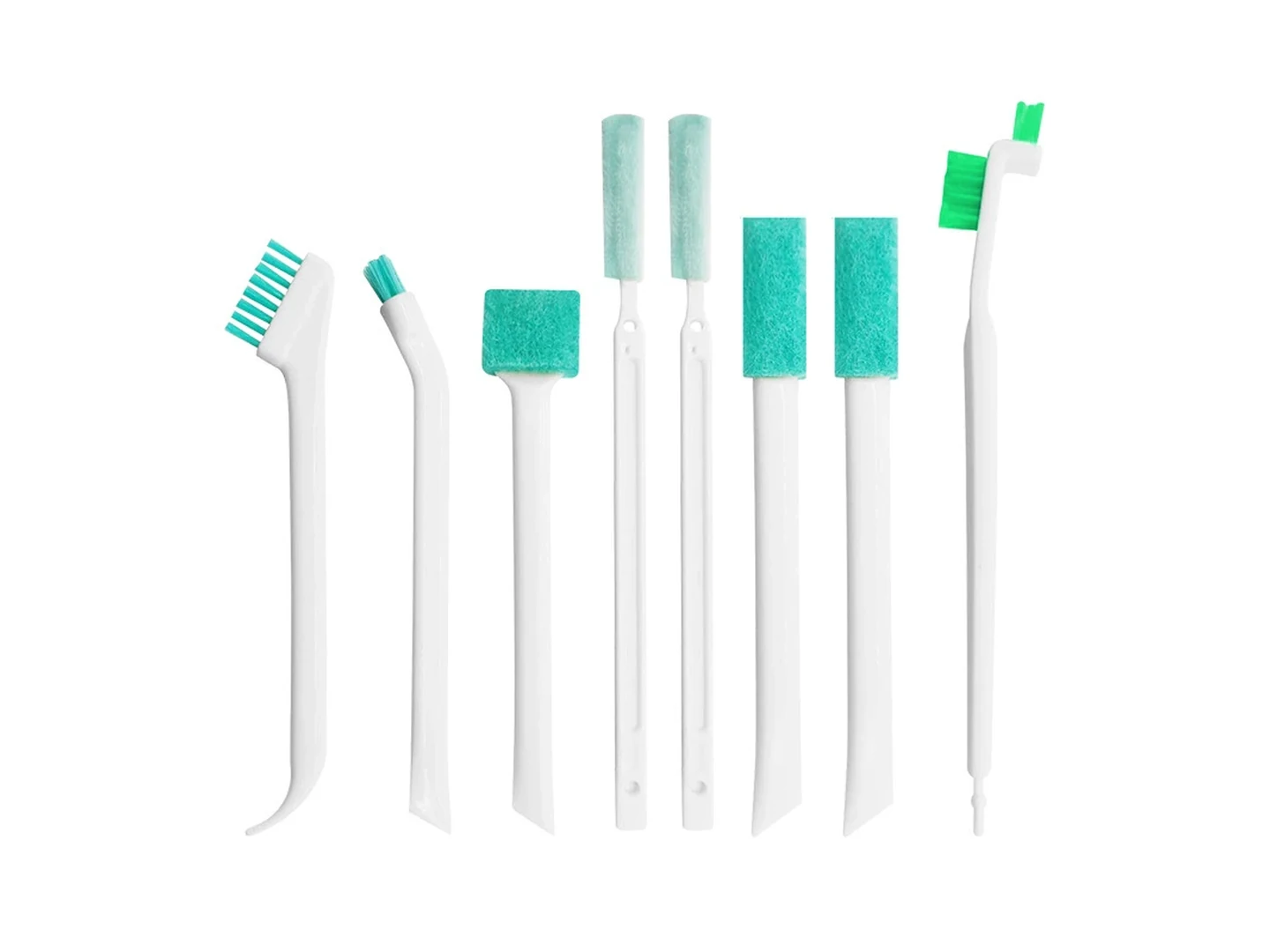
Small brush
500 pcs
Minimum order
Held in one hand: tube, bottle, detail and swab brushes — including long-handled ones with a small head.
Production lead time, once the specification is confirmed
- Up to 500 pcsWithin 7 days
- 501–50,000 pcsWithin 14 days
- Over 50,000 pcsWithin 21 days
Peak season can extend these times; the shipping date is confirmed in writing with your quotation. Sampling and shipping are quoted separately.
An eight-piece reusable cup cleaning brush set that pairs graduated head sizes, narrow-neck bottle brushes, straw brushes, and detail brushes to clean the complete interior and closure areas of cups, mugs, bottles, and hydration accessories. Each piece is matched to a specific opening and contact zone, so operators do not have to force one size into every vessel.
What can this brush do for you?
One Set Covers the Whole Cup, Not Just the Opening
The standard set carries head diameters around 10 mm, 15 mm, 20 mm, 30 mm, and 50 mm. A wide-mouth mug, a narrow-neck water bottle, a reusable straw, and a lid thread each get the piece sized for that opening. Using the wrong size folds bristles, leaves dead zones near the base, or scrapes the rim; using the matching brush keeps bristle contact continuous from sidewall to bottom curve.
Long, Tapered Heads Reach Deep Tumblers and Curved Bases
Working heads run 80–150 mm and overall lengths 150–250 mm, depending on the piece. The long reach lets an operator scrub the shoulder transition and curved bottom of a tall tumbler instead of cleaning only the mouth and upper wall, where residue is most visible.
Plastic Contact That Won’t Scratch Coatings or Logos
The brushes use PP filament for printed, coated, or soft plastic interiors and Nylon PA6 for smooth glass, glazed ceramic, and stainless steel. No exposed metal is present in the contact zone. The set gives a low-scratch cleaning path for internal coatings and brand artwork while still providing a firmer nylon option for glaze and metal.
Different Stiffness for Different Residue in One Kit
PP fill handles light beverage film, juice, cream, and milk residue. Nylon fill removes coffee oil, tea stain, and dried protein film. Instead of relying on one brush for every cup, the operator picks the piece whose stiffness matches the residue, which reduces repeat scrubbing and the chance of damaging a more delicate surface.
Valve and Spout Details Get Their Own Tool
A small-diameter detail brush and a silicone-tipped spout/valve brush clean bite valves, spout openings, o-ring channels, and nipple holes that the main cup brush cannot enter. Odor and biofilm start in these closures, and having a dedicated piece helps keep the lid from becoming the reason a cup is retired.
Reusable Multi-Piece System Lowers Replacement Waste
Instead of disposable sponges, short-life cotton brushes, and single-purpose cleaning picks, one kit covers the whole drinkware range and is built for repeated wet/dry cycles. Fewer discarded cleaning tools and fewer replacement orders mean a leaner consumables line for the restaurant, office, or washing station.
What is an 8-Piece Eco-Friendly Cup Cleaning Brush Set?
It is a hand-cleaning kit whose eight brushes are organized around the different access paths of a drinkware range. The typical standard set includes a wide-mouth cup and mug brush, a narrow-neck bottle brush, a small bottle or sippy-cup brush, a thin-neck valve brush, a straw brush, a lid/thread detail brush, a side/base scrub brush, and a silicone-tipped spout brush. Each piece contacts a different zone: body wall, shoulder, base, neck thread, straw lumen, or seal groove.
In use, the operator starts with warm water and mild detergent, selects the brush whose diameter matches the opening, and works in push, pull, and rotating strokes. Removable closures are cleaned separately with the detail or silicone-tip piece. The set is intended for hand washing; it is not an abrasive scrubber for baked-on food or a machine brush for automated lines.
The eco-friendly designation in this set refers to the reusable, low-waste structure of the kit, not to bamboo handles or natural bristle. The standard configuration uses BPA-free polypropylene handles and Nylon PA6/PA66 or PP filament, with a food-contact-suitable silicone tip on the valve piece. If a retail program needs bamboo, plant-fiber, or mono-material PP construction for recycling, that version must be specified as a project revision; do not assume those materials are present in the standard set.
Technical Specifications
The standard set composition below can be restructured for a customer order. Head diameter, working length, and material can be adjusted piece by piece.
| Piece | Typical Head Diameter | Working Length | Overall Length | Primary Material |
|---|---|---|---|---|
| Wide-mouth cup and mug brush | 50 mm | 120–150 mm | 200–250 mm | Nylon PA6 fill, PP handle |
| Narrow-neck bottle brush | 30 mm | 100–120 mm | 180–220 mm | Nylon PA6 fill, PP handle |
| Small bottle / sippy-cup brush | 20 mm | 80–100 mm | 150–180 mm | PP filament |
| Thin-neck / valve brush | 15 mm | 80–100 mm | 150–180 mm | PP filament or silicone tip |
| Straw brush | 10 mm | 80–100 mm | 150–200 mm | Nylon PA6 micro-bristle, PP core |
| Lid / thread / groove detail brush | 15 mm tapered or angled tuft | 30–50 mm | 100–150 mm | PP tufts |
| Side and base scrub brush | 40 mm | 80 mm | 150 mm | Nylon PA6 |
| Spout / bite-valve silicone brush | 8–12 mm molded tip | 50–80 mm | 150 mm | Food-contact-suitable silicone, PP handle |
| Brush type | Custom Bottle & Container Brushes | |||
| How it is driven | Hand-guided | |||
| Cleaning target | reusable water bottle, coffee and tea cup, and reusable metal cleaning | |||
| Surface or part | valves, metal, vessels, grooves, lumens, necks, glass, and shoulders | |||
| Residue or debris | coffee, coffee oil, cream, tea film, glaze, and baked-on food | |||
| Mounting / connection | 15 mm tapered or angled tuft |
Key operating parameters
| Parameter | Value / Options |
|---|---|
| Set quantity | 8 brushes |
| Filament material | Nylon PA6 or PA66, polypropylene PP; silicone tip on valve brush |
| Handle material | BPA-free polypropylene PP |
| Core / stem | PP core or plastic-coated stem; no exposed metal in contact zones |
| Head diameters | Standard pieces: 10, 15, 20, 30, 40, 50 mm; other diameters on request |
| Working length | 80–150 mm by piece |
| Overall length | 150–250 mm by piece |
| Use temperature | Hand washing from cold to about 80°C (176°F); not for boiling water or high-heat dishwasher drying |
| Chemical exposure | Resists coffee, tea, milk film, fruit juice, and mild household or foodservice detergents; avoid strong solvents and strong acids/alkalis |
| Packaging | Retail hang card, polybag, custom box, or bulk pack as configured |
Where does this brush work best?
- Reusable water bottles, sports bottles, and travel tumblers where the neck is narrower than the body and the base is hard to reach.
- Coffee and tea cups, ceramic mugs, and glass vessels where coffee oil, tea film, and cream residue settle at the base and shoulder.
- Baby bottles, sippy cups, and feeding accessories where small brushes and a silicone tip reach nipples, valves, collars, and baffle grooves without exposed metal.
- Reusable metal, glass, or silicone straws where residue and odor build up inside the lumen.
- Office break rooms, cafe counters, event cup programs, and foodservice dish stations that stock one shared cleaning kit for mixed cup inventory.
The set is a hand-cleaning tool for drinkware and small closures. It is not built for industrial pipe, chimney, drain, or machine-driven rotary cleaning.
How do I choose the right one?
Measure every opening before committing
List the mouth inner diameter, internal depth, neck inner diameter, and straw inner diameter for the cup range. A practical starting rule is to choose a head diameter around 70–90% of the container inner diameter so the bristles contact the wall with light pressure while the stem stays clear of the surface. If the stem scrapes, the brush is too large; if the head passes without sidewall contact, it is too small.
Match filament and stiffness to the surface
PP is the safer choice for printed, coated, acrylic, or soft plastic interiors. Nylon PA6 is the stronger scrubber for glass, ceramic glaze, stainless steel, and uncoated metal. Use the silicone tip or a PP detail brush on sealing surfaces such as o-rings, bite valves, and nipple openings. Always test the selected material on a non-visible area before a full rollout.
Verify reach for the tallest container
The brush should allow a comfortable grip outside the mouth while the working head touches the base. If the operator has to hold the brush close to the rim to reach the bottom, the cup needs a longer overall length or a different brush in the set.
Consider the full cleaning loop
If cups are washed after brushing in a high-temperature dishwasher, commercial sanitizer, or steam cycle, confirm whether the standard PP and nylon pieces tolerate that step. The standard set is intended for warm hand washing and air drying; machine-wash compatibility is a separate material selection.
A quick selection reference:
| Surface or condition | Suggested piece | Why |
|---|---|---|
| Printed or coated plastic cup, light film | 20–50 mm PP-filament brush | low-scratch contact on artwork and coatings |
| Glazed ceramic or glass, coffee and tea residue | 30–50 mm nylon brush | firmer scrubbing on smooth glaze |
| Narrow-neck bottle with 25–30 mm mouth | 20–30 mm bottle brush | passes the mouth and reaches the body |
| Reusable straw, 8–12 mm inner diameter | 10 mm straw brush | cleans the lumen without splitting the straw |
| Bite valve, nipple, o-ring groove | 15 mm detail brush or silicone tip | soft contact in sealing areas |
When this is not the right tool: baked-on or carbonized deposits should be removed by soaking or an abrasive pad; tubing below about 6 mm inner diameter needs a thin wire tube brush; industrial tanks and drums need longer custom handles; applications that demand single-use tools for contamination control should use disposable swabs instead.
Can I customize this brush?
The strongest customization variables are set composition, filament, length, and branding. To specify a custom configuration, provide the target container range including mouth inner diameter, internal depth, straw inner diameter, surface materials, typical residues, cleaning chemicals and temperature, and the desired packaging format. A dimension sheet or sample containers will shorten the sampling loop.
- Set composition — replace any piece, add duplicates of high-wear brushes, or build 4, 6, 8, or 10-piece configurations for a specific retailer or market.
- Filament and stiffness — Nylon PA6 or PA66, PP, crimped or straight fill, sanded tips, and color-coding by piece or by diameter.
- Handles and cores — PP colors, overmolded grip zones, hanging loops, extended overall length, plastic-coated wire or stainless core where metal is required.
- Valve / spout brush — silicone tip diameter, shape, and hardness, or a PP tuft replacement for non-silicone requirements.
- Branding and packaging — handle logo printing, private-label retail card, polybag, bulk carton, barcode, and insert cards.
- Project support — material declarations, inspection plans, and third-party testing can be arranged when the customer program requires documented compliance.
What size should a 8-piece eco-friendly cup cleaning brush set be, and how long does it last?
How can I tell if a brush diameter is right for a specific cup?
Slide the brush into the dry cup before adding water. The bristles should pass the narrowest opening without folding flat, and once inside the body they should touch the sidewall through the full stroke. If the handle or core scrapes the rim, the brush is too large; if it passes with no sidewall contact, it is too small for that vessel.
Can this set go through a commercial dishwasher?
The standard PP and nylon construction is intended for hand washing with warm water and mild detergent, followed by air drying. High-heat dishwasher cycles, steam sanitizing, or boiling can deform brushes and shorten bristle life. If the operation requires machine washing, specify a heat-tolerant material combination before ordering.
What should be removed before brushing a travel mug or bottle?
Remove the lid, gasket, valve, straw, and any detachable insert, and check that no food particle is trapped in the threads. Clean removable seals with the detail or silicone-tip brush and rinse each part separately. Brushing through an assembled lid leaves residue trapped in the closure and wastes the cycle.
Can the same brush be used for multiple cup types in a service line?
Yes, if the diameter and surface are compatible. A 50 mm nylon brush can clear coffee residue from glazed ceramic and glass, while a printed plastic tumbler should move to the PP-filament brush. Color-code handles by material or diameter to keep operators from mixing a nylon brush with a coated cup.
How do I know when a brush in the set needs replacement?
Check each piece weekly in a busy station. Replace any brush whose bristles stay flattened after rinsing, whose handle shows cracks or rough edges, or whose detail brush no longer enters valve openings. A brush that no longer springs back is leaving residue in the same areas it is supposed to clean.
Does brushing replace the rinse and sanitation step?
No. Brushing loosens and removes attached residue, but the cup still needs rinsing, and any required sanitizing or sterilizing must be performed as a separate step according to the process. The set is the mechanical-cleaning part of a complete washing sequence, not the entire sequence.
Guides that go deeper on this
Custom Manufacturing RFQ
Describe Your Application
Please share the brush dimensions, working area, residue type, material direction, quantity, and a drawing or photo for quotation.
Drawing or photo optional — it speeds things up, it does not gate the enquiry.
Custom Brush RFQ
Send Your Brush Project
Upload a drawing, product photo, or sample photo and provide the core dimensions and cleaning conditions.
“We need a brush to remove wet residue from a stainless steel conveyor, about 800mm wide. The current brush wears quickly. We can send photos.”
“We sell drinkware and need a cleaning brush to include with the product. Quantity around 5,000 pieces.”