
Custom Cleaning Brush
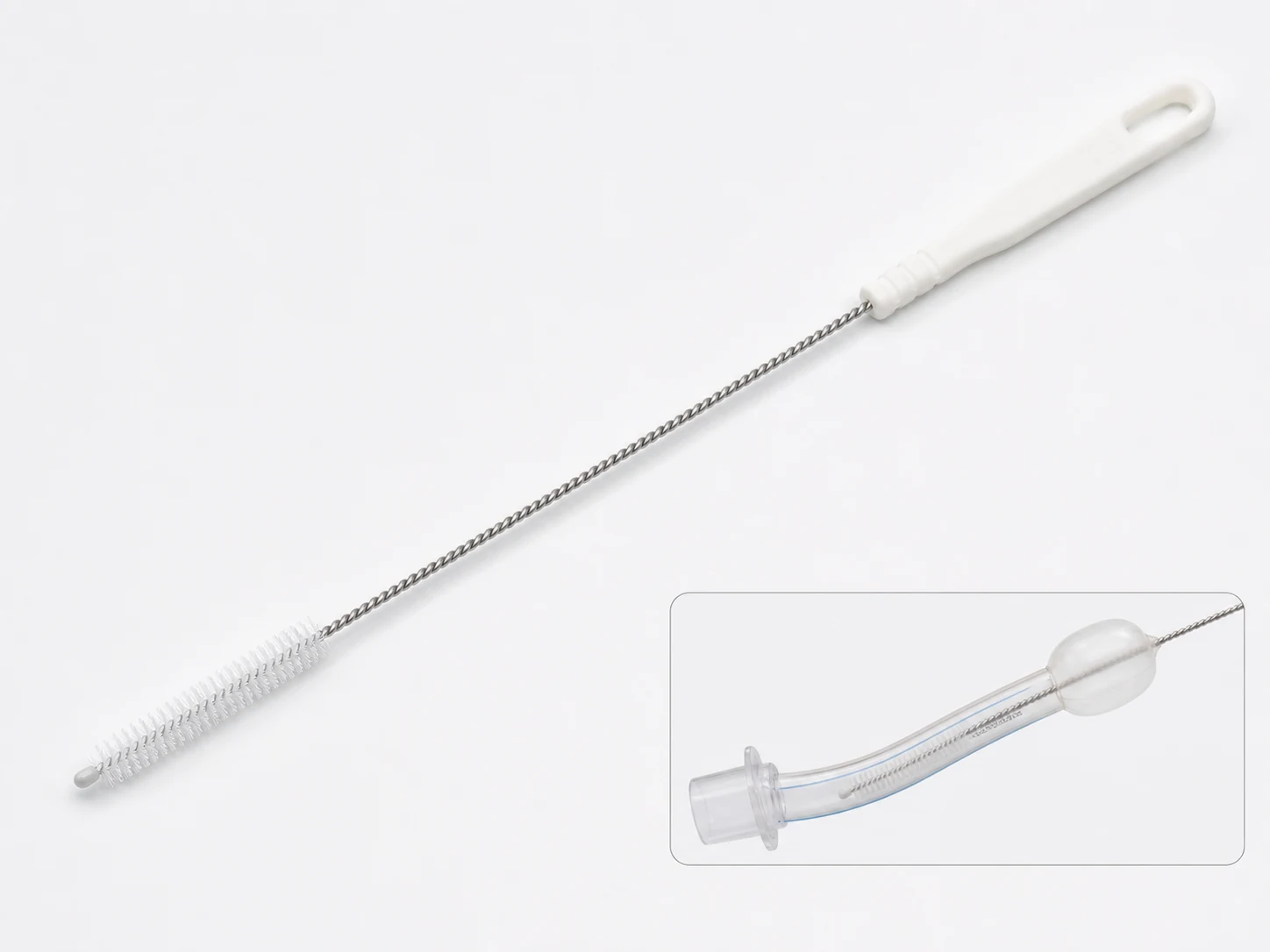
Endotracheal Tube Cleaning Brush
Endotracheal tube cleaning brush for reusable ETT reprocessing. Nylon PA bristles, PBT or stainless steel core, 6–14 mm diameters.
Small brush
500 pcs
Minimum order
Held in one hand: tube, bottle, detail and swab brushes — including long-handled ones with a small head.
Production lead time, once the specification is confirmed
- Up to 500 pcsWithin 7 days
- 501–50,000 pcsWithin 14 days
- Over 50,000 pcsWithin 21 days
Peak season can extend these times; the shipping date is confirmed in writing with your quotation. Sampling and shipping are quoted separately.
A flexible, lumen-specific cleaning brush for reusable endotracheal tubes and similar airway devices. It reaches the full internal length of the tube to remove mucus, secretions, and proteinaceous residue without scratching or abrading the tube wall.
What can this brush do for you?
Full-diameter contact on every pass
The brush diameter is matched to the internal diameter of your endotracheal tube, so each stroke contacts the entire circumference of the lumen. Unlike a generic pipe cleaner that only wipes a narrow track, this brush removes deposited secretions from all wall surfaces in a single pass.
Follows the natural curve of the tube without binding
The flexible core bends with the tube’s curvature, keeping the bristle tips in contact with the inner wall while preventing the core from pressing hard against the polymer surface. This reduces the risk of internal scratches or focal wear at the curve, which can become sites for biofilm attachment.
Nylon bristles lift dried mucus without abrading the tube
Nylon PA bristles are stiff enough to dislodge dried, protein-rich secretions, yet soft enough to avoid cutting or roughening PVC, silicone, or polyurethane tube walls. The result is effective soil removal that does not compromise the surface finish of the device.
Blunt, protected tip prevents distal-end damage
The working end is rounded or tufted with no exposed wire or sharp stem. It will not catch on the Murphy eye or puncture the distal opening, even when the brush is advanced to the full depth of the tube.
Rinses clean between uses
The nylon filament configuration sheds mucus and protein residue when rinsed under running water or in a detergent bath. The brush does not trap biological soil inside the bristle pack, which makes inspection and cleaning of the brush itself faster and more reliable.
What is an Endotracheal Tube Cleaning Brush?
An endotracheal tube cleaning brush is a hand-guided cleaning tool designed specifically for the internal lumen of reusable endotracheal tubes during the cleaning phase of medical device reprocessing. It is inserted through the connector end and advanced along the full length of the tube, typically with a back-and-forth and rotating motion, while the tube is immersed in an enzymatic or detergent cleaning solution.
The brush removes organic soil that manual flushing alone cannot dislodge: dried mucus, blood, saliva, and protein film that adhere to the inner wall after patient use. This mechanical action is an essential step before high-level disinfection or sterilization, because residual organic material can shield microorganisms from the disinfectant.
The tool is not a replacement for the validated cleaning protocol. It does not disinfect, and it is not designed to remove calcified deposits, hardened biofilm, or foreign objects. It is also not intended for single-use endotracheal tubes, which must not be reprocessed.
Technical Specifications
The table below lists the standard configuration range. Because every ETT model has different internal geometry, all dimensions and materials can be adjusted to your specific tube and reprocessing protocol.
| Parameter | Options / Values |
|---|---|
| Brush diameter | 6–14 mm standard; other diameters from 4–20 mm available on request |
| Working length | 20–300 mm (model dependent) |
| Overall length | Matched to tube length plus grip area; typically 100–450 mm |
| Core / stem | PBT polymer (non-metallic) or stainless steel wire (304/316) with optional polymer coating |
| Bristle material | Nylon PA; PBT or other polymer filaments available if specified |
| Bristle configuration | Straight, spiral, or flagged trim; fill density set per project |
| Tip design | Rounded, tufted, or ball-end; no exposed metal |
| Handle | None, loop, T-handle, or ergonomic grip; size color coding available |
| Chemical compatibility | Suitable for common enzymatic cleaners, neutral detergents, and intermediate-level disinfectants; confirm specific chemicals with the cleaner manufacturer |
| Operating temperature | Materials stable up to 80°C for typical rinse and thermal exposure; not intended for steam sterilization of the brush itself |
| Brush type | Custom Tube & Pipe Bore Brushes |
| How it is driven | Hand-guided |
| Cleaning target | hospital sterile processing departments reprocessing reusable pvc, medical device manufacturers cleaning newly molded endotracheal, and veterinary clinic and anesthesia practices reprocessing reusable cleaning |
| Surface or part | tubes, walls, lumens, tube walls, pvc, connectors, and terminals |
| Residue or debris | mucus, biofilm, protein, protein film, and blood |
| Mounting / connection | Threaded Removable / Fixed |
If a parameter in your RFQ differs from these ranges, request a custom configuration. We will provide a drawing for approval before production.
Where does this brush work best?
- Hospital sterile processing departments reprocessing reusable PVC or silicone endotracheal tubes between patient uses. The brush removes dried secretions from the full lumen before automated washer-disinfector cycles.
- Medical device manufacturers cleaning newly molded endotracheal tubes prior to packaging and terminal sterilization. The brush removes mold-release residue and particulate from the internal surface.
- Veterinary clinics and anesthesia practices reprocessing reusable airway tubes for animal patients, where mucus and saliva deposits must be removed without damaging the tube.
- Training and simulation centers maintaining reusable airway trainers and manikin tubes that require regular lumen cleaning between sessions.
How do I choose the right one?
Start with the internal diameter of the tube
Measure the narrowest internal diameter of the endotracheal tube. Choose a brush diameter that is 1–2 mm smaller than that measurement. A brush that is too large will bind, fold, or require excessive force, which can distort the tube. A brush that is too small will leave residue on the wall because the bristles barely make contact.
Select the core material for your protocol
If your reprocessing procedure prohibits metal or the tube wall is soft silicone, choose a PBT non-metallic core. If the tube is longer than 300 mm and needs a stiffer push-through action, a stainless steel core with a polymer coating may be the better choice. Always inspect any metal-core brush for exposed wire before use, because a damaged coating can scratch the lumen.
Match bristle stiffness to the residue and tube material
Medium-stiffness nylon is effective for dried secretions on PVC tubes. For silicone tubes or when the surface is more delicate, use softer nylon or flagged tips that provide cleaning action with less point pressure. Do not use wire bristles for endotracheal tube cleaning; they will leave scratches that become harborage points for biofilm.
Set the working length to reach the distal tip
Measure the distance from the connector opening to the distal opening of the tube. Add at least 20 mm of grip or handle area beyond that. The brush should reach the distal tip without the operator having to force it, and the blunt tip should not protrude more than a few millimeters beyond the tube end during normal strokes.
Consider workflow and identification
Color-coded handles or marking bands help prevent using the wrong diameter on the wrong tube size. Loop handles allow hanging for drying; T-handles improve control for longer tubes; a no-handle configuration is used when the brush is mounted in a semi-automated cleaning fixture. Choose the option that matches your process flow.
When to use a different cleaning method
Do not use this brush on single-use endotracheal tubes; they are not designed for reprocessing. If the residue is calcified, mineralized, or hardened biofilm, brushing alone will not remove it—use an enzymatic soak or ultrasonic pre-treatment first, then brush. For tube inner diameters below 5 mm, request a custom smaller diameter, because the standard range starts at 6 mm and using an oversized brush in a neonatal tube will damage it.
Can I customize this brush?
Endotracheal tube dimensions and reprocessing protocols vary widely, so the brush is configured to your specific device. To build the correct brush, provide the ETT model, internal diameter, length, tube material, reprocessing chemicals, wash temperature, and handling preference. A drawing or sample tube accelerates the process.
We can adjust:
- Diameter and length — brush diameter from 4–20 mm, working length from 20–300 mm or longer, overall length per your grip requirement
- Core and bristle materials — PBT or stainless steel core; nylon PA, PBT, or other specified polymer filaments; bristle diameter, trim, and density
- Tip geometry — rounded, tufted, ball-end, or a custom molded tip for special distal features
- Handle and marking — no handle, loop, T-handle, ergonomic grip, color coding, pad print, or laser marking for size identification
- Packaging — bulk, individually bagged, or assembled into reprocessing kits
If your reprocessing validation requires material declarations, inspection reports, cleaning efficacy test support, or third-party testing documentation, we can assist with those project-specific requirements during the customization process.
When is an endotracheal tube cleaning brush worn out rather than just dirty?
How do I know the brush is removing protein residue, not just loosening it?
After brushing and rinsing, swab the internal lumen near the distal end with a sterile cotton swab and test for residual protein using your facility’s protein detection method. If the test remains positive, increase brush contact (larger diameter or higher fill density), extend brushing time, or verify that the detergent concentration and temperature are correct.
Can this brush be used with enzymatic cleaners?
Yes, nylon PA and PBT are generally compatible with the enzymatic detergents and neutral pH cleaners used in medical device reprocessing. However, confirm the specific cleaner’s temperature and concentration limits with the cleaner manufacturer, and avoid prolonged exposure to strong acids, strong alkalis, or organic solvents unless the brush material is explicitly specified for those conditions.
Is the brush reusable or single-use?
Both configurations are available. A reusable brush must be thoroughly rinsed, disinfected according to your facility protocol, dried, and inspected after each use. A single-use brush is discarded after one cleaning procedure. Choose based on your reprocessing SOP and risk analysis.
What should I inspect before each use of a reusable brush?
Check for bent or kinked cores, missing or frayed bristles, exposed wire on metal-core brushes, and a tip that has lost its rounded profile. If any of these conditions are present, discard the brush. A damaged brush can scratch the tube or leave bristle fragments inside the lumen.
Can I clean a cuffed endotracheal tube with this brush?
Yes, but the brush is intended only for the internal lumen. The cuff and pilot balloon are cleaned separately according to your protocol. Do not force the brush past the distal tip or the Murphy eye if resistance is felt; that indicates a diameter mismatch or an obstruction inside the tube.
Does brushing replace the disinfection or sterilization step?
No. Brushing removes visible and microscopic organic soil from the lumen, but it does not disinfect or sterilize. The cleaned tube must still undergo your validated high-level disinfection or sterilization process. Brushing is a preparatory step that makes the subsequent process effective.
Guides that go deeper on this
Cannula and Endotracheal Tube Brushes: Protecting the Channel
Read this guideGuideCustom Brush Sampling and Validation Plan
Read this guideGuideHow to Maintain Chimney and Boiler Tube Brushes in Production
Read this guideGuideHow to Maintain Tube Brushes for Plastic Processing Lines
Read this guideCustom Manufacturing RFQ
Describe Your Application
Please share the brush dimensions, working area, residue type, material direction, quantity, and a drawing or photo for quotation.
Drawing or photo optional — it speeds things up, it does not gate the enquiry.
Custom Brush RFQ
Send Your Brush Project
Upload a drawing, product photo, or sample photo and provide the core dimensions and cleaning conditions.
“We need a brush to remove wet residue from a stainless steel conveyor, about 800mm wide. The current brush wears quickly. We can send photos.”
“We sell drinkware and need a cleaning brush to include with the product. Quantity around 5,000 pieces.”