
Custom Cleaning Brush
Micro Tube Brush
Custom micro tube brushes for 1–12 mm bores, ports, threads, blind holes, and cross-drilled passages. PBT, nylon, PP, or wire fill; stainless stems.
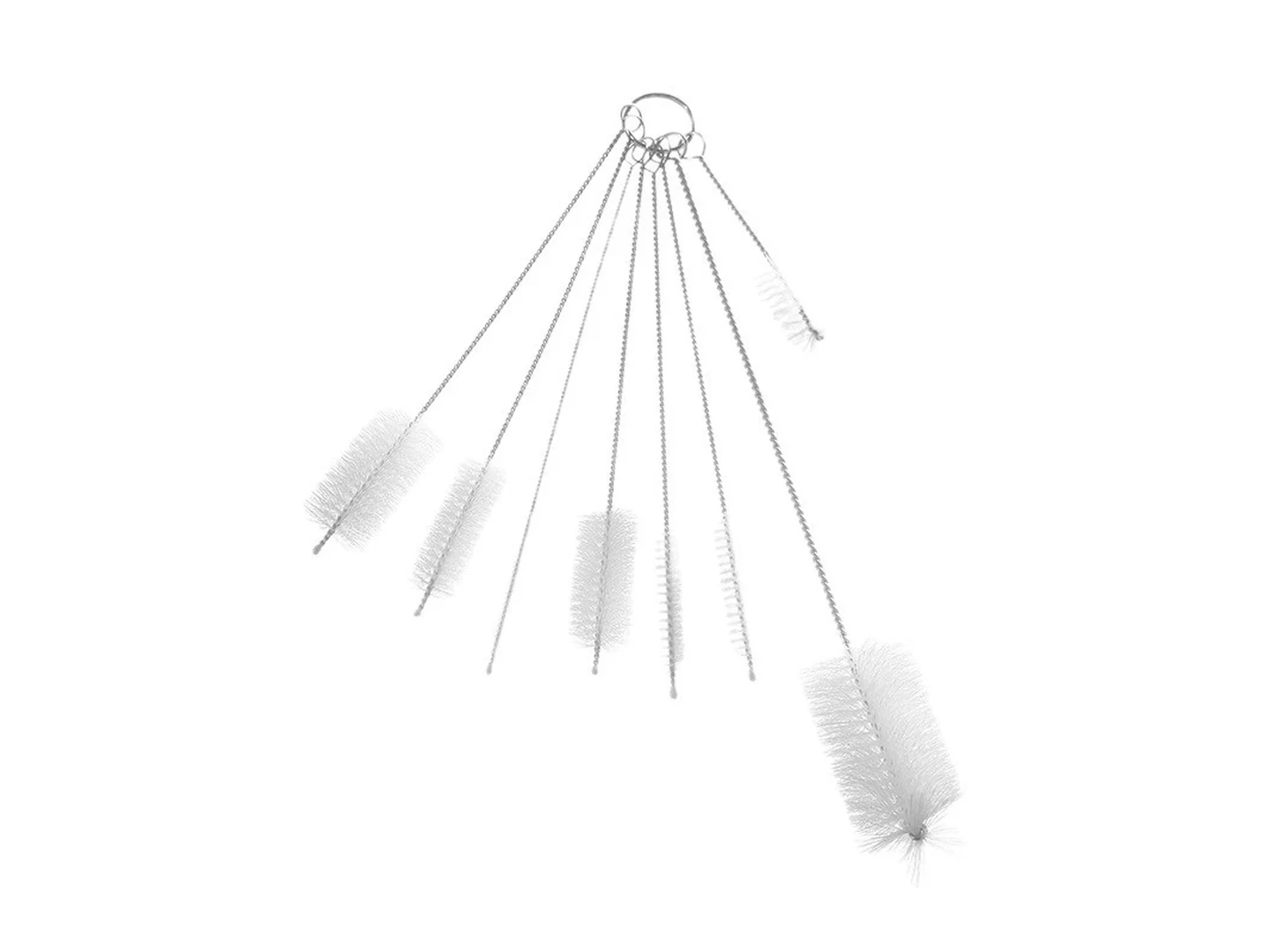
Small brush
500 pcs
Minimum order
Held in one hand: tube, bottle, detail and swab brushes — including long-handled ones with a small head.
Production lead time, once the specification is confirmed
- Up to 500 pcsWithin 7 days
- 501–50,000 pcsWithin 14 days
- Over 50,000 pcsWithin 21 days
Peak season can extend these times; the shipping date is confirmed in writing with your quotation. Sampling and shipping are quoted separately.
A micro tube brush engineered for bores, ports, valve bodies, and internal passages from 1–12 mm. Fine polymer or wire filaments on a narrow twisted stem reach threads, blind holes, cross-drilled ports, and tapers while releasing chips and process deposits rather than packing them in.
What can this brush do for you?
Fits Inside Passages Other Cleaning Tools Cannot Enter
Brush diameters from 1 mm let the brush follow small bores where swabs, pipe cleaners, and rolled cloth either wedge or cannot make contact. The narrow stem and helical filament pad scrub the full internal wall of valve spools, injector bodies, capillary tubes, and small fittings without forcing the opening larger or leaving dead spots in the bore.
Cleans Thread Roots, Cross-Holes, and Tapers in One Stroke
The twisted filament pattern is not a solid cylinder; individual filament tips flex into recesses. As the brush is pushed, pulled, and rotated, the filaments sweep chips out of thread roots, behind intersecting cross-holes, and down tapered seats. A plain round brush or foam swab glides over these areas.
Loosens Chips Without Packing Them into Blind Corners
Polymer fills like nylon, PBT, and polypropylene wipe and entrain loose chips, oil, coolant, and powder rather than hammering them into the bottom of a blind hole. The brush still needs a flush or vacuum to remove the debris, but the filament action leaves the residue loose instead of compacted.
Contact Pressure You Can Specify
Filament diameter (0.08–0.25 mm), fill density, and brush oversize are selected for the bore. Near-size contact is used for light film wiping; 5–20% oversize gives controlled scrubbing action. Wire fills get lower interference to avoid gouging soft aluminum or brass substrates.
Long, Flexible Reach for Buried Ports
Overall lengths to 450 mm plus loop, threaded, and flexible extension stems allow the brush to service ports buried inside assemblies. The operator can clean a deep lube passage or pilot valve bore without full teardown of the hydraulic block or manifold.
Materials Matched to the Process Fluid
Stainless steel or brass stems and chemically compatible fill materials handle oil, coolant, water-based detergents, and light solvents. The brush does not rust in wet processes or shed fibers into clean hydraulic or fuel circuits.
What is a Micro Tube Brush?
A micro tube brush is a twisted-in-wire cleaning tool built for small internal passages. A fine wire stem holds short, fine filaments in a continuous helical pattern, creating a brush that is narrow enough to enter a small bore but flexible enough to contact the wall. The stem may be a single length of wire, a doubled loop, or a custom-ended shaft; the fill may be synthetic polymer or metal wire depending on the deposit.
In use, the operator inserts the brush into the bore and works it with a combination of push, pull, and rotating strokes. The helical filaments sweep the circumference of the hole, flex into threads and cross-drilled intersections, and capture loose debris between the filament tips. The brush is pulled back through the passage, carrying material out with it. For straight-shank versions, low-speed rotary operation is possible, but most cleaning is done by hand to preserve feel and avoid over-scoring.
The product is not a bore honing tool or a substitute for flushing. It removes attached debris and works it free; the process fluid or a cleanup flush still has to carry the loosened material out of the passage. It is also not intended for large-diameter pipe cleaning or open surface scrubbing; those jobs need a brush with a larger working face.
Technical Specifications
Dimensions below are a reference range; each brush is normally matched to a specific bore diameter, passage length, and residue. Not all combinations apply to every project.
| Parameter | Standard Options / Range | Selection Note |
|---|---|---|
| Brush diameter (overall OD) | 1–12 mm | Sized against hole ID or passage minimum diameter. |
| Brush section length | 25–127 mm | Length of filament-covered cleaning area. |
| Overall length | 100–450 mm | Includes handle/stem length; matched to depth plus operator grip. |
| Filament diameter | 0.08–0.25 mm | Smaller for finer finishes and high filament count; larger for stiffer wiping. |
| Fill material | Nylon (PA), PBT, PP, brass, stainless steel, carbon steel, abrasive nylon | Choose by chemical environment, surface finish limit, and deposit type. |
| Stem style | Single stem, double stem (twisted handle), threaded, loop, ring, flexible extension | Matched to access route, retention need, or machine interface. |
| Stem material | 304 stainless steel, brass, or project-specific metal/coating | Brass useful for softer substrates; stainless for wet or corrosive environments. |
| Contact setting | Near-size for wiping; 5–20% oversize for polymer scrubbing; lower interference for wire fill | Oversize measured against nominal bore ID; not against brush core. |
| Fill pattern | Helical twisted filament | Density and trim length can be adjusted for blind holes, threads, and long strokes. |
| Brush type | Custom Tube & Pipe Bore Brushes | |
| How it is driven | Hand-guided | |
| Cleaning target | hydraulic and pneumatic valve body, fuel system component, and precision machined part cleaning | |
| Surface or part | bores, passages, holes, ports, tubes, valves, tapers, and thread | |
| Residue or debris | chips, carbon, process deposits, mold, loose debris, coolant, oil, and leaves | |
| Mounting / connection | Threaded Removable / Fixed |
All values in the table are typical reference ranges. For a specific project, we will set brush diameter, fill material, filament size, and stem configuration from your bore drawing or sample part.
Where does this brush work best?
- Hydraulic and pneumatic valve bodies — spool bores, pilot orifices, cross-drilled galleries, and seat areas after machining, deburring, or lapping; removes chips, honing compound, and assembly debris.
- Fuel system components — injector bodies, carburetor passages, nozzle tips, and metering ports; polymer fills lift varnish and carbon; wire fills cut hardened fuel deposits where surface permits.
- Precision machined parts — blind tapped holes, small sensor ports, dowel pin bores, and cooling channels in molds and tooling; removes chips before final assembly or coating.
- Medical and laboratory devices — reusable instrument channels, cannula, needle hubs, and fluid path bores; PP or nylon fills selected for low shedding and chemical compatibility with cleaning agents.
- Small engine and small arms — gas ports, firing pin channels, carburetor jets, and lube passages; long reach versions clean without complete disassembly.
- Additive manufacturing and microfluidics — support material residues in internal channels, manifolds, and small manifold bores; near-size polymer fill protects as-printed surface roughness.
How do I choose the right one?
Start with the bore, not the part name
Measure minimum internal diameter, bore depth, and any cross holes, undercuts, tapers, or blind ends. Brush OD is selected against the smallest accessible diameter; oversize is based on nominal bore ID, not core diameter. Use pin gages to confirm.
Match the filament to the residue and the finish requirement
- Polymer fill (nylon, PBT, PP): light films, oils, coolants, powder, soft varnish; preserves fine machine finishes; use near-size or 5–20% oversize.
- Brass fill: soft metal deposits, light scale, carbon; good for aluminum or brass bores without deep scoring; use lower interference.
- Stainless steel fill: hard deposits, rust, carbon, polymer contamination; use when bore material is steel and scratching is acceptable.
- Carbon steel fill: maximum aggression on ferrous parts; avoid stainless or aluminum unless a secondary finish is acceptable.
- Abrasive nylon: surface preparation or stubborn coating removal; test on a scrap part first.
Choose stem and end style for access
Single stem for straight push-pull; double stem for better torque and durable gripping; loop or ring for hanging or lanyard retention; threaded ferrule for attaching to a rod or machine; flexible extension for curved access into manifolds. Ensure overall length leaves enough grip outside the part.
Consider hand vs. rotary operation
Hand strokes give feedback and are preferred for precision bores. For rotary cleaning, choose a straight-shank version with balanced fill, low speed, and confirm the fill will not flare. Wire fill at high speed can score the bore or throw broken wire strands.
When a micro tube brush is the wrong tool
If the passage ID is under 1 mm or the entry is very small, use a pipe-cleaner swab, chemical flush, or ultrasonic cleaning. If the bore has a precision finish that cannot tolerate any contact, use non-contact cleaning. If the job is large internal surfaces or pipe scale, select a larger tube brush with heavier fill. If the residue is welded or baked-on and the substrate is soft, hot solvent or chemical cleaning may be safer than aggressive wire brushing.
Can I customize this brush?
Micro tube brushes are made to the bore, not sold as a fixed one-size product. Provide the bore ID and length, cross hole locations and sizes, surface finish target, residue type, cleaning chemical, temperature, and preferred interface. A drawing, CAD file, or sample part shortens the process.
- Brush geometry: diameter, section length, overall length, trim shape (straight cylinder, taper, stepped, end tuft, or contoured profile).
- Fill system: filament material (nylon, PBT, PP, wire metals, abrasive nylon), filament diameter, density, helical pitch, and oversize amount.
- Stem and end style: single or double stem, loop, ring, threaded ferrule, flexible extension; material (304 stainless steel, brass, or coated); stiffness and length.
- Handle/interface: molded grip, extended handle, hex shank or straight shank for rotary, marking or ID color.
- Packaging and marking: bulk, individually bagged, color-coded lots, customer part number printing on packaging.
- Project support: material declarations, inspection reports, third-party testing, or project-specific documentation can be supported during the customization process.
Which filament survives the cleaning and still lasts on a micro tube brush?
How do I check that the brush actually reaches the bottom of a blind hole?
Mark the stem at the depth where the handle or ferrule meets the part opening, using the known bore depth. After several strokes, inspect the bottom with a borescope or push a clean swab to the bottom and check for residue transfer. If debris remains, increase the brush section length or adjust the tip tuft so the filaments contact the bottom.
Can I run a micro tube brush in a hand drill?
Only versions with a straight shank and balanced fill should be used in a drill, and only at low speed. High speed can flare the filament tips, whip the stem, or break wire fill, which can score the bore or leave broken wires in the passage. Hand strokes are generally safer for precision bores.
How do I know if I need polymer fill or wire fill for a carboned passage?
Loose or soft carbon that wipes off with a thumbnail usually responds to PBT or nylon fill with the appropriate oversize. Hard, baked-on carbon that resists a plastic scraper requires brass or stainless fill. Test on a scrap part or non-critical bore first to see whether wire leaves marks that violate the finish specification.
Will brushing alone clean a blind hole?
No. Brushing loosens and repositions the debris, but the chips and film still need a removal path. Follow with solvent flush, air blow-out (with safety shielding), vacuum extraction, or an ultrasonic bath. Brush, then evacuate; do not expect the brush to carry out all loose material from a blind cavity.
How often should micro tube brushes be replaced?
Inspect before each batch. Replace when polymer filaments are matted, melted, or reduced in length; when wire fill shows broken or pulled strands; when the stem has kinks, fatigue cracks, or corrosion. A worn brush produces inconsistent contact and can leave residue or scratch the bore, so replacement is usually cheaper than rework.
Guides that go deeper on this
Custom Manufacturing RFQ
Describe Your Application
Please include the main sizes, application, residue, preferred material, interface, quantity, and any drawing or sample available.
Drawing or photo optional — it speeds things up, it does not gate the enquiry.
Custom Brush RFQ
Send Your Brush Project
Upload a drawing, product photo, or sample photo and provide the core dimensions and cleaning conditions.
“We need a brush to remove wet residue from a stainless steel conveyor, about 800mm wide. The current brush wears quickly. We can send photos.”
“We sell drinkware and need a cleaning brush to include with the product. Quantity around 5,000 pieces.”