
Custom Cleaning Brush
Pool Filter Cartridge Brush
Head width and filament spacing matched to pleat pitch, so the tips slide into the valleys between folds and lift oil film without tearing media.
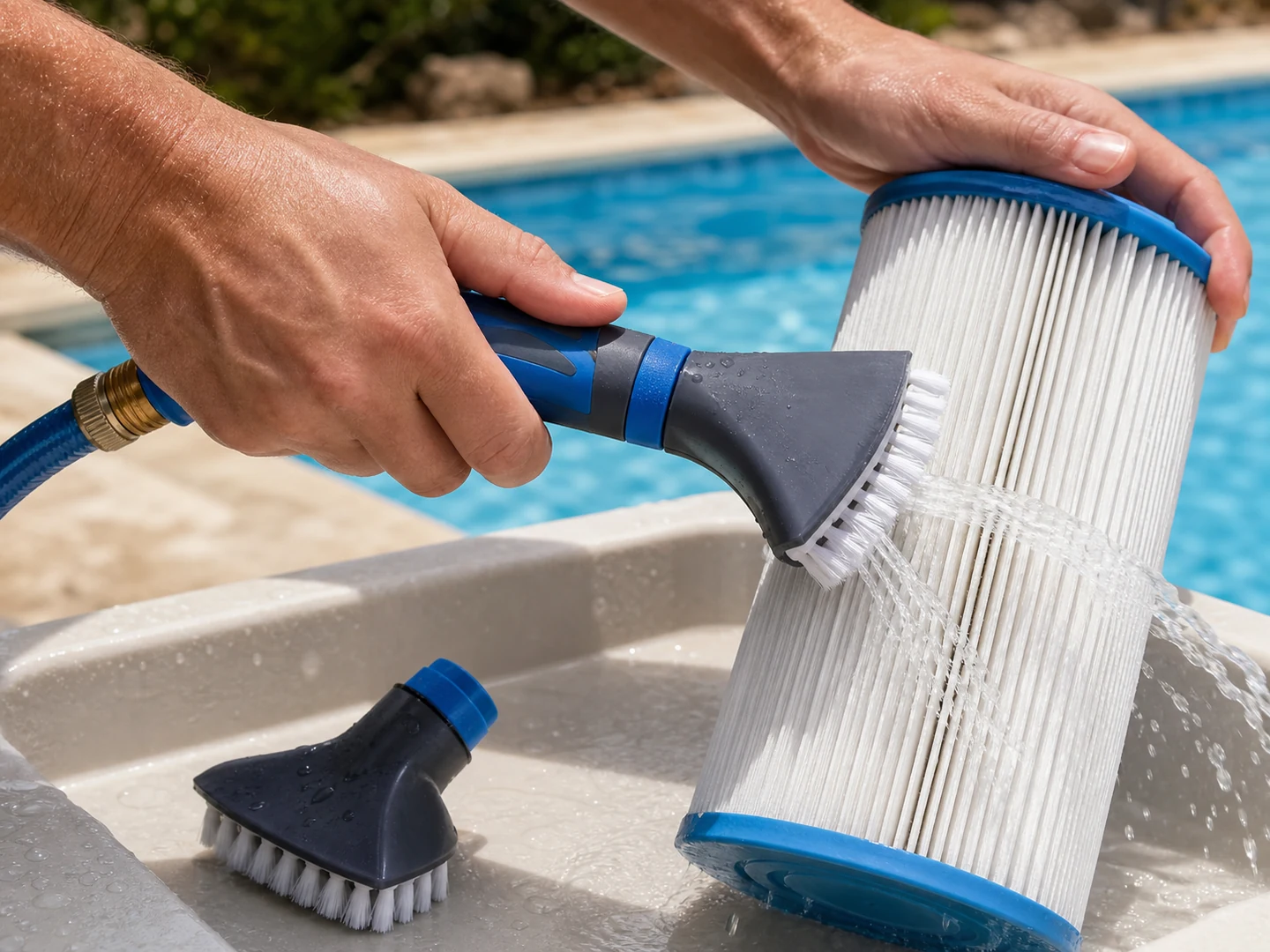
Medium brush
100 pcs
Minimum order
Worked with two hands or on a pole: chimney, gutter and pond-filter brushes, discs, cups and tank brushes.
Production lead time, once the specification is confirmed
- Up to 100 pcsWithin 7 days
- 101–5,000 pcsWithin 14 days
- 5,001–50,000 pcsWithin 21 days
- Over 50,000 pcsConfirmed with your quotation
Peak season can extend these times; the shipping date is confirmed in writing with your quotation. Sampling and shipping are quoted separately.
A hand-guided brush designed specifically for cleaning pleated pool filter cartridges, reaching between pleats and into end-cap grooves to lift dust, pollen, scale, oil film, and trapped particles without tearing the media.
What can this brush do for you?
Reaches between pleats without shredding the media
The head width and filament spacing are matched to typical pleat pitches, so the filaments slide into the valleys between folds instead of snagging the raised edges. Removing debris from inside the pleat, rather than only from the outer surface, restores more flow path and extends the time between deep chemical soaks or cartridge replacement.
Dislodges scale, oil film, and compacted debris without harsh abrasives
Polypropylene and nylon filaments are stiff enough to break up dried scale, sunscreen oil film, and compacted pollen, but they are soft enough to avoid scratching or puncturing polymer or paper filter media. Unlike wire brushes, this brush will not tear pleats or open pinholes in the membrane.
Cleans end-cap grooves and curved transitions
Tapered and comb head forms follow the cartridge’s curved profile and reach into the ring grooves and end-cap seams where debris builds up. Flat and cylindrical head forms cover the pleat faces and outer circumference quickly, so one brush can handle the full contact area.
Works wet or dry in pool chemical environments
The selected PP and nylon grades resist chlorinated water, bromine, and saltwater exposure, so the brush can be used during normal filter cleaning with mild acid or alkaline cartridge cleaners and will rinse clean after use without retaining pool chemicals.
What is a Pool Filter Cartridge Brush?
A Pool Filter Cartridge Brush is a hand-guided cleaning tool built for manual maintenance of pleated filter cartridges used in residential pools, spas, and commercial aquatic systems. It uses trimmed filament sections—typically polypropylene or nylon—secured in a molded or wound head that is sized to fit between or across the pleats of the filter element.
During use, the operator holds the brush against the pleated media and works along the folds from the top of the cartridge toward the end cap, using light to moderate pressure. The brush removes particles, scale, and oily residue that backwashing or hosing alone leaves behind. Unlike a wire brush, the filament ends bend on contact and conform to the pleat profile, so cleaning force is spread over many filament tips rather than concentrated at sharp points.
The brush is meant for routine mechanical cleaning of intact filter media. It is not a replacement for chemical soaking when oil or scale has hardened, and it is not designed for use on severely degraded, brittle, or already torn cartridges where further brushing would cause additional damage.
Technical Specifications
All dimensions are adjusted to your cartridge’s outside diameter, pleat spacing, and pleat depth. The table below shows the standard working ranges for this brush line.
| Parameter | Value / Options |
|---|---|
| Head width | 15–90 mm (selected to fit between pleats or span a group of pleats) |
| Brush section (filamented length) | 60–180 mm |
| Overall length | 200–300 mm |
| Trim length | 10–35 mm (filament length above the base; longer trim increases flexibility and reach into pleat valleys) |
| Filament diameter | 0.10–0.40 mm (finer filaments for paper media, thicker filaments for scale and oil film) |
| Head form | Flat, tapered, pleat, comb, or cylindrical (custom profile available) |
| Fill materials | Polypropylene (PP), Nylon (PA 6, PA 6.6, PA 6.12, or blend) |
| Handle | PP, TPE overmolded, or stainless steel core, depending on grip and chemical exposure |
| Operating environment | Chlorinated or saltwater pool, spa, and industrial water systems; wet or dry manual use |
| Chemical compatibility | Filament grades resist common pool sanitizers and mild acid/alkaline filter cleaners; verify with strong solvents or oxidizers |
| Brush type | Custom Handheld Detail Brushes |
| How it is driven | Hand-guided |
| Cleaning target | residential pool and spa filter cartridge, commercial aquatic facility maintenance, and cartridge refurbishment and exchange program cleaning |
| Surface or part | pleats, filters, end-cap grooves, comb, profiles, seams, and bends |
| Residue or debris | scale, oil, oil film, pollen, particles, dust, trapped particles, and pitch |
| Mounting / connection | Fixed |
If you already have a cartridge part number, send it with your inquiry and we will match the brush dimensions to that cartridge instead of asking you to measure every pleat.
Where does this brush work best?
- Residential pool and spa filter cartridges — pleated polyester, cellulose, or blended media where routine cleaning prevents early pressure rise and restores flow.
- Commercial aquatic facility maintenance — service crews cleaning multiple cartridges per week need a repeatable tool that does not damage media during high-volume maintenance.
- Cartridge refurbishment and exchange programs — cleaning stations that inspect, brush, and reuse cartridges before putting them back into service.
- Industrial pleated filter elements — water treatment loops and machine coolant systems where manual brushing is part of the scheduled cleaning cycle and access to pleats is available.
How do I choose the right one?
Match head width and form to the pleat pitch
Measure the distance between adjacent pleat tips on your cartridge. Choose a head width equal to or slightly narrower than the pleat gap if you want the filaments to reach deep into each valley. A slightly wider flat or comb head will span two or three pleats and cover more surface per stroke but may not clean as deeply. The head form matters too:
| Head form | Best for |
|---|---|
| Flat | General coverage across pleat faces |
| Tapered | Following the cartridge curvature and reaching end-cap seams |
| Pleat / comb | Cleaning multiple pleat valleys in one pass |
| Cylindrical | End-cap inner rings and curved transitions |
Select filament diameter and trim length for the media and residue
Paper or cellulose media is more prone to surface wear, so start with a fine filament (0.10–0.20 mm) and a longer trim (25–35 mm) for gentle contact. Polymer media can tolerate a stiffer filament (0.25–0.40 mm) and a shorter trim (10–20 mm) to deliver more scrubbing force against scale and oil film. If the cartridge only sees loose dust and pollen, PP is usually sufficient; if scale or hard films are present, nylon with a higher diameter is the better choice. Never use a wire brush on a pool filter cartridge—wire ends cut and tear the pleats.
Set the working length and handle for the job
Most cartridges are cleaned outside the filter tank, on a bench or cleaning stand, so an overall length of 200–300 mm gives good control without excessive leverage. For very tall commercial cartridges, a longer handle can reach the full media height, but control decreases with extra length; a two-handed grip or a shorter brush with more passes is often the safer choice.
Consider the cleaning chemical and frequency
If your process uses strong degreasers, acid soaks, or oxidizing solutions, specify the product name and dilution when ordering. The correct PP or nylon grade will be selected for that environment; some high-concentration chemicals can soften or embrittle standard grades.
When another tool is better
Do not use this brush on cartridges with torn, brittle, or collapsed pleats—replace those elements instead. If the scale deposit cannot be removed with reasonable hand pressure, a chemical soak or ultrasonic cleaning stage is needed before brushing. For very high-volume automated cleaning lines, a rotary cartridge cleaning brush may be more productive than a hand brush.
Can I customize this brush?
Yes. Pool filter cartridge brushes are configured around your specific cartridge, not sold as one fixed size. We can adjust the following:
- Head width and length — matched to your cartridge diameter, pleat spacing, and media height.
- Head form — flat, tapered, pleat, comb, cylindrical, or a custom molded insert for a proprietary pleat pattern.
- Filament — material (PP, PA 6, PA 6.6, PA 6.12, or blend), diameter, trim length, and color.
- Handle — length, straight or ergonomic shape, grip material (PP, TPE overmold, stainless steel), hanging hole, or molded logo.
- Package — bulk cartons, individual polybag, retail card, or custom labeling for your service kits.
To quote a custom brush, provide the cartridge outside diameter, pleat spacing or pitch, media type, debris you are removing, cleaning chemicals used, and whether the brush is used wet or dry. A photo or part number speeds up the match. For projects that require material documentation, third-party inspection, or specific test protocols, we can support those requirements during customization.
How long does a pool filter cartridge brush last, and how is it cleaned between runs?
How do I know the brush will not damage my filter media?
Choose the softest filament that still removes the debris. Start with a fine PP or nylon filament, then increase diameter only if residue remains. After brushing a test area, inspect the pleats for fuzzing, pilling, or visible wear. If the media surface shows changes, drop back to a finer filament or longer trim.
What is the correct brushing direction on a pleated cartridge?
Brush along the pleats, from the top of the cartridge toward the end cap, never across the pleats. Brushing across the folds can bend or crease the media and permanently reduce filtration area. Rotate the cartridge a quarter turn after each section to keep the coverage even.
Can I use this brush with a filter cleaning solution?
Yes, the PP and nylon grades used in this brush are compatible with most mild acid and alkaline cartridge cleaners and with chlorinated or saltwater rinses. Avoid soaking the brush in strong solvents, concentrated oxidizers, or undiluted acids unless you have confirmed the specific filament grade is resistant.
How can I tell when the brush needs replacement?
Check the filament ends periodically. If the filaments are permanently bent, splayed, or losing stiffness, the brush is no longer delivering consistent contact and should be replaced. A worn brush leaves uneven cleaning and may require more passes to reach the same result.
Should I remove the cartridge from the filter before brushing?
Yes. Remove the cartridge from the filter housing and set it on a cleaning stand or work surface. Brushing inside a closed filter gives poor access, makes it impossible to see the pleat condition, and can push loosened debris into areas you cannot rinse properly.
Guides that go deeper on this
Custom Manufacturing RFQ
Describe Your Application
To quote this brush accurately, send the size, material, cleaning target, residue, quantity, and any available drawing or sample photo.
Drawing or photo optional — it speeds things up, it does not gate the enquiry.
Custom Brush RFQ
Send Your Brush Project
Upload a drawing, product photo, or sample photo and provide the core dimensions and cleaning conditions.
“We need a brush to remove wet residue from a stainless steel conveyor, about 800mm wide. The current brush wears quickly. We can send photos.”
“We sell drinkware and need a cleaning brush to include with the product. Quantity around 5,000 pieces.”