
Custom Cleaning Brush
Floor Stripping Brush
Custom floor stripping brush for removing old finish, wax, and sealer from VCT, concrete, and tile.
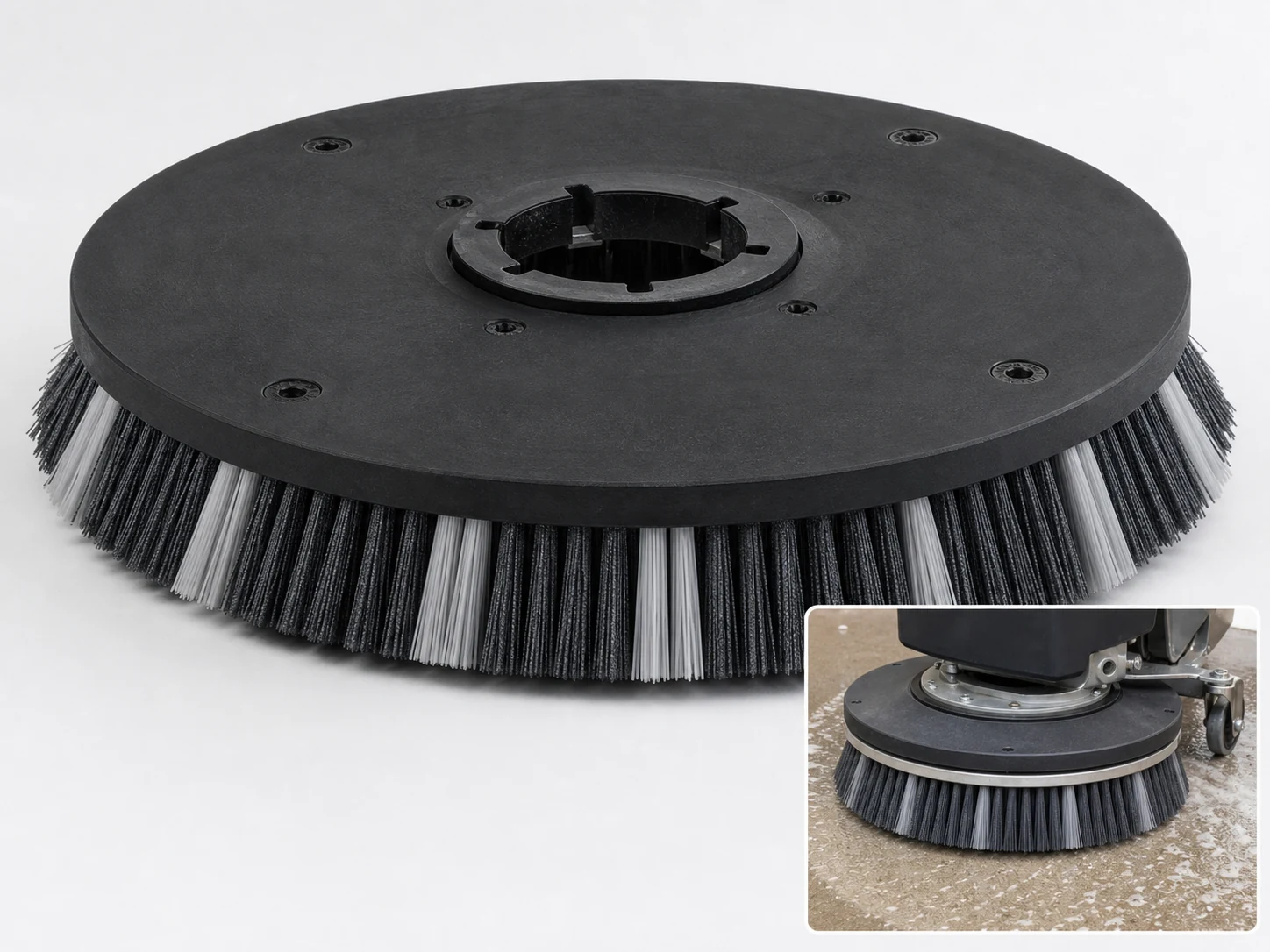
Large-format brush
100 pcs
Minimum order
Built one at a time on a core or channel: full-width rollers, sweeper brooms and long strip.
Production lead time, once the specification is confirmed
- Up to 100 pcsWithin 20 days
- 101–1,000 pcsWithin 30 days
- Over 1,000 pcsConfirmed with your quotation
Peak season can extend these times; the shipping date is confirmed in writing with your quotation. Sampling and shipping are quoted separately.
Old floor finish lifts unevenly, leaves swirl lines, and blocks adhesion of the next coat. A floor stripping brush removes worn finish, wax, sealer, and coating layers from hard floors so the new coating bonds to a clean, uniform surface. It is built in rotary disc and cylindrical roller configurations with silicon carbide abrasive nylon fill and a machine-specific drive interface.
What can this brush do for you?
Cut Through Multiple Coats of Finish Without Metal Fragments
Silicon carbide abrasive nylon filaments carry grit throughout their length, so the brush continues cutting as the filament tips wear down. Unlike wire brushes, it leaves no broken wire fragments in the floor or the stripping slurry, which keeps the newly stripped surface safer for maintenance crews and ready for recoating.
Match Aggression to the Buildup Instead of Fighting It Blind
Filament diameter from 0.25 to 1.20 mm and trim length from 20 to 80 mm give the buyer control over cutting pressure. A thicker, shorter trim concentrates force on flat, heavily coated floors; a thinner, longer trim follows recessed grout lines and uneven tile without lifting the brush face off the surface.
Mount Straight onto the Machine Deck You Already Run
The hub, bore, clutch plate, spline, or threaded insert is machined to the floor machine or auto-scrubber model specified. The brush swaps in the same way as the existing pad driver, so the stripping crew does not need to modify the machine or build adapter plates on site.
Stay Productive in Wet Stripping Chemistry
Nylon-based fill is selected for continuous immersion in common alkaline floor strippers. When the chemical concentration, pH, and water temperature are specified at the start, the brush keeps its stiffness and trim through a full stripping run instead of softening, shedding filaments, or losing tuft retention into the slurry.
Keep Strip Lines and Swirls Out of the Next Coat
Uniform tuft spacing and controlled trim length create a consistent footprint across the disc or roller face. That reduces the uneven pressure and overlap marks that can show through a fresh finish, so the recoat levels uniformly and has fewer visible defects.
What is a Floor Stripping Brush?
A floor stripping brush is a machine brush made for aggressive wet removal of old finish and sealer from hard flooring. It is built either as a circular disc for rotary floor machines and swing buffers, or as a cylindrical roller for auto-scrubbers and cylindrical deck machines. The working face consists of tufted nylon filaments, either silicon carbide abrasive nylon or plain nylon PA, set into a plastic or composite block with a machine-specific drive interface.
The brush is not used alone. In a typical restoration sequence, the operator applies floor finish remover and lets it dwell until the coating softens, then runs the machine brush over the floor to loosen and remove the softened layers. The resulting slurry is wet-vacuumed or mopped up, the floor is rinsed or neutralized, and after drying the new finish is applied. The brush breaks the bond between old coating layers and the hard surface without gouging the tile, concrete, or stone underneath.
Because the fill is nylon-based rather than wire, the brush suits finished hard floors where rust staining and deep scratching are not acceptable. It is not a substitute for a finishing or polishing brush, and it is not intended for dry abrasive use.
Technical Specifications
All values are project-selectable ranges. The final configuration is fixed when the floor type, machine interface, and coating condition are confirmed.
| Parameter | Value / Options |
|---|---|
| Brush configuration | Rotary disc or cylindrical roller for floor scrubber and auto-scrubber drives |
| Brush diameter, disc | 100–700 mm, matched to pad driver or deck size |
| Working width, roller | 100–1200 mm, matched to scrub deck width |
| Trim length | 20–80 mm; shorter trim increases cutting pressure, longer trim conforms to uneven floors and grout lines |
| Filament diameter | 0.25–1.20 mm; thicker filaments increase aggression |
| Fill material | Silicon carbide abrasive nylon for stripping; nylon PA for gentler scrubbing or blended fills |
| Grit loading | 46–240 grit, selected by coating thickness and floor hardness |
| Hub / drive interface | Machine-specific bore, clutch plate, spline, threaded insert, or keyed hub |
| Operating mode | Wet stripping with floor finish remover; not for dry abrasive operation |
| Chemical environment | Compatible with common alkaline stripping solutions; specify pH, concentration, and water temperature |
| Brush type | Custom Floor Scrubber Sweeper Brushes |
| How it is driven | Machine-driven, mounted in the equipment |
| Cleaning target | vct and resilient tile floor, quarry tile and ceramic tile, and large open area cleaning |
| Surface or part | floors, roller, tile, concrete, grout lines, terrazzo, pads, and composite |
| Residue or debris | wax, leaves, grease, slurry, old coating, and rust |
| Mounting / connection | Machine-specific bore, clutch plate, spline, threaded insert, or keyed hub |
Before ordering, confirm the machine make and model, exact drive dimensions, and deck clearance so the brush face meets the floor at the correct working angle.
Where does this brush work best?
- VCT and resilient tile floors in schools, hospitals, retail stores, and offices where yellowed or scuffed finish has built up over years and must be removed before recoating.
- Terrazzo and concrete floors in lobbies, warehouses, and industrial facilities where sealer or coating layers are worn, hazed, or contaminated and need mechanical removal before new treatment.
- Quarry tile and ceramic tile in commercial kitchens and service areas where wax or polymer finish traps grease and black marks; longer trim follows recessed grout lines.
- Large open areas where ride-on auto-scrubbers or cylindrical deck machines are used; roller brushes sized to the exact deck width clean a full path in one pass.
- Failed recoat correction when a fresh finish was applied over residue and now peels or crazes; the brush removes the failed top layer so the floor can be restored properly.
These are hard-surface applications. Soft flooring, unsealed wood, and laminate are outside the intended use.
How do I choose the right one?
Start with the machine interface. The brush cannot be evaluated for performance until it fits the deck. Identify the machine make and model, the pad driver diameter or roller shaft and bracket dimensions, the drive type, and any reducer ring or clutch plate already in use.
Then match the fill to what is being removed:
- Multiple coats of old finish, heavy wax buildup, or hard concrete and terrazzo: silicon carbide abrasive nylon in the 46–120 grit range with filament diameter 0.60–1.20 mm and shorter trim.
- Lighter finish buildup, frequent maintenance stripping, or surfaces where scratching must be minimized: silicon carbide abrasive nylon in the 180–240 grit range, or plain nylon PA, with filament diameter 0.25–0.50 mm and longer trim.
- Grout lines, tile edges, and uneven floors: longer trim from 50 to 80 mm keeps the tips in contact; on smooth VCT, shorter trim from 20 to 40 mm delivers more cutting pressure per bristle.
Set the diameter or width for the deck. A disc brush should cover the pad driver without excessive overhang; a roller brush must match the scrub deck width and end brackets exactly. A brush that is too narrow leaves untreated bands, and one that is too wide can bind against the machine or adjacent surfaces.
Finally, confirm the chemical process. This brush is intended for wet stripping with a floor finish remover. If the facility uses dry or low-moisture methods, or if the target is thick epoxy, paint, or mastic rather than floor finish, a different abrasive tool or pre-treatment may be required. For delicate floors or unknown finish chemistry, run a test patch with the planned chemical before committing the full floor area.
If the brush is too aggressive after a test patch, move to a lower grit, smaller filament diameter, or longer trim. If it is too slow, move up in grit or filament diameter, or review the stripper dwell time and concentration.
Can I customize this brush?
Floor stripping brushes are configured around the machine and the floor program, so most dimensions and materials can be adjusted. To define the build, provide the machine make and model, drive dimensions, floor type, coating type and number of coats, stripping chemical and concentration, water temperature, and the desired coverage per shift. A photo or drawing of the existing brush or pad driver helps avoid interface errors.
We can adjust:
- Configuration — rotary disc, cylindrical roller, or segmented brush blocks for multi-section decks
- Dimensions — outer diameter, working width, trim length, trim shape, and block height
- Fill material — silicon carbide abrasive nylon grit from 46–240, nylon PA, or a blended fill, with filament diameter and tuft density specified for the job
- Drive interface — bore, clutch plate, spline, keyway, threaded insert, or custom hub to match the floor machine or auto-scrubber
- Block and backing — plastic, composite, or wooden disc core; reinforced roller core for heavy scrub decks
- Color and marking — custom filament color, block color, and label or identification marking for service programs
- Packaging — bulk cartons, individual boxes, or project-specific packing and labeling
When the project requires material declarations, inspection, or third-party testing support for the specified chemical or operating conditions, we can assist with those requirements during the customization process.
Which filament survives the cleaning and still lasts on a floor stripping brush?
How do I know when a floor stripping brush needs replacement?
Inspect the bristles after cleaning and drying. If the trim has shortened by more than about 25–30 percent, the tips are flattened or permanently bent, or the machine needs more passes to remove the same finish, replace the brush. Uneven wear across the brush face usually indicates deck leveling or pressure needs adjustment.
Should I use this brush on a dry floor?
No. Floor stripping brushes are designed for wet use with a stripping solution. Dry operation creates dust, overheats the filament tips, shortens brush life, and can burnish finish into the floor instead of removing it.
Can this brush remove thick wax without a stripping chemical?
It will mechanically cut through some wax, but finish removal is slower and less uniform without a proper stripper. The chemical softens and releases the coating, and the brush then removes the loosened material. For best results, follow the stripper manufacturer’s dwell time and use the brush for agitation and slurry pickup.
How can I tell if the brush is too aggressive for my floor?
Run a small test patch in an inconspicuous area using the same stripper and machine speed. If the floor shows visible scratching, swirl marks, or excessive material loss beyond the finish layer, step down to a lower grit, longer trim, or a nylon PA fill. If finish remains after the recommended dwell time and passes, move up in grit or filament diameter.
What is the difference between silicon carbide abrasive nylon and regular nylon PA fill?
Silicon carbide abrasive nylon has grit particles embedded throughout each filament, so it continues to cut as the filament wears. Regular nylon PA provides gentler scrubbing and is more suitable for post-stripping scrubbing, light buildup, or surfaces where abrasion must be minimized. Many programs use Sic nylon for the stripping pass and PA nylon for a follow-up cleaning pass.
How can I reduce overlap marks or strip lines?
Keep the machine deck level, maintain a consistent forward speed, and overlap each pass by about 25 percent of the brush diameter or working width. Let the stripping solution dwell long enough that the finish is removed in one or two passes. Forcing the brush across inadequately softened finish creates uneven pressure and visible lines.
Guides that go deeper on this
Custom Manufacturing RFQ
Describe Your Application
Please share the brush dimensions, working area, residue type, material direction, quantity, and a drawing or photo for quotation.
Drawing or photo optional — it speeds things up, it does not gate the enquiry.
Custom Brush RFQ
Send Your Brush Project
Upload a drawing, product photo, or sample photo and provide the core dimensions and cleaning conditions.
“We need a brush to remove wet residue from a stainless steel conveyor, about 800mm wide. The current brush wears quickly. We can send photos.”
“We sell drinkware and need a cleaning brush to include with the product. Quantity around 5,000 pieces.”