
Custom Cleaning Brush
Gun Bore Brush
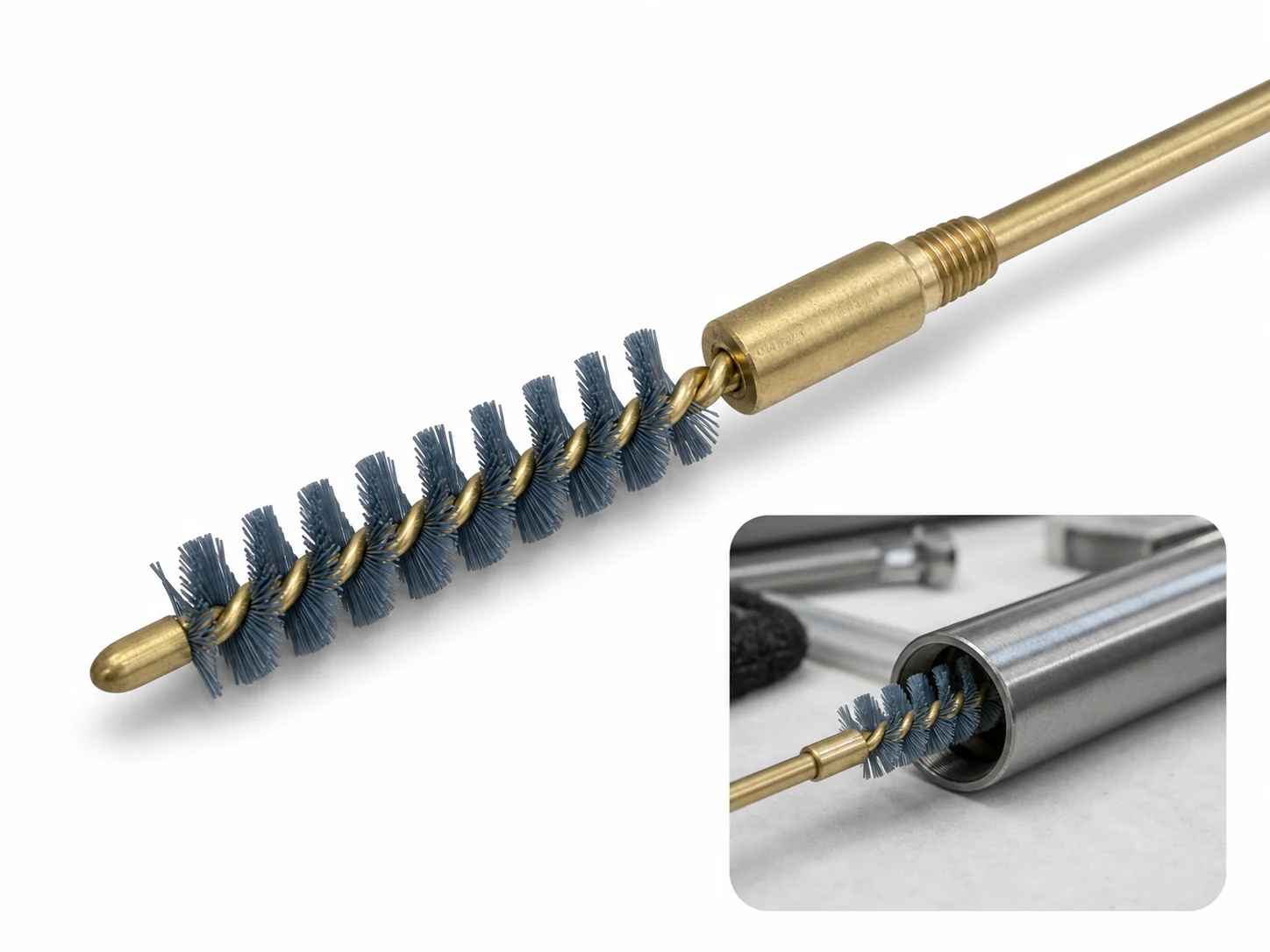
Caliber-matched gun bore brushes for.22–.50 caliber barrels. Phosphor bronze, nylon, brass, or stainless steel fill with 5-40, 8-32, M3/M4 threads.
Small brush
500 pcs
Minimum order
Held in one hand: tube, bottle, detail and swab brushes — including long-handled ones with a small head.
Production lead time, once the specification is confirmed
- Up to 500 pcsWithin 7 days
- 501–50,000 pcsWithin 14 days
- Over 50,000 pcsWithin 21 days
Peak season can extend these times; the shipping date is confirmed in writing with your quotation. Sampling and shipping are quoted separately.
A caliber-matched cleaning brush for pistol, rifle, and shotgun barrels, built to scrub carbon, powder residue, copper, and lead from the bore and rifling. The brush threads onto standard cleaning rods so it can be pulled through the full length of the barrel without changing the rest of the cleaning kit.
What can this brush do for you?
Caliber-Matched Fill That Follows the Rifling
Brush diameter is set to the bore and groove dimensions of the specific caliber, so the radial fill contacts both the lands and the bottom of the rifling grooves. A brush that is undersized will slide through the bore and leave fouling in the grooves; an oversized brush will bind and can damage the crown or bend the core. Matching the diameter lets one pass carry consistent scrubbing pressure through the entire rifled section.
Threads Onto Standard Cleaning Rods and Short Handles
The base of the stem is formed as a threaded stud in 5-40, 8-32, 10-32, M3, or M4, so the brush mounts directly to the rod, adapter, or short handle already in the customer’s kit. There is no special coupler to lose, and the same brush format can be supplied across several calibers without changing the rod system.
Fill Material Is Matched to the Fouling and Barrel Surface
Phosphor bronze wire removes copper and lead deposits from steel and chrome-lined bores because it is harder than the fouling but softer than the barrel steel. Nylon PA holds solvent at the contact face and scrubs powder residue with less metal-to-metal contact. Brass, stainless steel, and carbon steel fill are available when the cleaning program is built around carbon removal or a specific level of mechanical action.
Filament Diameter and Density Set the Scrub Pressure
Individual filament diameter from 0.05 mm to 0.25 mm and the number of fill rows per working length determine how much pressure the brush applies. Denser, stiffer fill opens heavier deposits faster; lighter fill protects fine rifling and reduces rod torque. The same nominal caliber can be supplied in two or three fill aggressions without changing the brush envelope.
Repeatable Cleaning Without Reworking the Kit
The brush is a consumable part of a bore-cleaning sequence. Because the thread, length, and diameter remain consistent, replacement brushes drop into the same rod and storage layout. Private-label or kit programs can keep a single SKU structure across calibers and material choices.
What is a Gun Bore Brush?
A gun bore brush is a short twisted-wire brush designed to scrub the inside of a rifled barrel. The bristles are captured between two twisted core wires, and the core ends in a threaded stud that screws into a cleaning rod. In use, the operator runs the brush through the barrel from the chamber end, with or without a light rotating stroke, so the radial fill contacts the lands, the grooves, and the area just ahead of the chamber as it travels.
It is not a patch jag, a bore mop, or a chamber brush. The brush removes attached fouling; patches and solvent then carry the loosened material out of the bore. A bore brush is also not an obstruction remover and should not be used to drive out a stuck case, a lodged patch, or a blocked barrel.
Diameter is the main identity of the brush. A .30 caliber brush and a 9 mm brush are not built around the same barrel diameter even if the packaging calls both “bore brushes,” so the production drawing starts from actual bore/groove size, thread, and working length rather than a generic part number.
Technical Specifications
Common production parameters are shown below. Brush diameter, working length, thread, and fill material are set to the specific caliber and rod system; the values are not a fixed stock list.
| Parameter | Value / Options |
|---|---|
| Brush diameter | 2–20 mm, selected to bore/groove diameter |
| Caliber coverage | .22 to .50 caliber; larger shotgun gauge brushes available as custom diameter |
| Working length (bristle section) | 20–80 mm |
| Overall length including thread | 50–150 mm |
| Thread interface | 5-40, 8-32, 10-32, M3, M4, or custom |
| Fill material | Phosphor bronze, nylon PA, brass, stainless steel, carbon steel |
| Filament diameter | 0.05–0.25 mm |
| Core / stem | Twisted steel, stainless steel, or brass core wire; thread formed at base |
| Suggested fit | Wire fill: near bore size; nylon fill: 5–20% oversize for scrubbing contact; keep lower interference for stiff wire |
| Operating environment | Compatible with bore solvents, CLPs, and water-based cleaners; choose stainless core for humid or wet storage conditions |
| Brush type | Custom Tube & Pipe Bore Brushes |
| How it is driven | Hand-guided |
| Cleaning target | rifle barrel, shotgun bore, and oem cleaning-kit program cleaning |
| Surface or part | bores, thread, grooves, chambers, carbon steel, plastic, and tooling |
| Residue or debris | carbon, and powder residue |
| Mounting / connection | 5-40, 8-32, 10-32, M3, M4, or custom |
Where does this brush work best?
- Rifle barrels from .22 rimfire through large centerfire: remove powder residue, carbon in the throat/leade, and copper or lead deposited in the grooves after extended firing.
- Handgun barrels for 9 mm, .40, .45, and similar calibers, where short working lengths match the barrel and rod travel without excess flex.
- Shotgun bores where a gauge-matched brush diameter is used before wad and plastic fouling hardens; wire fill should be specified for the barrel material.
- OEM cleaning-kit programs: the same threaded brush can be packed with a rod, patch jag, and bore mop as a caliber-specific kit.
- Range, law-enforcement, and armorer maintenance: high-cycle cleaning where brushes are replaced at scheduled intervals and consistent thread/fit reduces tooling mix.
- Gunsmith service work: after a copper or lead solvent soak, the brush provides the mechanical action that lifts the loosened layer before patching.
How do I choose the right one?
Start with actual bore and groove diameter
Do not rely only on the caliber stamp. Measure or look up the barrel’s land and groove dimensions, and choose the brush diameter from that figure. For wire fill, the brush should run near bore size so the bristles sweep the grooves without heavy binding. For nylon fill, a 5–20% oversize gives the filament enough deflection to apply scrubbing pressure across the lands.
Match the thread to the cleaning rod
The most common rod threads are 5-40 for small calibers, 8-32 for most pistol and rifle rods, and 10-32 where older or larger-format rods are used. Metric M3 and M4 are available for rod systems built around metric threads. Specify either the existing rod thread or supply the adapter that will be used before the brush diameter is locked.
Choose fill material by fouling type and barrel surface
| Cleaning situation | Fill material to use |
|---|---|
| Copper or lead fouling in steel or chrome-lined bore | Phosphor bronze |
| Powder residue and solvent application with less metal contact | Nylon PA |
| Moderate carbon and wad fouling where lower aggressiveness is enough | Brass |
| Heavy carbon in conventional steel bores | Stainless steel or carbon steel — confirm surface finish compatibility first |
Set working length to the travel, not the barrel length
The bristle section only needs to cover the area the operator scrubs in each stroke. Pistol brushes can use 20–40 mm working sections; rifle brushes may use 40–80 mm. Overall length includes the thread and should keep the rod, brush, and bore aligned so the tip never forces against the crown.
When a different brush or tool is the better choice
- Use a separate, larger-diameter chamber brush for the chamber and shoulder; a bore brush cannot clean a chamber it does not fill.
- Use a patch jag or bore mop to apply oil, dry the bore, or remove loose carbon that does not need scrubbing.
- Use a copper-removing solvent system with patches when fouling is chemically active; the brush is the mechanical assist, not the whole treatment.
- Use a nylon brush instead of wire when the bore has a delicate plated, coated, or antique surface.
- Use an obstruction rod for stuck cases, blocked bores, or lodged patches; a bore brush is not built for obstructions.
Can I customize this brush?
Gun bore brushes are usually configured per caliber and kit rather than sold from a fixed stock table. For a clean specification, provide the caliber, actual bore/groove diameter, cleaning-rod thread, required overall length, fill material, and how the brush will be packaged in the kit.
We can adjust:
- Diameter and caliber — matched to specific bore/groove dimensions from .22 through .50 caliber, plus larger gauge or non-standard diameters.
- Fill material — phosphor bronze, nylon PA6/PA612, brass, stainless steel, or carbon steel wire.
- Filament and fill construction — filament diameter, rows per working length, twist direction, and fill density to set scrub pressure.
- Core and thread — steel, stainless steel, or brass twisted core; 5-40, 8-32, 10-32, M3, M4, or a project-specific thread; male or female interface, short loop, or integrated handle as required.
- Working and overall length — 20–80 mm bristle section; 50–150 mm total length, or custom for odd rod systems and compact kits.
- Color and marking — colored nylon fill, thread or base color, private-label packaging, or pad/laser marking on the handle or kit card.
- Packaging — bulk, individual polybag, carded retail, kit insertion, or project-specific packing.
If your program needs material declarations, inspection documentation, or third-party testing for a customer’s quality requirements, we can arrange those services during the project setup.
What size should a gun bore brush be, and how long does it last?
How do I check that the brush diameter is correct before use?
Run the brush through the barrel by hand with moderate rod pressure. A correctly sized wire brush should show light, even drag through the full length without hanging or binding, and a nylon brush should require slightly more deflection. If the brush sticks hard, bends the core, or feels like it is cutting, the diameter is too large. If it passes with no contact, it is too small and will miss the bottom of the grooves.
Can one bore brush clean the chamber as well?
No. A bore brush is sized to the bore and rifling diameter, which is smaller than the chamber. The chamber, shoulder, and neck need a separate chamber brush of the appropriate larger diameter. Trying to clean a chamber with a bore brush leaves most of the chamber surface untouched.
Do I still need patches and solvent if I use the brush?
Yes. The brush breaks the fouling bond and pushes material out of the lands and grooves, but it does not absorb the loosened residue. Solvent and patches carry the removed carbon, copper, or lead out of the bore. The standard sequence is solvent, brush, patch, and repeat until patches come out clean or show only trace color.
How long does a gun bore brush last?
Brush life depends on bore condition, fill material, and cleaning frequency. Replace the brush when the bristles flatten and do not spring back, when fill rows open up, when the core becomes kinked, or when the thread no longer holds firmly in the rod. Nylon fill also degrades after repeated solvent exposure and should be inspected each session.
Can the brush be run with a drill or powered cleaning rod?
Only at low speed and only when the core, thread, and working length have been specified for powered use. High-speed rotation can overheat the filament, distort the twisted core, and cause wire fill to score the bore. Hand-turned rod strokes are the normal operating method for standard bore brushes.
What should I do if the brush binds inside the barrel?
Stop immediately and check whether you are pulling against the muzzle crown or forcing a brush that is oversized. Back the rod out slowly from the chamber end if possible, recheck the diameter against the actual bore/groove size, and use a bore guide to keep the rod centered. A brush that binds on the lands should not be forced through, because the core can bend or the crown can be damaged.
Guides that go deeper on this
Custom Manufacturing RFQ
Describe Your Application
For a custom quote, we need the key dimensions, surface or part, residue, material preference, quantity, and reference image or drawing.
Drawing or photo optional — it speeds things up, it does not gate the enquiry.
Custom Brush RFQ
Send Your Brush Project
Upload a drawing, product photo, or sample photo and provide the core dimensions and cleaning conditions.
“We need a brush to remove wet residue from a stainless steel conveyor, about 800mm wide. The current brush wears quickly. We can send photos.”
“We sell drinkware and need a cleaning brush to include with the product. Quantity around 5,000 pieces.”