
Custom Cleaning Brush
Metal Acid Pickling Brush Roller
Custom acid pickling brush roller for steel strip and line-roll cleaning. PP, PBT, SiC nylon or 316 wire fill; 100–500 mm OD.
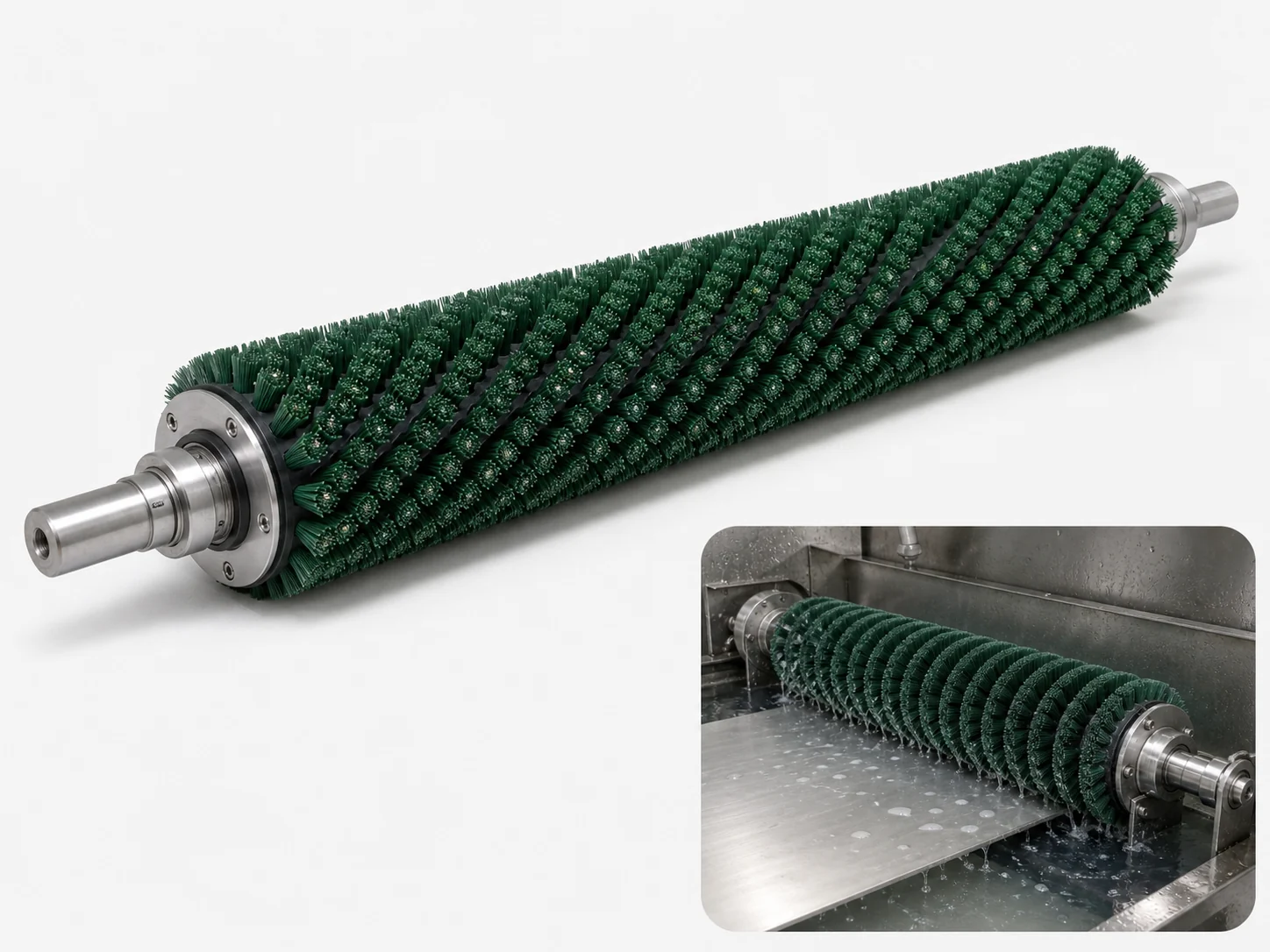
Large-format brush
100 pcs
Minimum order
Built one at a time on a core or channel: full-width rollers, sweeper brooms and long strip.
Production lead time, once the specification is confirmed
- Up to 100 pcsWithin 20 days
- 101–1,000 pcsWithin 30 days
- Over 1,000 pcsConfirmed with your quotation
Peak season can extend these times; the shipping date is confirmed in writing with your quotation. Sampling and shipping are quoted separately.
A driven roller brush for continuous steel strip, coil, and line-roll cleaning inside acid pickling, rinse, and degreasing sections. The filament fill is selected against the actual acid type, concentration, and bath temperature, and the roller is dimensioned to the line’s strip width, roll face, and drive interface.
What can this brush do for you?
Full-width contact on a moving strip without stopping the line
The cylindrical face runs across the strip and the driven roll keeps every filament row working the surface while the line stays at speed. Engagement is set by roll position and trim length, so cleaning pressure stays repeatable from coil to coil instead of depending on an operator’s hand.
Filament fill matched to the acid, not just to the wear spec
PP and PBT fills survive concentrated mineral pickling acids far longer than standard nylon. PA612 is reserved for degreasing, rinse, or dilute-acid positions where the chemistry is known to be safe. 316 stainless wire is available where scale and smut demand more aggressive tips, but only after chloride and acid contact is reviewed. Picking the fill from the tank chemistry prevents a roller that wears out in weeks from chemical attack while the tips still look unworn.
Removes both loose oxide and carryover oil film before the next process
After the pickle tanks, the strip carries residual scale patches, black smut, and iron fines. At entry, oil film and metallic fines from prior operations can travel into the cold mill or furnace section. A properly selected roller takes these off the surface before they become roll marks, coating defects, or mill contamination.
Open face drains acid and releases fines instead of packing them
Trim length, fill density, and a straight or helical filament pattern are set so rinse water and acid drain through the face. Loose scale and fines leave the contact zone rather than building up in the filament base and re-marking the strip.
One drive concept covers strip and line-roll cleaning duties
The same roller design can be mounted above or below the strip, or set against idler, deflector, and pinch rolls to stop acid residue from building into a transfer layer. Shaft ends, bearings, and drive connections are matched to the existing frame, so the brush becomes a replacement item on the line rather than a retrofit project.
What is a Metal Acid Pickling Brush Roller?
A Metal Acid Pickling Brush Roller is a machine-mounted rotary brush used in continuous strip processing lines. It consists of a steel or stainless core with a dense cylindrical fill of synthetic filaments or stainless wire, mounted on journals and driven at a controlled speed either with or against strip travel.
In a pickling line the roller is typically placed after the acid tanks and rinse section, where it sweeps the moving strip surface and removes the smut, residual oxide, and fines that the acid has loosened. In entry degreasing sections it removes oil film and metallic particles ahead of the furnace or cold mill. The brush can also be turned against a line roll—an idler, deflector, or pinch roll—to prevent acid residue and fines from hardening into a crust that marks subsequent strip.
Cleaning action comes from the filament tips, not from the core. Filament diameter, trim length, fill density, and abrasive loading determine how hard the tips work the surface. The acid does the chemical descaling; the roller does the final mechanical surface conditioning and carryover removal. That distinction matters: it is not a scale breaker for heavy mill scale, and it does not replace the acid tank.
Because the roller works inside acid mist, spray, or splash, every exposed component—core, shaft ends, fasteners, and fill—must be selected for the actual chemistry and temperature. A roller that works in a rinse section may fail quickly if moved into a hot acid section, even if the mounting dimensions are identical.
Technical Specifications
| Parameter | Value / Options |
|---|---|
| Brush form | Cylindrical roller, strip/lath brush, or segmented brush sized to the treatment line |
| Roller outside diameter | 100–500 mm standard; other diameters by line drawing |
| Working face length | Matched to strip width plus edge allowance or roll face width |
| Core / shaft | Carbon steel with acid-resistant coating, 304/316 stainless, or polymer core; keyed, clamped, or flanged journals |
| Fill material | PP, PBT, PA612 nylon, SiC-impregnated nylon, 316 stainless steel wire |
| Filament diameter | 0.20–1.50 mm synthetic; 0.20–0.45 mm stainless wire, selected by duty |
| Trim length | 40–120 mm typical; set from engagement and wear allowance |
| Fill pattern / density | Straight or helical rows; straight or crimped wire; density set for drainage and residue release |
| Maximum continuous service temperature | PP approx. 80°C; PBT approx. 120°C; PA612 approx. 100°C; 316 wire higher (material-specific) |
| Chemical environment | Pickling acid type, concentration, and temperature determine fill; PP/PBT for strong mineral acid sections; PA612 for mild/dilute acid, rinse, or degreasing; 316 only where acid exposure is known compatible |
| Drive and rotation | Continuous rotation, direction with or against strip travel; speed and bearing arrangement engineered to the line |
| Mounting | Pillow block, flange, or machine-specific frame; engagement adjustable in service |
| Replacement | Full roller assembly or replaceable strip/segment fill for field changeout |
| Brush type | Custom Roller and Conveyor Brushes |
| How it is driven | Machine-driven, mounted in the equipment |
| Cleaning target | continuous hydrochloric or sulfuric acid pickling line, entry degreasing and pre-cleaning section, and pickle-section roll cleaning |
| Surface or part | roller, coils, rolls, tanks, steel strip, drain, and metal |
| Residue or debris | fines, scale, oil, oil film, oxide, acid residue, mist, and particles |
| Mounting / connection | Continuous rotation, direction with or against strip travel; speed and bearing arrangement engineered to the line; Pillow block, flange, or machine-specific frame; engagement adjustable in service |
Roller OD, face length, and shaft details are taken from the actual line drawing; there is no universal standard size for pickling brush rollers. The values above are project-selected, not a warehouse stock list.
Where does this brush work best?
- Continuous hydrochloric or sulfuric acid pickling lines: post-tank and post-rinse positions where the strip must be cleared of residual scale, black smut, and iron fines before cold rolling.
- Push-pickling and turbulent pickling lines for hot-rolled strip: surface conditioning ahead of a tandem cold mill or skin pass line.
- Entry degreasing and pre-cleaning sections on galvanizing and annealing lines: removal of oil film and metallic fines before the strip enters the furnace; fill is typically PA612 or PBT in this less aggressive chemical environment.
- Pickle-section roll cleaning: idler, deflector, bridle, and pinch rolls where acid residue and oxide fines form a crust that transfers back to the strip.
- Coil processing and service center lines: where pickled or oiled strip needs consistent surface finish before slitting, cutting, or coating.
How do I choose the right one?
Begin with the position: above or below the strip, or against a roll. Then fix the working width—face length should cover the full strip width plus edge wander, or the full roll face plus any end clearance. Roller OD and shaft length are copied from the line drawing; do not guess from a catalog size.
Then select the fill by chemistry before abrasiveness. Use the following order:
| Operating condition | First-choice fill | Notes |
|---|---|---|
| Strong HCl/H2SO4 acid tanks, hot continuous exposure | PP, or PBT when more tip stiffness is required | Chemical survival comes first; nylon is not suitable for concentrated acid at temperature |
| Rinse section after pickle, wet scale and smut removal | PBT or PA612 if pH is near-neutral and temperature moderate | Stiffer tip improves smut removal; verify pH and chloride concentration |
| Alkaline degreasing section, oil film plus fines | PA612 | Strong wear performance in non-acid, lower-corrosion positions |
| Hard oxide patches and smut, intermittent acid splash | SiC-impregnated nylon | Abrasive tips increase mechanical removal; must remain chemically compatible |
| Tenacious scale/smut, dilute or intermittent acid exposure only | 316 stainless steel wire | Aggressive; hot concentrated chlorides will pit the wire—review before use |
After fill chemistry, set filament diameter and trim length by residue and duty. Thinner filaments around 0.20–0.50 mm suit oil film and light fines; 0.60–1.20 mm suit smut and residual scale; wire is selected at the thin end of its range for sustained flexibility. Longer and denser fill removes more but needs more drive power and drains less freely.
Set engagement from the process result, not a fixed number. Start light enough to preserve the face, then increase until the strip comes out cleanly bright under inspection light without filament breakage or excessive drag. If the line runs several gauges, set for the thinnest product so thicker strip does not bottom the tips on the core.
When another approach fits better: heavy intact mill scale before the acid tank belongs to the scale breaker, shot blast, or acid immersion itself. Thick sludge and loose packing may be better cleared with high-pressure spray and air blow-off ahead of the brush. For very light oil removal on clean stock, an air knife or wringer rolls may be enough. The roller earns its place where acid, rinse, or degrease leaves a consistent surface residue that a stationary contact cannot.
Can I customize this brush?
Pickling brush rollers are built to the line. The working drawing determines the base geometry; the acid chemistry determines the material set. For an accurate configuration, provide the line drawing or roll sketch, strip width and gauge range, line speed, acid type/concentration/temperature, target contact (strip or roll), current brush dimensions and failure photos, and mounting/drive details.
Configurable elements include:
- Roller geometry: outside diameter, face length, core diameter, shaft extension, keyway or clamp interface, bearing journals, and flanges.
- Fill material: PP, PBT, PA612, SiC-impregnated nylon, 316 stainless wire, or mixed sections for different zones across the face.
- Filament construction: diameter, trim length, crimp, straight or helical rows, fill density, and abrasive grit loading.
- Brush form: one-piece roller, strip/lath brush sections, or segmented rings for field replacement without pulling the shaft.
- Core and hardware: stainless or coated steel core, corrosion-resistant fasteners, and protection details for acid mist and splash.
- Marking and packaging: identification plate, color coding, batch marking, and acid-safe packing for transport and storage.
For project requirements involving material declarations, inspection plans, documented tests, or third-party verification, we can support those during the customization and pre-production process.
How do you tell when a metal acid pickling brush roller is worn out?
How do I quickly tell whether the acid is attacking the current fill?
Compare a new filament sample with used filament from the same roll. Chemical attack usually shows as brittle tips that snap cleanly, surface etching, color change, or diameter loss near the base and edges. Mechanical wear shows as smooth, tapered tips and bent or crushed filaments. If the old brush fails by snapping rather than wearing, the material is wrong for the chemistry even if the roll dimensions fit.
Does this brush roller replace the pickle tank or acid rinse?
No. The acid tanks perform the chemical descaling and surface activation. The brush roller removes the post-pickle smut, loosened scale, oil film, and metallic fines the acid leaves behind or the strip carries in from earlier operations. It conditions the surface for the next process; it does not replace the acid step itself.
Can one roller be shifted between the pickling and degreasing sections?
Only after a chemistry review. A PA612 fill that works well in an alkaline degreaser can embrittle in hot acid, while a PP fill selected for acid resistance may give up too much stiffness in a degreasing position. If the line needs both duties, it is usually safer to keep separate rollers with fills matched to each section.
What should operators check during a line stop?
Inspect the face for uneven wear grooves, filament loss, or material packed into the base of the fill. Check core runout, shaft end corrosion, loose fasteners, and whether the engaged position has drifted. A wear channel in one strip-width band often points to strip tracking or roll alignment issues, not just brush life.
How do I verify the brush is removing enough smut from the strip?
Wipe the brushed surface with a clean white lint-free cloth under strong light. A clean strip leaves little or no black residue; a dark streak or persistent smut means the brush is not fully clearing the surface. Before changing the brush, check upstream acid strength and temperature, strip speed, engagement, and whether the fill material is still flexible at the working temperature.
What happens when the trim length wears down too far?
Tip contact falls first, which reduces cleaning pressure before the core is reached. If the line continues running, you get streaks, uneven brightness, and more frequent roll contamination. Replace the roller or its strip/segment fill when the wear allowance is consumed—usually before the trim loses roughly one-third of its original working length—or adjust engagement to maintain contact and schedule replacement at the next line stop.
Guides that go deeper on this
Abrasive Nylon Grit and Filament Selection
Read this guideGuideBrush Roller Conveyor Mistakes with Dry Dust
Read this guideGuideBrush Speed, Engagement, and Heat
Read this guideGuideConveyor Belt Cleaning Brush Design
Read this guideGuideFloor Scrubber Brush Selection: Disc Brush vs Roller Brush
Read this guideCustom Manufacturing RFQ
Describe Your Application
To quote this brush accurately, send the size, material, cleaning target, residue, quantity, and any available drawing or sample photo.
Drawing or photo optional — it speeds things up, it does not gate the enquiry.
Custom Brush RFQ
Send Your Brush Project
Upload a drawing, product photo, or sample photo and provide the core dimensions and cleaning conditions.
“We need a brush to remove wet residue from a stainless steel conveyor, about 800mm wide. The current brush wears quickly. We can send photos.”
“We sell drinkware and need a cleaning brush to include with the product. Quantity around 5,000 pieces.”