
Custom Cleaning Brush
Narrow Tube Brush
Custom narrow tube brushes from 3.2 mm to 25 mm for bore, port, thread, and blind hole cleaning. Nylon, PBT, brass, steel, or abrasive fill.
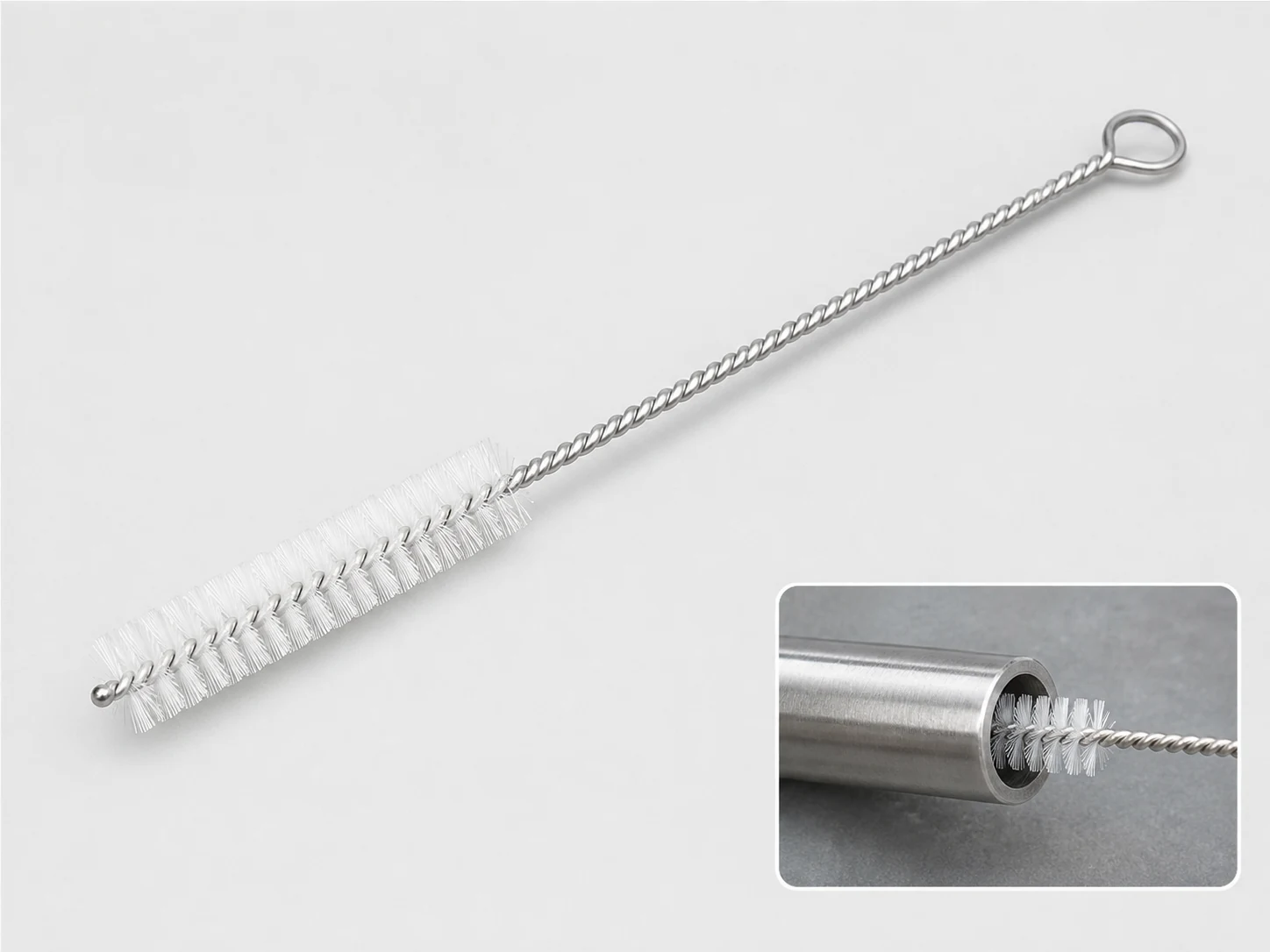
Small brush
500 pcs
Minimum order
Held in one hand: tube, bottle, detail and swab brushes — including long-handled ones with a small head.
Production lead time, once the specification is confirmed
- Up to 500 pcsWithin 7 days
- 501–50,000 pcsWithin 14 days
- Over 50,000 pcsWithin 21 days
Peak season can extend these times; the shipping date is confirmed in writing with your quotation. Sampling and shipping are quoted separately.
A small-bore internal cleaning brush for tubes, bores, ports, and restricted passages, available from 3.2 mm to 25 mm in diameter with polymer or wire fill. It reaches internal walls, threads, cross holes, blind ends, and curved passages to remove chips, coolant, oil, scale, carbon, powder, and other process deposits.
What can this brush do for you?
Cleans openings down to 3.2 mm where standard brushes cannot enter
The narrow core and compact fill section let the brush pass through small ports, fittings, and restrictor bores. You can clean the full depth of a passage rather than stopping where a larger tube brush binds at the entry.
Fill chosen for the deposit, not just the bore size
Nylon and PBT handle oil, coolant, and light process film; brass and stainless steel tackle scale, carbon, and rust; horsehair offers gentle wiping; abrasive nylon adds a light deburring action. The brush removes what is actually in the passage instead of only pushing it around.
Stem construction matches the cleaning motion
Single and double stems give a stable hand-rotated action in straight bores, threaded ends allow controlled rotary mounting, loop and ring ends support retention or pull-through use, and a flexible extension follows curved tubing. The stem carries the fill to the deposit rather than limiting the stroke.
Contact pressure can be set for wiping or scrubbing
Near-size diameters wipe internal surfaces without overloading threads or coatings, while 5–20% oversize polymer fill creates conforming scrubbing contact. Wire fill is specified with lower interference to avoid stem twisting and excessive metal removal.
Built for wet and oily working environments
Polymer and metal fill options stay functional in coolant, solvent, and light chemical exposure. Stem and handle materials can be matched to washdown or corrosion-prone operations, so the brush remains usable after repeated exposure rather than degrading after the first shift.
What is a Narrow Tube Brush?
A narrow tube brush is a small-diameter internal cleaning brush with radial filament or wire fill mounted along a slender stem. It is designed for use inside tubular and drilled passages where the opening is too small for a standard pipe brush, bottle brush, or hand tool. The brush is inserted into the bore or port, then rotated and stroked so the fill tips contact the internal wall, thread roots, cross-hole edges, and blind-end bottom.
It is used as a maintenance and production cleaning tool rather than a heavy material-removal tool. It removes loose and lightly attached process residue, prevents deposit build-up in small passages, and prepares bores and ports for assembly, coating, or flow testing. The correct configuration depends on the bore ID, passage depth, access path, residue type, surface sensitivity, and whether the brush will be used by hand or mounted in a rotary fixture.
An important operating consideration is fit. The brush must pass through the smallest entry feature, not just the nominal tube diameter. Threads, stepped transitions, or cross holes reduce the effective opening. Selecting the right fill and contact setting prevents jamming, stem damage, or scrubbing the bore out of tolerance.
Technical Specifications
All key dimensions and materials can be adjusted to the bore and process. Specify the smallest access ID, target cleaning zone, residue, chemical exposure, and operating temperature so the configuration is matched to the job.
| Parameter | Standard configuration |
|---|---|
| Brush diameter | 3.2–25 mm, matched to the smallest cleaned ID |
| Brush section length | 25–127 mm |
| Overall length | 150–500 mm |
| Filament diameter | 0.08–0.25 mm for polymer fill; wire diameter specified by wire type |
| Fill material | Nylon (PA), PBT, PP, brass, stainless steel, carbon steel, horsehair, or abrasive nylon |
| Stem style | Single stem, double stem, threaded end, loop, ring, or flexible extension |
| Stem material | Galvanized steel, stainless steel, or flexible polymer, selected for environment |
| Contact setting | Near-size for wiping; 5–20% oversize for flexible polymer scrubbing; reduced interference for wire fill |
| Handle | Project-matched plastic, wood, or metal when hand use is specified; can be omitted for machine mounting |
| Operating conditions | Fill and stem selected for oil, coolant, solvent, chemical, and elevated temperature exposure as specified |
| Brush type | Custom Tube & Pipe Bore Brushes |
| How it is driven | Hand-guided |
| Cleaning target | fuel system port and internal passage, small-diameter tube and pipe id, and connector cleaning |
| Surface or part | bores, passages, tubes, thread, ports, holes, cross holes, and walls |
| Residue or debris | coolant, chips, carbon, scale, oil, process deposits, powder, and process residue |
| Mounting / connection | Threaded Removable / Fixed |
Where does this brush work best?
- Hydraulic, pneumatic, and fuel system ports and internal passages after machining or during overhaul.
- Small-diameter tube and pipe IDs where deposit build-up affects flow or cleanliness before installation.
- Fittings, adapters, and connectors with internal threads, sealing seats, or step transitions.
- Blind holes, cross-drilled passages, tapers, and angled bores in machined components.
- Heat exchanger tubes, sampling lines, and instrument ports that need controlled internal cleaning.
- Pre-assembly clean-out of drilled, reamed, tapped, or honed holes to remove chips and coolant.
How do I choose the right one?
Start with the actual passage geometry
Measure the smallest internal diameter the brush must pass through, including threads, steps, and cross holes. Record the total depth and the location of the deposit zone. A brush sized to the nominal tube ID may jam at a thread root or a reduced entry.
Select the fill for the residue and surface
| Residue or condition | Recommended fill | Use note |
|---|---|---|
| Loose chips, coolant, light oil | Nylon or PBT | Good solvent resistance, low scoring risk |
| Carbon, rust, scale | Stainless steel or carbon steel wire | Aggressive; use reduced interference on softer base metals |
| Soft-metal ports or spark-sensitive areas | Brass wire or horsehair | Gentler contact; confirm spark requirements before specifying |
| Light edge blending or surface prep | Abrasive nylon | Adds mild cutting; avoid on precision sealing surfaces unless tolerated |
Set the brush diameter for the contact you need
Use near-size fill for wiping film and protecting threads or coated surfaces. Use 5–20% oversize polymer fill when the brush must press into the walls and scrub deposits. For wire fill, keep interference lower because wire does not flex as uniformly and can catch on cross-hole edges or strip soft metal.
Match the stem to the drive and path
- Straight bore, manual rotation: single or double stem.
- Curved tubing or offset access: flexible extension.
- Powered rotary or fixture mounting: threaded end with rigid stem.
- Pull-through or retained use: loop or ring end.
Check length and section placement
Brush section should cover the deposit zone. For blind holes, place the fill at the tip. For cross holes, the section should be long enough to sweep the opening while the brush is rotated. Overall length must give the operator control at the cleaning depth without excessive stem flex.
Confirm environment and duty
Specify chemical exposure, wash temperature, wet or dry use, and expected cycles per shift. These determine whether a polymer fill, metal fill, coated stem, or stainless stem is appropriate. A brush that works in one fluid line may degrade quickly in another.
When a narrow tube brush is not the right tool
Passages below about 3.2 mm usually need a non-woven swab, pipe cleaner, or precision applicator. Very long curved runs beyond the practical stem reach may need a flexible shaft drain brush or a different access method. Heavy deburring, weld scale, or dimensional correction needs a hone, reamer, or powered abrasive tool rather than a brush. Brushing is for deposit removal and light surface conditioning, not for changing bore dimensions.
Can I customize this brush?
Almost every dimension and material on a narrow tube brush can be set to the specific bore and process. The most reliable way to start is to provide the smallest access ID, internal thread details, total depth, deposit location, residue type, operating chemical, temperature, and whether the brush is hand-driven or mounted. A drawing or sample tube speeds up the configuration.
Adjustable parameters include:
- Brush diameter, brush section length, and section placement along the stem
- Overall length, stem diameter, and stem material (galvanized steel, stainless steel, or flexible polymer)
- Filament material, filament diameter, trim length, and fill density
- Stem end form: single, double, threaded, loop, ring, or flexible extension
- Handle form when hand use is required: straight, loop, tee, or ergonomic grip in plastic, wood, or metal
- Color, marking, or identification code for tool crib control
- Packaging: bulk, individual bag, kit, or project-specific labeling
If the project requires material documentation, dimensional inspection, third-party testing, or other project-specific quality support, these can be arranged during the customization scope instead of being assumed for every stock configuration.
What size fits the opening, and how is a narrow tube brush cleaned afterwards?
How can I tell if the brush is too large for the entry thread or step?
Insert the brush slowly by hand. If the stem flexes sharply or the fill binds at the thread crest before reaching the bore body, the brush is too large for the access feature. Reduce the brush diameter or choose a tapered fill section, then retest. The brush should pass the smallest entry point without forcing and still contact the main bore.
How do I verify the bore is actually clean after brushing?
Flush the passage and collect the effluent on a clean white cloth or filter. If the cloth shows repeated residue, adjust the fill, contact setting, brush section length, or number of passes. For visual confirmation on larger bores, use a bore light; on very small passages, inspect a clean wipe sample after insertion and withdrawal.
Can I use the brush with solvent or cleaning chemicals in the bore?
Yes, but the fill and stem must be selected for the specific chemical. Nylon and PBT are broadly compatible with many light oils and aliphatic solvents; brass and stainless offer better tolerance for certain aggressive or aqueous environments. Always provide the chemical name, concentration, and contact time before specifying a material.
How much can a flexible extension bend?
The usable bend depends on the extension length, inner diameter, and the force needed to rotate the fill. A gentle continuous curve is acceptable; sharp elbows below the passage radius or multiple bends will reduce rotation and can kink the core. If the tube path includes tight elbows, provide the bend radius or a sample so the correct extension construction can be chosen.
Should this brush be used wet or dry?
For most chip, powder, and process film removal, a wet or solvent-assisted pass releases residue more effectively and reduces wear on polymer fill. Dry use is acceptable for light carbon or loose debris, but hard deposits benefit from a compatible penetrating fluid before brushing. Match the wetting agent to the fill material to avoid filament softening or swelling.
How should the brush be stored between uses?
Rinse the fill to remove abrasive residue, allow it to dry, and store it with the fill not under load. Hanging by the loop or handle prevents the filament from taking a permanent set. Keep metal-fill brushes away from moisture if carbon steel is specified, and keep polymer-fill brushes away from direct UV and strong solvents when not in use.
Guides that go deeper on this
Can a Vent Hole Cleaning Brush Turn a Corner in Curved Pipes?
Read this guideGuideHow to Maintain Narrow Tube Brush in Production
Read this guideGuideWhich Vent Hole Cleaning Brush Is Safe on Laboratory Glassware?
Read this guideGuideCustom Brush Sampling and Validation Plan
Read this guideGuideHow to Maintain Chimney and Boiler Tube Brushes in Production
Read this guideGuideHow to Maintain Tube Brushes for Plastic Processing Lines
Read this guideCustom Manufacturing RFQ
Describe Your Application
Please share the brush dimensions, working area, residue type, material direction, quantity, and a drawing or photo for quotation.
Drawing or photo optional — it speeds things up, it does not gate the enquiry.
Custom Brush RFQ
Send Your Brush Project
Upload a drawing, product photo, or sample photo and provide the core dimensions and cleaning conditions.
“We need a brush to remove wet residue from a stainless steel conveyor, about 800mm wide. The current brush wears quickly. We can send photos.”
“We sell drinkware and need a cleaning brush to include with the product. Quantity around 5,000 pieces.”