
Custom Cleaning Brush
Sisal Bottle Brush
Custom sisal bottle brushes with stiff tufted sisal fill, twisted-wire core, and PP handle for set-on residue in glass, stainless, and durable containers.
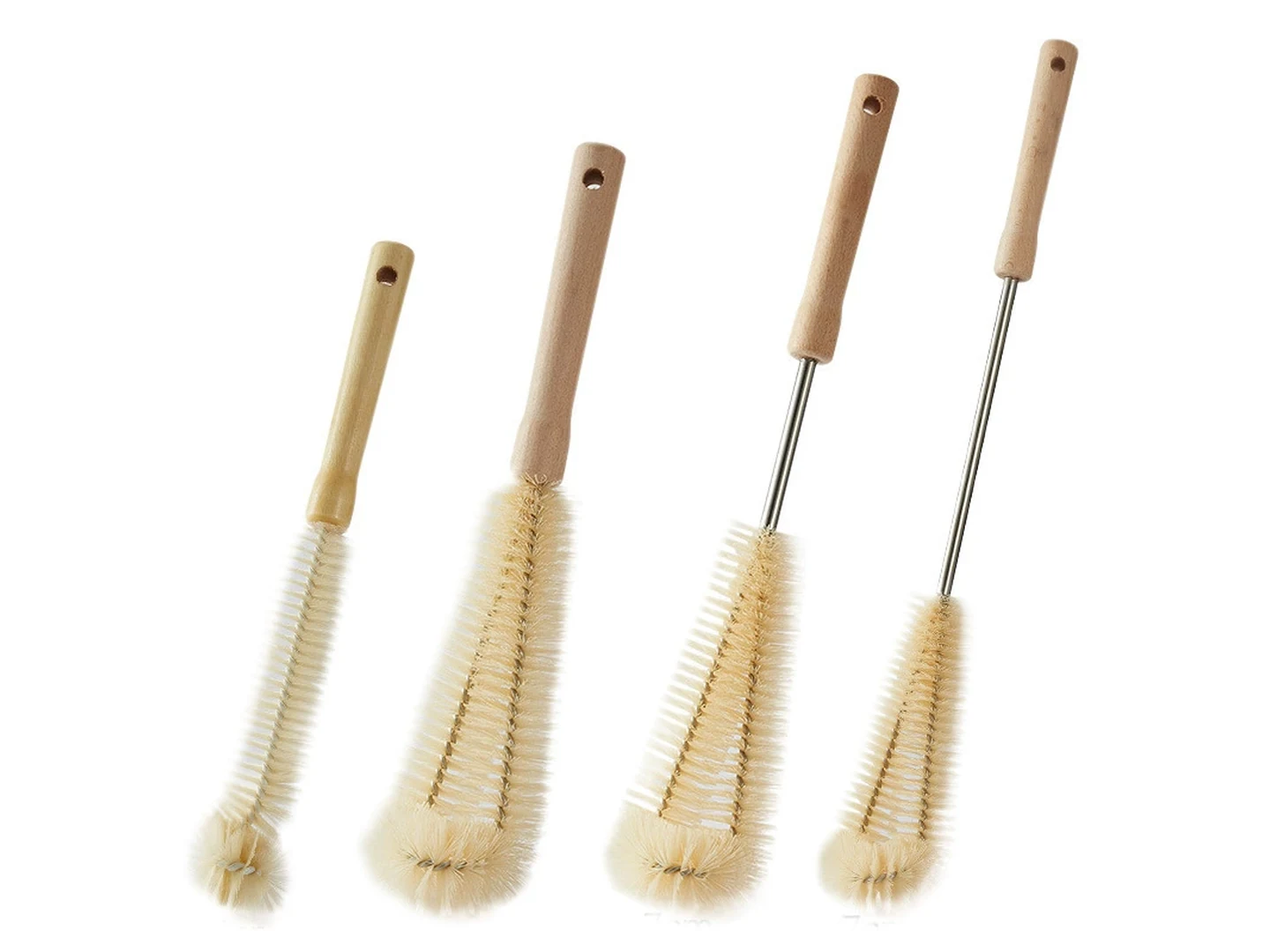
Small brush
500 pcs
Minimum order
Held in one hand: tube, bottle, detail and swab brushes — including long-handled ones with a small head.
Production lead time, once the specification is confirmed
- Up to 500 pcsWithin 7 days
- 501–50,000 pcsWithin 14 days
- Over 50,000 pcsWithin 21 days
Peak season can extend these times; the shipping date is confirmed in writing with your quotation. Sampling and shipping are quoted separately.
The Sisal Bottle Brush is a natural-fiber bottle brush cleaner that pairs stiff sisal tufting with a twisted-wire core to scrub set-on beverage film, dried residue, and odor-causing deposits from the interior walls, shoulders, bases, and neck threads of narrow-neck containers. It is built for glass, stainless steel, and other durable surfaces that can accept real mechanical scrubbing without scratching.
What can this brush do for you?
Stiff Natural Bristles Scrub What Soft Brushes Leave Behind
Sisal fibers are coarser and stiffer than nylon or silicone filaments, so the brush scrubs dried beverage films, protein residue, biofilm, and odor deposits instead of polishing them. If a soft bottle brush only moves film around the interior, this one removes it.
Flexible Twisted-Wire Core Follows the Bottle Shape
The working head is built on a spiral wire core that flexes as the brush enters the bottle. It reaches past the neck and presses bristles into the sidewall, shoulder, and base, so cleaning contact continues where straight-handle brushes lose pressure and leave dead zones.
Radial Bristle Coverage Cleans the Entire Inner Circumference
Tufted sisal bristles extend around the core in a complete circle. As the operator pushes, pulls, or rotates the handle, the bristles scrub the entire inner circumference, including the neck seat and internal threads, in a single motion.
Aggressive Scrubbing With Less Risk Than Wire Fill
Compared with steel wire brushes, sisal provides a stiff cleaning surface while remaining far less aggressive against glass and stainless steel under normal hand pressure. It fills the gap between soft filament brushes that leave deposits and steel brushes that risk scratches.
Open Bristle Pattern Rinses Free and Air-Dries
The spacing between bristle rows releases loosened soil with a rinse and allows air to move through the head between uses. Rinse, shake, and hang the brush bristle-side down to keep the natural fiber from staying wet between shifts.
What is a Sisal Bottle Brush?
A Sisal Bottle Brush is a hand-guided bottle cleaning tool whose working head is filled with radially tufted sisal fiber caught in a twisted wire stem. The sisal bristles perform the scrubbing; the twisted wire gives the head its shape and transmits operator force through a narrow bottle opening. A handle, typically polypropylene, TPE-overmolded plastic, or wood, extends the reach into deep containers.
In use, the operator inserts the head through the container opening, pushes it to the base, and works the brush with back-and-forth and rotating strokes. Bristle tips contact the sidewall while the tufted end reaches the curved bottom and shoulder transition. Because the core remains flexible, the head follows mild container contours without requiring the bottle itself to flex or move.
This is a mechanical scrub brush, not a soft polisher or chemical applicator. The right configuration depends less on bottle volume than on the narrowest opening, interior depth, surface material, residue type, cleaning chemistry, and wash temperature. Prolonged exposure to strong acids, strong alkalis, steam, or standing water will shorten natural fiber life, so the cleaning environment should guide both material choice and everyday care. For wet or hygiene-driven applications, specify a stainless steel core.
Technical Specifications
The table lists standard build parameters for this brush. Final dimensions are set from the container drawing or sample so the head enters cleanly and maintains sidewall contact through the full stroke.
| Parameter | Value / Options |
|---|---|
| Brush head diameter | 20–70 mm, selected to pass the narrowest opening and contact the body |
| Working length | 120–300 mm, set by container depth and the area to be cleaned |
| Overall length | 200–450 mm, including the handle length needed for operator reach and control |
| Fill material | Sisal fiber tufted in radial rows; optional synthetic blend with PBT for extended wet-cycle life |
| Fiber diameter per filament | 0.10–0.50 mm; bundle diameter and trim length adjusted to stiffness requirements |
| Head form | Cylindrical, tapered, tufted-end, or custom profile for shoulder and base access |
| Core wire | Galvanized steel or 304 stainless steel twisted wire; stainless recommended for wet or hygiene areas |
| Handle | PP, TPE overmold, wood, or project-specified material |
| Operating environment | Mild detergent solutions and rinse water; avoid continuous exposure above 60°C (140°F), strong acids, strong alkalis, and steam |
| Project customization | Dimensions, materials, handle style, color, marking, and packaging adjustable to the application |
| Brush type | Custom Bottle & Container Brushes |
| How it is driven | Hand-guided |
| Cleaning target | reusable water bottle and stainless steel drinkware, glass beverage bottle, and laboratory bottle and media container cleaning |
| Surface or part | containers, shoulders, necks, glass, thread, sidewalls, bases, and walls |
| Residue or debris | fiber, beverage film, dried residue, biofilm, powder, protein, coffee oil, and liquid film |
| Mounting / connection | Fixed |
Where does this brush work best?
- Reusable water bottles and stainless steel drinkware that build up protein shake film, coffee oils, or sports drink residue in the base and shoulder areas.
- Glass beverage bottles, growlers, and carboys with narrow neck openings that need manual scrub action before sanitizing or rinsing.
- Laboratory bottles and media containers where powder residue, biofilm, or dried product has collected above the liquid line.
- Food and beverage sample containers, small mix vessels, and process bottles with sugar-based residue or odor-causing films on durable interiors.
- Industrial and institutional containers with caked powder, sticky liquid film, or residue that a soft nylon brush cannot dislodge.
How do I choose the right one?
Start with the contact surface, not the residue. Sisal fiber is stiffer than nylon and more aggressive than silicone. Use it on glass, stainless steel, uncoated metal, glazed ceramic, and rigid plastics that tolerate abrasive contact. If the container has a coated interior, polished finish, non-stick lining, or another scratch-sensitive surface, switch to a nylon, PBT, or silicone bottle brush.
Set the dimensions from the bottle geometry. Measure the narrowest internal opening and the internal depth. The head diameter must pass the opening while remaining large enough to press bristles into the sidewall. A head that is too small will polish rather than scrub; a head that is too large will bind at the neck. Working length must let the bristle section reach the base and shoulder transition without leaving the handle too short to control.
Match bristle stiffness and density to the residue. Fine, dense tufting removes film and light residue. Heavier, longer bristles with wider spacing carry more water and detergent into the container and remove thicker deposits. If the current bristle pack is too soft or too stiff, ask our team to adjust tuft density and trim length.
Select the wire core for the cleaning environment. Galvanized steel works in dry or lightly wiped applications, but stainless steel is the right choice when the brush is used with water, detergents, or sanitizing chemistry, and wherever corrosion or contamination would be a problem.
Finally, consider what brushing will not replace. Sisal bristles loosen and remove attached films, but they do not chemically descale, disinfect, or neutralize odor. Hard mineral scale, burned-on carbon, or embedded deposits may require an acid cleaner, a wire brush, or a different cleaning process. Use this brush as the mechanical step in a complete cleaning sequence.
Can I customize this brush?
This brush is built to the container, not pulled from a fixed catalog. To quote correctly, send a bottle drawing or a sample together with the following details: narrowest internal opening ID, internal body diameter and depth, container material and interior coating, residue type, cleaning chemicals and water temperature, required total length and handle form, and target use frequency or replacement cycle.
We can adjust the following variables:
- Head geometry: diameter, length, cylindrical, tapered, tufted-end, bottleneck, or custom profile
- Fill: 100% sisal or a sisal/synthetic blend; fiber gauge, tuft density, and trim length
- Core and stem: galvanized or 304/316 stainless twisted wire, single or double spiral, and flexibility level
- Handle: PP, TPE overmold, wood, loop or hanging feature, ergonomic grip, and overall length
- Color and marking: natural or dyed sisal, colored handle, laser or pad print, molded identification mark
- Packaging: bulk pack, individual polybag, retail card, branded sleeve, or project-specific carton
If the project requires material documentation, inspection support, or third-party testing assistance, tell us early in the process. We can structure the build and documentation around your approval or compliance needs.
Which filament lasts longest on a sisal bottle brush?
What is the maximum water temperature for a sisal bottle brush?
Standard sisal retains its scrubbing stiffness in warm water up to about 60°C (140°F). Boiling water, steam, or repeated dishwasher and autoclave cycles will weaken the natural fibers and should be avoided. For higher temperatures, switch to a synthetic-filament or steel-wire brush.
How do I know when to replace the brush?
Replace the brush when the bristles stay flattened after use, the twisted wire core is exposed, the core shows visible corrosion, or the brush no longer makes firm sidewall contact inside the container. Also check the handle-to-wire joint for looseness before each shift.
Will sisal bristles shed into the bottle?
A new brush may shed a few short fiber ends on first use. Rinse the brush and bottle thoroughly before processing. Continued shedding usually means the tufting is too loose for the application or the head is being forced through an opening that is too small. A denser tuft or larger stem core normally solves it.
Can this brush remove hard limescale or mineral deposits?
It can scrub soft mineral film, but hard scale usually needs an acid descaler before or after brushing. The brush supplies mechanical action; it does not replace the chemical descaling reaction. Brushing first can open the scale surface so the cleaner penetrates faster.
Is this brush suitable for coated or anodized interiors?
No. Sisal is aggressive enough to dull or scratch many coatings, anodized finishes, and soft plastics. Use a nylon, PBT, or silicone bottle brush for those surfaces. Sisal is intended for glass, stainless steel, uncoated metals, and other abrasion-tolerant interiors.
How should the brush be stored between uses?
Rinse it free of detergent and loosened soil, shake out excess water, and hang it bristle-side down in a ventilated area. Do not leave it soaking in water or cleaning solution. A stainless core resists corrosion, but dry storage extends both core and fiber life.
Guides that go deeper on this
Custom Manufacturing RFQ
Describe Your Application
For an accurate quotation, please provide the main dimensions, material preference, working surface, residue, quantity, and a drawing or photo.
Drawing or photo optional — it speeds things up, it does not gate the enquiry.
Custom Brush RFQ
Send Your Brush Project
Upload a drawing, product photo, or sample photo and provide the core dimensions and cleaning conditions.
“We need a brush to remove wet residue from a stainless steel conveyor, about 800mm wide. The current brush wears quickly. We can send photos.”
“We sell drinkware and need a cleaning brush to include with the product. Quantity around 5,000 pieces.”