
Custom Cleaning Brush
Sisal Baby Bottle Cleaner PP Nylon
Custom sisal and nylon baby bottle cleaner on a PP handle. Scrubs dried milk film, formula rings and powder residue from necks, shoulders and bases.
Small brush
500 pcs
Minimum order
Held in one hand: tube, bottle, detail and swab brushes — including long-handled ones with a small head.
Production lead time, once the specification is confirmed
- Up to 500 pcsWithin 7 days
- 501–50,000 pcsWithin 14 days
- Over 50,000 pcsWithin 21 days
Peak season can extend these times; the shipping date is confirmed in writing with your quotation. Sampling and shipping are quoted separately.
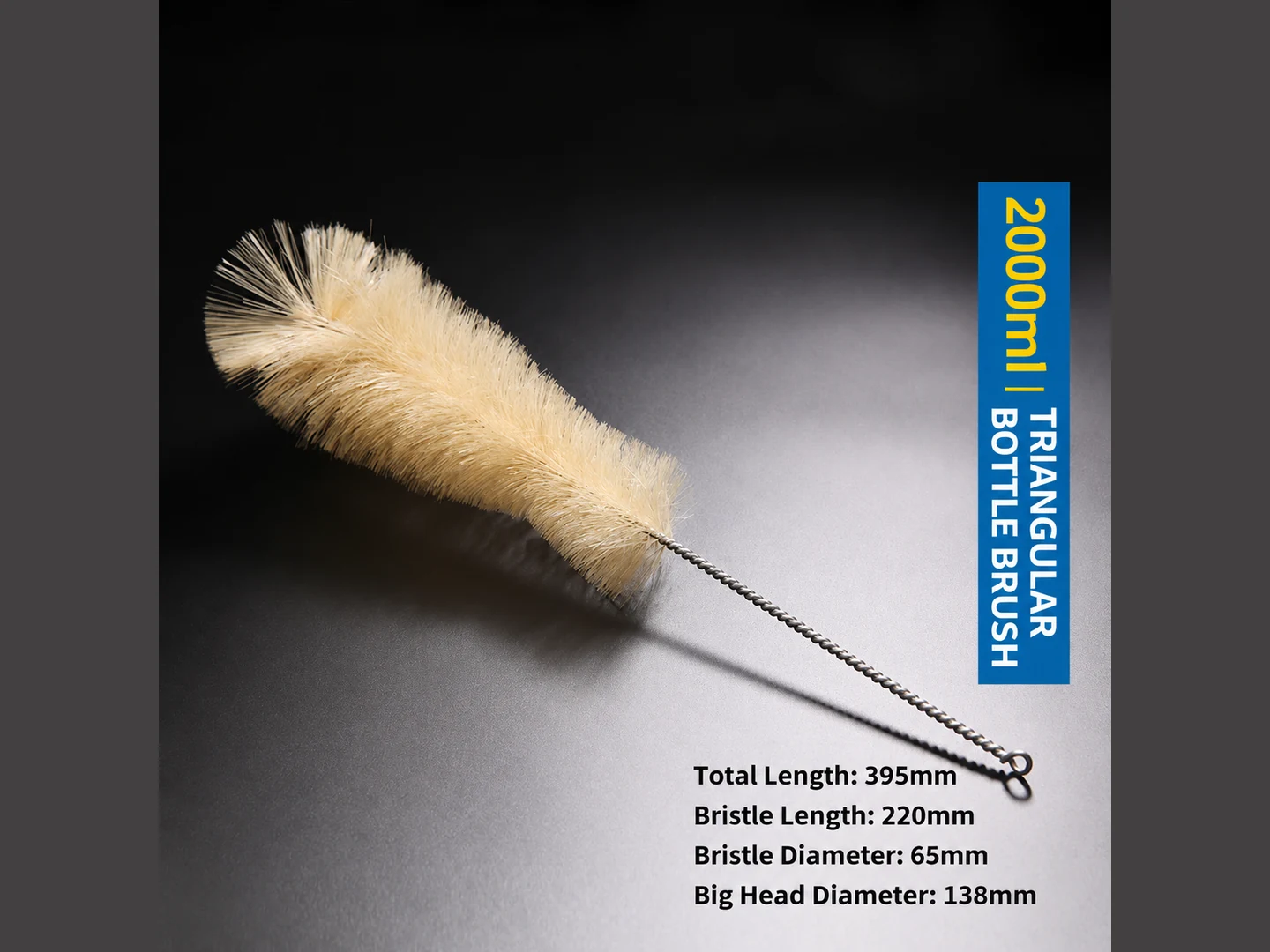
A natural-fiber bottle brush that pairs stiff sisal scrub tufts with flexible nylon filaments on a polypropylene handle, built to reach bottle necks, shoulders, and curved bases while removing dried milk film, formula rings, and powder residue.
The standard configuration uses a narrow cylindrical head with a tufted end so the brush enters the bottle opening, contacts the sidewall, and follows the base transition without leaving uncleaned dead zones.
What can this brush do for you?
Breaks Up Dried Milk Film and Formula Rings
The sisal tufts provide a stiffer mechanical action than nylon alone, so dried milk deposits, powder residue, and the ring line at the bottle shoulder come off with fewer strokes. Nylon filaments around the sisal then lift the loosened film off the surface instead of pushing it around.
Reaches the Neck, Shoulder, and Curved Base
The working head is tapered or cylindrical with a tufted end, so the same pass can clean the neck thread area, follow the shoulder, and press into the base curve. A straight-ended brush leaves a residue ring at the bottom transition; this head is shaped to make contact there.
Lightweight PP Handle Won’t Rust or Crack in Water
The one-piece polypropylene handle is unaffected by water, detergents, and everyday bottle-washing chemicals. It does not rust like a wire stem, does not splinter like wood, and keeps the whole tool light enough for repeated daily use in kitchens or nurseries.
Nylon Filaments Protect Soft Bottle Walls
Nylon is the primary contact for general film removal, so the brush cleans plastic, glass, and coated bottle walls without the cut or scratch marks that metal scrapers or harsh abrasives produce. The sisal is concentrated where extra scrubbing is needed rather than running across the entire surface.
Rinses Clean After Each Use
Open filament spacing and the PP handle leave few places for milk residue to lodge. A quick rinse under running water removes most loosened film and keeps the brush ready for the next use, reducing odor build-up between washings.
What is a Sisal Baby Bottle Cleaner PP Nylon?
A Sisal Baby Bottle Cleaner PP Nylon is a hand-operated bottle brush with a cleaning head that combines natural sisal fiber and nylon filament, mounted on a polypropylene handle. It is used to mechanically clean the inside of baby bottles, feeding bottles, breast pump parts, and similar narrow-neck containers before rinsing or sterilization.
In use, the brush is inserted through the bottle neck, then pushed, pulled, and rotated so the head contacts the sidewall, shoulder, and base. The sisal fibers work like a natural scrub pad on dried residue, while the nylon carries soft film away. The PP handle gives the operator a comfortable, water-resistant grip and doubles as a hanging point when the bottle is stored upright to dry.
The brush is a cleaning tool, not a sterilizer. It removes visible residue and odor-causing deposits; any required sanitizing or sterilization is still a separate process step. The natural sisal fiber is also intended for wet cleaning with rinsing after use, not for prolonged soaking or repeated autoclave exposure.
Technical Specifications
Values below show the standard production window for this brush. Head diameter, working length, overall length, and the sisal/nylon arrangement are adjusted to the bottle dimensions and residue type for each project.
| Parameter | Value / Options |
|---|---|
| Cleaning head diameter | 20–70 mm, selected to pass the narrowest neck and contact the bottle body |
| Working head length | 120–300 mm, matched to internal depth and shoulder reach |
| Overall length | 200–450 mm, including the PP handle section |
| Fill materials | Natural sisal fiber + nylon PA filament; placement and ratio configurable |
| Filament diameter | 0.10–0.50 mm for nylon; sisal supplied as twisted tufts with trimmed working face |
| Head form | Cylindrical, tapered, or tufted-end; standard is a narrow cylinder with a rounded tufted tip |
| Neck clearance | 10–60 mm head-to-neck clearance recommended to prevent wedging |
| Handle material | Polypropylene (PP), colored or natural, with optional hanging hole |
| Typical wash environment | Cold to warm water with neutral or mild detergents; hand wash and air dry recommended |
| Sisal care note | Rinse and air dry after each use; avoid prolonged soaking, boiling, or repeated steam sterilization |
| Brush type | Custom Bottle & Container Brushes |
| How it is driven | Hand-guided |
| Cleaning target | baby, breast pump part, and narrow-neck water bottle and drinkware cleaning |
| Surface or part | shoulders, necks, sidewalls, glass, plastic, bases, pads, and walls |
| Residue or debris | powder, dried milk film, powder residue, fiber, protein, protein residue, and dried residue |
| Mounting / connection | Fixed |
Where does this brush work best?
- Baby feeding bottles where dried milk film, formula line, or powder collects at the shoulder and base and a sponge or cloth cannot reach.
- Breast pump parts — flanges, valves, and collection bottles — when the brush head is sized to fit the narrow openings without jamming.
- Narrow-neck water bottles and drinkware used daily with protein shakes, smoothies, or electrolyte mixes that leave a film on the wall.
- Glass or plastic laboratory/sample bottles that need mechanical removal of powder or protein residue before the next wash cycle.
- Private-label or OEM baby care lines where a natural-fiber cleaning tool is part of a feeding accessory kit or retail program.
How do I choose the right one?
Start with the bottle’s narrowest internal opening and the internal body diameter. The head must pass the neck without forcing, then still make contact with the sidewall. If the head is too large it will wedge or fold over; if too small it will not clean the body. Measure the neck ID and the depth to the base before specifying head diameter and working length.
Then match the sisal-to-nylon ratio to the residue and bottle material. Dried milk film and powder build-up respond well to a higher sisal content, because the stiff fibers break the deposit’s surface. Soft or coated plastics benefit from a higher nylon ratio, which removes the same film with less risk of dulling or micro-scratching. Glass bottles can take more sisal without surface damage.
Set the working length to the bottle depth plus a little extra reach for the shoulder. The overall length should let the operator hold the handle comfortably while the head touches the base, without excessive flex or loss of control. A longer handle is not automatically better — deep bottles with a short head may require a longer working section, not just a longer grip.
Consider the cleaning cycle. This brush is built for wet hand cleaning with rinsing and air drying. If the bottle program includes boiling, steam sterilization, or autoclaving on every cycle, the sisal fiber will degrade faster than a fully synthetic head. For those processes, an all-nylon or silicone bottle brush is usually the better choice. Use a twisted-wire tube brush when the opening or passage is too narrow for this head, and use an abrasive pad or wire brush only when the residue is hard mineral scale that filament cleaning cannot remove.
Can I customize this brush?
Yes. This brush is ordered against the bottle dimensions and cleaning routine, not as an off-the-shelf part only. To define the custom configuration, provide the bottle neck ID, body ID, internal depth, bottle material, residue type, wash chemicals, wash temperature, and whether the brush will be used in a dishwasher, hand-wash, or sterilization process.
We can adjust:
- Head geometry — diameter, length, taper profile, tufted-end shape, or a custom multi-diameter form for bottle shoulders and bases
- Fill arrangement — sisal-to-nylon ratio, tuft placement, sisal tuft length, nylon filament diameter, and bristle density
- PP handle — length, straight or contoured grip, hanging hole, grip texture, or ergonomic shaping for daily hand use
- Color and marking — PP handle color, nylon filament color, pad print, laser marking, or raised molded branding on the handle
- Packaging — bulk, individual polybag, retail card, kit bundling with other bottle care items, or custom private-label packaging
If your project needs material documentation, inspection plans, or third-party testing support for the buyer’s quality or safety requirements, we can coordinate those requirements during the customization stage.
When is a sisal baby bottle cleaner PP nylon worn out rather than just dirty?
How can I check whether the head will pass through my bottle neck?
Measure the narrowest internal diameter of the neck. The head’s maximum outside diameter should be at least 2–3 mm smaller than that measurement when dry. Then test the brush by inserting it slowly without twisting; if it binds or folds over at the opening, reduce the head diameter or adjust the taper.
Is sisal fiber safe to use on baby bottles?
Sisal is a plant-derived fiber and contains no metal or synthetic abrasive, but it is porous and can hold moisture. Rinse the brush thoroughly after each use and air dry it in a ventilated spot. If your process requires repeated boiling, steam sterilization, or autoclaving, choose an all-nylon or silicone head instead, because repeated heat degrades the natural fiber faster.
Will this brush scratch plastic feeding bottles?
The nylon filaments are soft enough for most bottle-grade plastics, including PP and PE. The stiffer sisal tufts can dull or lightly scratch very soft, uncoated plastics if heavy pressure is used. For sensitive bottles, request a higher nylon-to-sisal ratio or test the brush on a sample bottle before full production.
What should I check before each use?
Look for loose sisal tufts, bent or missing nylon filaments, cracks in the PP handle, and any odor that remains after rinsing. If fibers are shedding or the head no longer springs back to shape, retire the brush. A worn brush leaves residue behind instead of removing it.
How should I clean the brush itself?
Rinse under running water after every use, working out trapped film from between the filaments. Shake off excess water and hang the brush by the handle hole to dry. Do not leave it soaking in soapy water or milk solution for long periods, because the sisal will swell and develop odor.
When should I replace the brush?
Replace it when the sisal tufts flatten and stay flat, the nylon filaments fan out permanently, or the handle develops stress cracks. For daily use in a household or nursery, a replacement interval of one to three months is common, but inspect the tuft ends weekly if the brush is shared across multiple bottles.
Guides that go deeper on this
Custom Manufacturing RFQ
Describe Your Application
For an accurate quotation, please provide the main dimensions, material preference, working surface, residue, quantity, and a drawing or photo.
Drawing or photo optional — it speeds things up, it does not gate the enquiry.
Custom Brush RFQ
Send Your Brush Project
Upload a drawing, product photo, or sample photo and provide the core dimensions and cleaning conditions.
“We need a brush to remove wet residue from a stainless steel conveyor, about 800mm wide. The current brush wears quickly. We can send photos.”
“We sell drinkware and need a cleaning brush to include with the product. Quantity around 5,000 pieces.”