
Custom Cleaning Brush
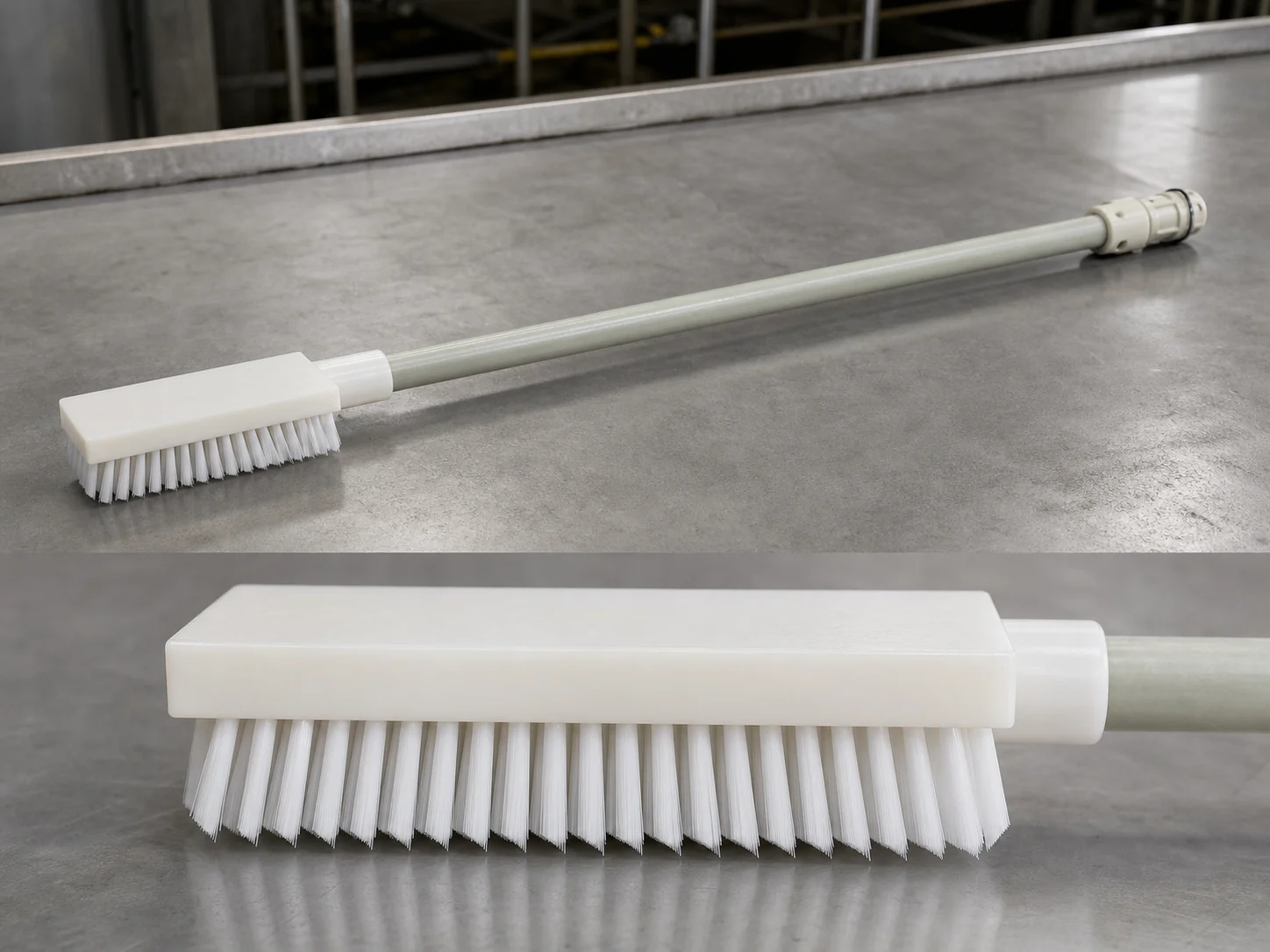
200mm PVDF Acid Tank Brush
Chemical-resistant 200mm PVDF acid tank brush for pickling tanks, plating lines, and corrosive environments. Long reach handle, quick-change head.
Small brush
500 pcs
Minimum order
Held in one hand: tube, bottle, detail and swab brushes — including long-handled ones with a small head.
Production lead time, once the specification is confirmed
- Up to 500 pcsWithin 7 days
- 501–50,000 pcsWithin 14 days
- Over 50,000 pcsWithin 21 days
Peak season can extend these times; the shipping date is confirmed in writing with your quotation. Sampling and shipping are quoted separately.
This chemical-resistant cleaning brush is built to survive direct contact with aggressive acids and corrosive process chemicals. The 200 mm working head uses PVDF filament to remove chemical film, oxide scale, and sludge from tank walls, floors, and internal structures in metal pickling, plating, and chemical storage applications.
What can this brush do for you?
Withstands concentrated acids without dissolving or shedding
The PVDF (polyvinylidene fluoride) bristles are inherently resistant to most inorganic acids — hydrochloric, sulfuric, nitric, phosphoric — as well as many bases, halogens, and organic solvents. Unlike nylon or natural fiber brushes that soften, swell, or degrade in acid tanks, this brush keeps its stiffness and scrubbing action over repeated exposures.
Removes deposits without contaminating the bath
PVDF does not release metal ions, dyes, or degraded fiber fragments into the process liquid. That means you can scrub oxide film, chemical residue, and sludge from an acid tank without risking bath contamination — a critical concern in metal finishing, electroplating, and high-purity chemical operations.
Keeps the operator away from acid splash and fumes
The 600 mm long glass-fiber-reinforced handle places your hands well outside the tank opening while the brush reaches the surface being cleaned. The 28 mm diameter grip is shaped for a secure hold even when wearing chemical-resistant gloves, reducing the chance of slipping into the bath.
Swaps heads in seconds with a quick-change coupling
The rectangular PVDF head mounts to the handle with a tool-free quick-change coupling. When bristles wear or when you need a different head profile for another tank, the operator replaces the head in seconds and keeps the same handle. This reduces spare-part inventory and keeps cleaning time to a minimum.
Operates at elevated process temperatures
PVDF retains its stiffness and chemical resistance at continuous temperatures up to 150°C (302°F). It works inside heated rinse tanks, hot acid baths, and processes where other polymer brushes would soften and become ineffective.
Rectangular profile covers wide flat surfaces efficiently
The 200 mm × 80 mm rectangular working face contacts more area per stroke than a round brush of similar size. On large tank walls and floors, that translates directly into faster cleaning cycles and less operator fatigue.
What is a 200mm PVDF Acid Tank Brush?
A 200mm PVDF Acid Tank Brush is a hand-guided industrial cleaning tool designed specifically for interior surfaces of acid tanks, chemical storage vessels, and process equipment operating in corrosive environments. The working head is a rectangular block, 200 mm long and 80 mm wide, filled with PVDF filament across the entire face. The head is attached to a 600 mm glass-fiber-reinforced composite handle through a quick-change coupling, giving an overall reach of approximately 800 mm.
The brush is used with push, pull, and scrub strokes to loosen and remove chemical film, oxide layers, scale, oil sludge, and other process deposits that accumulate on metal surfaces in pickling lines, plating shops, and chemical reactors. Because every component — bristles, head block, handle, and coupling — is selected for chemical resistance, the brush can be immersed in the same acid it is cleaning without degrading, corroding, or contaminating the bath.
This is not a general-purpose maintenance brush and not a substitute for aggressive mechanical cleaning. It is intended for chemical-resistant scrubbing of soft to medium-hard deposits on accessible surfaces. If you need to remove heavy, baked-on scale or weld spatter, a stainless steel wire brush or abrasive brush would be more appropriate.
Technical Specifications
| Parameter | Value / Options |
|---|---|
| Head length | 200 mm (standard; other lengths available) |
| Head width | 80 mm (rectangular working face) |
| Head shape | Rectangular block, full-face bristle layout |
| Bristle material | PVDF (polyvinylidene fluoride) filament |
| Bristle stiffness | Medium-firm standard; optional soft, firm, or custom filament diameter |
| Maximum operating temperature | 150°C (302°F) for PVDF bristles |
| Handle material | Glass-fiber-reinforced composite (chemical resistant) |
| Handle length | 600 mm (from grip end to coupling) |
| Grip diameter | 28 mm |
| Connection | Quick-change coupling, tool-free head replacement |
| Overall reach | Approximately 800 mm (head + handle) |
| Chemical compatibility | Excellent against most inorganic acids, bases, halogens, and many solvents; verify for strong oxidizers and high-temperature combinations |
| Brush type | Custom Handheld Detail Brushes |
| How it is driven | Machine-driven, mounted in the equipment |
| Cleaning target | metal acid pickling line, electroplating and anodizing shop, and chemical manufacturing and storage cleaning |
| Surface or part | tanks, metal, tank walls, floors, vessels, composite, bars, and metal surfaces |
| Residue or debris | scale, sludge, oxide, chemical film, chemical residue, oxide scale, oil sludge, and metal particles |
| Mounting / connection | Quick-change coupling, tool-free head replacement |
All dimensions, materials, and configurations can be adjusted to match your tank geometry and process chemicals. Contact us with your tank dimensions, chemical concentrations, temperature, and deposit type for a project-matched specification.
Where does this brush work best?
- Metal acid pickling lines — cleaning pickling tanks, rinse tanks, and acid storage vessels where hydrochloric, sulfuric, or nitric acid is used to remove scale from steel and alloys.
- Electroplating and anodizing shops — scrubbing tank walls, anode/cathode bars, and racking to remove sludge and scale without contaminating plating solutions.
- Chemical manufacturing and storage — cleaning reactor vessels, storage tanks, and containment areas that hold aggressive acids, caustics, or solvents.
- Wastewater treatment plants — removing chemical residue and scale from acid neutralization tanks, mixing tanks, and equalization basins.
- Steel mills and metal processors — cleaning quench tanks, scale pits, and process tanks where oxide sludge and oily deposits accumulate.
- Any environment where the brush itself must not corrode, dissolve, or shed metal particles into the chemical process.
How do I choose the right one?
Use the following points to confirm that this brush fits your job, and to identify any needed adjustments.
- Chemical environment first. List the exact acids or chemicals in the tank, their concentration range, and the maximum operating temperature. PVDF covers a wide range of inorganic acids, but it is not universally compatible. Strong oxidizers (e.g., hot concentrated sulfuric acid above 100°C, fuming nitric acid) or certain organic solvents can attack PVDF. If in doubt, request a chemical compatibility check or a sample for immersion testing.
- Temperature limit. PVDF bristles are rated to 150°C. If your process runs hotter, consider PFA or PPS-based brushes instead. The handle and coupling materials also need to be rated for the same temperature.
- Residue type and hardness. This brush is designed for chemical film, soft oxide, oil sludge, and process scale that can be removed by chemical-resistant scrubbing. If you are dealing with hard mineral scale, baked-on carbon, or heavy rust that requires aggressive abrasion, switch to a stainless steel wire brush, a silicon carbide filament brush, or a mechanical cleaning method.
- Surface geometry. The rectangular head is efficient on flat tank walls and floors. If your tank has curved bottoms, rounded corners, or internal baffles, a round or custom-shaped head may follow the contour better. Tell us the tank geometry so we can recommend the right head shape.
- Reach and operator safety. The 600 mm handle provides a safe distance for most shallow to medium-depth tanks. For deeper tanks, we can supply longer handles or extensions. The 28 mm grip is sized for chemical-resistant gloves; if your operators use thicker gloves, a larger grip diameter can be specified.
- Head replacement plan. The quick-change coupling makes head replacement fast. Decide whether you need one handle with multiple heads (for different tanks or as wear spares) or one complete brush per workstation. Specify the chemical environment so we can match the coupling material correctly.
When a PVDF brush is not the right choice: If your chemical attacks PVDF, use a PFA or PTFE brush. If the deposit is too hard for polymer bristles, use a metal wire or abrasive brush. If the tank opening is too small for an 80 mm wide head, use a bottle brush or narrow strip brush. If the tank is too deep or hazardous for manual cleaning, consider an automated brush system or extended-reach tooling.
Can I customize this brush?
Yes. The 200mm PVDF Acid Tank Brush is built to order around your tank and process. To define the right configuration, we need the following from you: tank dimensions (especially depth and access opening), chemical composition and concentration, operating temperature, deposit type, and any operator safety constraints. A photo or drawing of the tank interior speeds up the design.
Common customization points include:
- Head dimensions and shape: length from 100 mm to 400 mm, width from 40 mm to 150 mm, and profiles such as flat, curved, angled, or custom-molded to fit tank contours.
- Bristle material and stiffness: PVDF filament in different diameters and trim lengths for softer or firmer scrubbing; alternative chemical-resistant filaments such as PFA, PTFE, or PPS for more aggressive chemical or temperature environments.
- Handle: length, diameter, material (glass-fiber composite, stainless steel, PVDF-coated, or PP), grip texture, splash guard, hanging loop, or ergonomic shape.
- Quick-change coupling: material and locking style matched to your chemicals; keyed or color-coded couplings to prevent using the wrong head in a different acid.
- Marking and identification: color coding by chemical zone, laser-marked part numbers, pad-printed logos, or chemical-compatibility labels.
- Packaging: bulk, individually bagged, cleanroom-packed, or retail-ready with handling instructions.
For projects that require certification support, material declarations, chemical compatibility test reports, or third-party inspection, we can coordinate those as part of the customization process.
When is a 200mm PVDF acid tank brush worn out rather than just dirty?
How do I verify that PVDF is compatible with my exact acid mixture?
Send us the chemical names, concentration range, and maximum temperature of your bath. We will run a compatibility check against PVDF chemical resistance data and, if needed, provide a small sample for immersion testing in your actual process. As a quick initial check, confirm that your acid is not listed as a known attack agent for PVDF (such as hot concentrated sulfuric or fuming nitric at elevated temperatures) and that you are below 150°C.
How should the brush be cleaned and stored between uses?
After use, rinse the entire brush thoroughly with water or a compatible solvent to remove residual acid and deposits. Shake off excess liquid and hang the brush by the handle grip so the bristles drain and air dry. Store in a dry, ventilated area away from UV light and incompatible chemicals. Do not store a wet acid-soaked brush in a closed container, as trapped fumes can attack the handle or coupling over time.
When should I replace the brush head?
Inspect the PVDF bristles regularly. If the bristles are permanently bent, matted, or shorter than 60% of their original trim length, replace the head. A worn head requires more strokes to remove the same amount of deposit and increases operator fatigue. The quick-change coupling allows a head swap in under 10 seconds, so keep a spare head on hand at each workstation.
Does this brush create sparks or static electricity?
PVDF is a non-conductive polymer and will not produce sparks during normal scrubbing. However, in environments with flammable vapors, static charge can build on the plastic handle and bristles. If your tank contains volatile solvents or an explosive atmosphere, tell us so we can evaluate adding conductive or anti-static components, grounding the handle, or selecting a different brush material. Do not assume this brush is safe for use in explosive atmospheres without that review.
Can this brush be used on food-contact or pharmaceutical surfaces?
This brush is designed for industrial chemical cleaning, not direct food contact. While food-grade PVDF is available, it does not automatically make this brush food-contact compliant. If your application involves food, beverage, or pharmaceutical contact surfaces, specify that requirement so we can select appropriate materials, provide FDA-compliant grades, and supply the necessary documentation. For direct food-contact uses, a dedicated food-grade brush should be sourced rather than repurposing an industrial acid brush.
What if my tank is deeper than 600 mm?
We can provide handle lengths up to 1200 mm or more, or design a modular extension system that attaches to the quick-change coupling. Tell us the tank depth and the operator’s working position (top access, side access, or through a manway) so we can calculate the correct handle length and balance. Deeper tanks may also require a stiffer handle with less flex to maintain scrubbing pressure.
Guides that go deeper on this
Custom Manufacturing RFQ
Describe Your Application
For a custom quote, we need the key dimensions, surface or part, residue, material preference, quantity, and reference image or drawing.
Drawing or photo optional — it speeds things up, it does not gate the enquiry.
Custom Brush RFQ
Send Your Brush Project
Upload a drawing, product photo, or sample photo and provide the core dimensions and cleaning conditions.
“We need a brush to remove wet residue from a stainless steel conveyor, about 800mm wide. The current brush wears quickly. We can send photos.”
“We sell drinkware and need a cleaning brush to include with the product. Quantity around 5,000 pieces.”